
Research

Commitment in family-run hotel businesses

For her Master's thesis, Christina Walter surveyed employees in family-run hotel businesses about their emotional attachment to the company using an online questionnaire.
Thesis: Christina Walter (2024)

Why is this topic relevant for the Austrian tourism industry?

The tourism industry is burdened by a high turnover rate, resulting in customer dissatisfaction, a lack of employee motivation and productivity losses. However, the success and competitive advantage of the tourism industry, a labor-intensive service industry, depends largely on committed employees. This reinforces the importance of organizational commitment. If employees are satisfied and respond with organizational commitment, they are loyal, care about the company, are committed and identify with the company. Furthermore, small and medium-sized enterprises (SMEs) dominate Austria's tourism industry with 99.9 percent. However, the effective management of employees is one of the biggest problems in these companies. The lack of professionalism in HR management is due, among other things, to a lack of knowledge, resources and time to deal more intensively with the issue of employee retention and attractiveness as an employer.

What are the key findings of your work and what significance do they have for tourist destinations and businesses?

The evaluation of the survey shows that the participants attach great importance to organizational support, a positive company reputation and a range of further training opportunities. Furthermore, the employees surveyed consider a high degree of delegation of responsibility, social relationships and supervisor behavior to be important. When asked about their intention to leave, it was found that employees have a low intention to leave the company. This means that affective organizational commitment reduces the intention to leave. The influence on employee retention is also examined. An average rating of 4.51 (scale: 1 = strongly disagree; 5 = strongly agree) indicates that employees remain loyal to the company if they identify strongly and are emotionally attached to their employer. Affective commitment therefore has a positive and significant influence on employee loyalty. This is confirmed by the simple linear regression with the dependent variable "employee retention" and the independent variable "affective commitment". Consequently, a positive correlation between affective commitment and employee retention can be confirmed, which is also taken up several times in the literature reviewed. The theoretical and practical analyses clearly show the influencing factors of affective organizational commitment in family-run hotel businesses. The higher the affective commitment, the greater the motivation and commitment to contribute to the success of the company. If employees can identify with their company and feel an emotional connection, they are loyal to their employer.
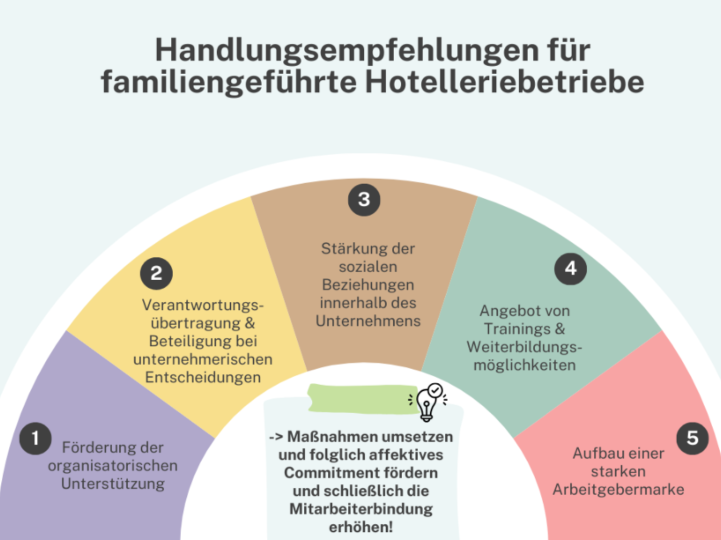

  1. Promoting organizational support

    A positive and supportive corporate and management culture is important in order to create a sense of well-being and solidarity among employees. Family-run hotels can impress with their authenticity and a welcoming and familiar atmosphere. Transparent communication and values such as appreciation and honesty also promote affective organizational commitment.
  2. Transfer of responsibility and participation in business decisions

    Family-run hotels should transfer responsibility to their employees and offer them the opportunity to play an active role in shaping the organization. Employers can also benefit from this, as employees often have new, innovative ideas, as they themselves are actively involved in the business and know the guests and their needs inside out. As a result, the guest experience may be improved, allowing companies to derive numerous benefits.
  3. Strengthening social relationships within the company

    Social relationships within the company are crucial for the development of affective commitment. For this reason, family-run hotels are recommended to offer conditions that strengthen team spirit and cooperation. Not only the relationship with colleagues, but also the behavior of superiors is crucial. If managers behave in an appreciative manner and create a sense of well-being among employees, employees are more likely to be loyal and emotionally attached to the company.
  4. Offering training and further education opportunities

    Training and development opportunities can increase employee satisfaction and their affective commitment. The company also benefits when strengths are promoted and opportunities are used to expand knowledge. Comprehensive training can also be highly relevant in generating new ideas and driving innovation. As a result, continuous employee development usually also increases guest satisfaction.
  5. Building a strong employer brand

    As the topic of employer branding is becoming increasingly important, family-run hotel businesses should consider positioning themselves as an excellent employer. A strong employer brand should score points with a unique corporate culture and values as well as attractive working conditions. Employer branding can be used to convey emotional benefits to employees in order to strengthen their identification with the company. A good corporate reputation strengthens employees' self-confidence and affective organizational commitment.
Christina Walter

Christina Walter, a native of Dornbirn, initially completed a BA in "Corporate Management in Tourism and Leisure Management" at MCI Tourism, where she also completed a Master's degree in "Strategic Management & Tourism" in 2024. She gained practical experience in HR Recruiting at thyssenkrupp Presta AG, Eschen (Liechtenstein), among others. Christina Walter has been working as Marketing Manager at HENN GmbH & Co KG in Dornbirn since August 2024.

Thesis supervision: FH-Prof. PD MMag. Dr. habil. Anita Zehrer

Thesis
MCI Tourism

Prepared for what lies ahead in tourism