

Prepared for what lies ahead in tourism
Stay up-to-date with current, independent statistics and information on tourism in the Alpine region.
 Inspiration

F.acT: What does Terra Raetica stand for and which regions does it cover?

Sebastian Vicoli: In Roman times, Terra Raetica (Rhaetian land) was the name given to the cultural community of several peoples in the Alpine region - today, Terra Raetica is gaining a new significance. As a cross-border CLLD Interreg program area in the IT-AT program, 70% of projects are funded by the EU so that municipalities, towns, tourism associations and clubs can work together across national borders in the region. CLLD stands for Community Led Local Development, which means that the local stakeholders in the region themselves decide bottom-up which cross-border projects they want to implement. The Terra Raetica program area includes parts of North Tyrol (Landeck district and Imst district), South Tyrol (Vinschgau-Val Venosta) and parts of the canton of Graubünden (Engiadina Bassa/Val Müstair) in Switzerland.
F.acT: What are the main project focuses of the Terra Raetica collaboration?
Sebastian Vicoli: The regions of the three countries are not only connected geographically, but also share cultural similarities and face similar challenges. The aim of the EU Interreg program is to overcome these common challenges and improve the quality of life in the region. The Terra Raetica strategy defines three priorities - inclusive growth (health and social affairs, equal opportunities), smart growth (economy, innovation and education, tourism, leisure infrastructure) and sustainable growth (cultural heritage, natural heritage, mobility, energy and climate). Two thematic working group meetings (nature, culture, social affairs and tourism) are organized annually by working group leaders so that cross-border projects in these priorities can be developed bottom-up. The working groups offer the relevant stakeholders of Terra Raetica a platform to exchange ideas and develop projects together. Another working group that has been organized to date by the Graubünden Office for Energy and Transport is Mobilita Raetica - also known as the "Schlanders Talks".
F.acT: What is the overarching goal of Mobilita Raetica?
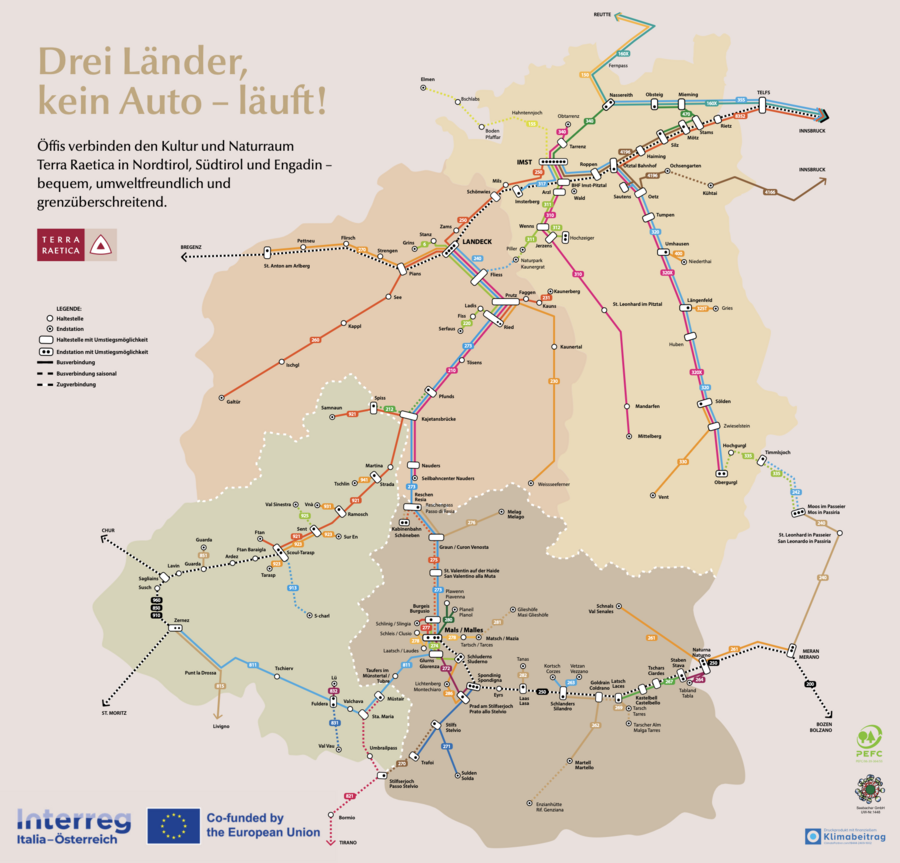
Sebastian Vicoli: The overarching goal of Mobilita Raetica is to improve and further develop cross-border public transport in the sub-regions of Terra Raetica so that more people (locals and tourists) avoid using their cars in the future and travel by public transport instead. The focus here is on public transport as a central element of sustainable mobility across national borders. Mobilita Raetica promotes continuous exchange and close cooperation between the responsible transport associations in the three countries, the VVT in Tyrol (Austria), the STA in South Tyrol-Vinschgau (Italy) and the SBB and the canton of Graubünden in Switzerland. In addition, communication between the bus companies and exchanges on issues relating to cross-border public transport between the political decision-makers, such as the district heads and district governors or, on the Swiss side, the President, are also specifically supported. The aim of this cooperation is to continuously improve public transport services, coordinate them better and make them more attractive for the population. This goal has been particularly relevant since the introduction of the cross-border bus route 273 from Landeck to Mals, which has been running daily since December 10, 2023 and represents an important milestone for cross-border public transport in the region.
F.acT: What initiatives are being taken to make the use of sustainable mobility more attractive?
Sebastian Vicoli: In order to make the use of sustainable mobility more attractive, Mobilita Raetica is focusing on measures at several levels and deliberately turning various screws at the same time. One central initiative is to make the bus stop infrastructure along the cross-border bus route 273 more attractive and to renovate it. Only wooden bus stops are being promoted, which underlines the regional and sustainable nature of the project. The focus on bus stops was chosen deliberately, as the initiative was largely driven by the participating municipalities of Pfunds, Ried, Nauders, Tösens and Mals and was actively supported by the Tyrolean Oberland tourism association. In addition, research results show that well-developed local mobility makes a significant contribution to increasing the proportion of tourists who travel by public transport - even from more distant regions. At the same time, a high-quality bus stop infrastructure in combination with well-frequented bus connections creates significant added value for the local population, especially for commuters and schoolchildren.
A cross-border timetable booklet in the form of the Z-Card folder, which provides a clear overview of the public transport network in the three countries, was also implemented. This project was made possible by the close cooperation of all tourism associations in the region, with each TVB in Terra Raetica selecting a destination that is easily accessible by public transport. In addition, the Tiroler Oberland - Nauders sub-region tourism association is working hard to close the gap in the cycle path on the last section between Pfunds and Nauders, a project that has been on the agenda for some time due to geological challenges.
Another important focus is the expansion of digital real-time displays at bus stops where their use makes sense. This is being done in close cooperation and with the support of VVT. In future, there is still a need for development here, particularly to ensure that real-time information from Swiss and Italian bus connections can also be shown on the displays on the Austrian side, especially at sensitive junctions directly on the border, such as in Nauders and in the area of the Kajetansbrücke bridge near Pfunds. Another planned step, which is currently still in the development phase, is the installation of bike boxes at important junctions and transfer points such as Landeck and Mals train stations in order to further strengthen the combination of cycling and public transport.
F.acT: Which institutions are involved in the major Interreg Italy-Austria Mobility3 project?
Sebastian Vicoli: Numerous institutions from administration, mobility, regional development and tourism are involved in the major Interreg Italy-Austria project Mobility3 - Sustainable public transport in Terra Raetica. The lead partner of the project is the municipality of Pfunds, which represents the neighboring municipalities of Nauders, Ried and Tösens. The project partner on the Italian side is the municipality of Mals, while on the Austrian side the Verkehrsverbund Tirol (VVT) is involved as a further project partner. In addition, several institutions are involved in the project as associated partners, including the Tiroler Oberland tourism association, the Landeck regional management (regioL), the Lower Engadin Regiun Engiadina Bassa / Val Müstair regional management (EBVM), the GWR-Vinschgau cooperative for regional development and further education, the Reschenpass tourism association, the Graubünden Office for Energy and Transport and the Austrian mobility associations. Other institutions have also expressed their interest in the project in the form of letters of interest, including the University of Innsbruck - Landeck site, the KLAR! regions of the district and the EUREGIO.
F.acT: What is the biggest challenge of cross-border mobility in Terra Raetica?
Sebastian Vicoli: One of the biggest challenges of cross-border mobility in Terra Raetica lies in the different administrative structures, legal frameworks and technical systems of the three countries involved, one of which is not an EU member state. Despite similar mobility-related starting points, incompatible digital systems in particular make cross-border communication between buses, digital passenger information displays and the timetable and connection apps of the transport associations difficult. While important groundwork is already being done at regional level, progress is also required at national level in the long term. This subject area is therefore part of the large-scale Interreg project submitted and is being worked on by the Austrian Mobility Associations in cooperation with the VVT.
Another key challenge is the coordination of bus services with rail services at the three main railroad stations of Landeck, Mals and Scuol-Tarasp in order to ensure short transfer times. Different responsibilities and timetable logics make the necessary compromises complex, which is why a cross-border platform for timetable coordination was created with the Schlanders talks as part of Mobilita Raetica.
In addition, the heavy tourist through traffic over the Reschen Pass, especially from Germany via Austria to Italy, puts a considerable strain on the road infrastructure. In order to reduce car traffic, it is necessary to make public transport more attractive, especially in rural regions. This includes a higher frequency, high-quality bus stop infrastructure, easily accessible timetable information, the expansion of cycling infrastructure including parking facilities and supplementary services such as car sharing and mobility hubs. The aim is to enable people to switch from cars to public transport with as little loss of comfort as possible - a particular challenge in the border region that also reflects the core mission of the regional management teams involved as part of the EU Interreg program.