
Prepared for what lies ahead in tourism
Stay up-to-date with current, independent statistics and information on tourism in the Alpine region.
 Project
Prof. Dr. Ivonne Preusser (TH Köln) and Denise Fecker MSc (co-author: Prof. Dr. Frank Gehring, FOM) presented the results of their study on employee retention in ski schools at the WK Personal 2021 autumn workshop on 16 & 17.09.2021 at Heinrich Heine University Düsseldorf. The study is based on an online employee survey with N = 113 participants from the Serfaus ski school.
Ski schools (or "snow sports schools") are one of the 5 core service providers in Tyrolean tourism. As is common in the hotel, catering, cable car and sporting goods industries, ski schools employ their staff on the basis of fixed-term seasonal employment contracts. Depending on the size of the business, Tyrolean ski schools can employ up to 600 snow sports instructors per winter season.
Ski instructors represent the face of their respective ski school in contact with guests and therefore play a decisive role in creating customer satisfaction and retaining regular guests (Johnson & Ashforth, 2008). They therefore influence customer ratings and the perception of the service quality of ski schools (Buonocore, 2010). The major challenge of HR management for tourism businesses is that more than half of seasonal employees in the tourism industry do not come from Tyrol or Austria, but from abroad (Rechnungshof Österreich, 2020). It is therefore of considerable importance for ski schools to consider how they can convince their employees to return in the following season.
The issue of a shortage of skilled workers is not a new phenomenon in tourism. Nevertheless, it has become even more important as the pandemic has progressed. Although studies on employee satisfaction and employee retention are already available for the service sector in the hotel and catering industry, there are still hardly any empirical findings on this topic for the ski school sector.
In organizational research, organizational commitment has established itself as a central target variable for employee retention. This study is based on the affective component of the 3-dimensional commitment model according to Meyer et al. (2002). Affective organizational commitment (AOC) describes the emotional attachment of employees to their organization. Shared values, identification with organizational goals and pride in belonging to the company are central characteristics of a person's emotional attachment to the organization. In addition, AOC demonstrates a high level of commitment to the company (Felfe, 2008) and the desire to remain in the organization (van Dick, 2004).
An anonymous online employee survey was conducted to identify relevant factors for the AOC of ski instructors to their ski school. Finally, the responses of 113 participants were evaluated using statistical analysis methods in the SPSS, PROCESS and AMOS software.
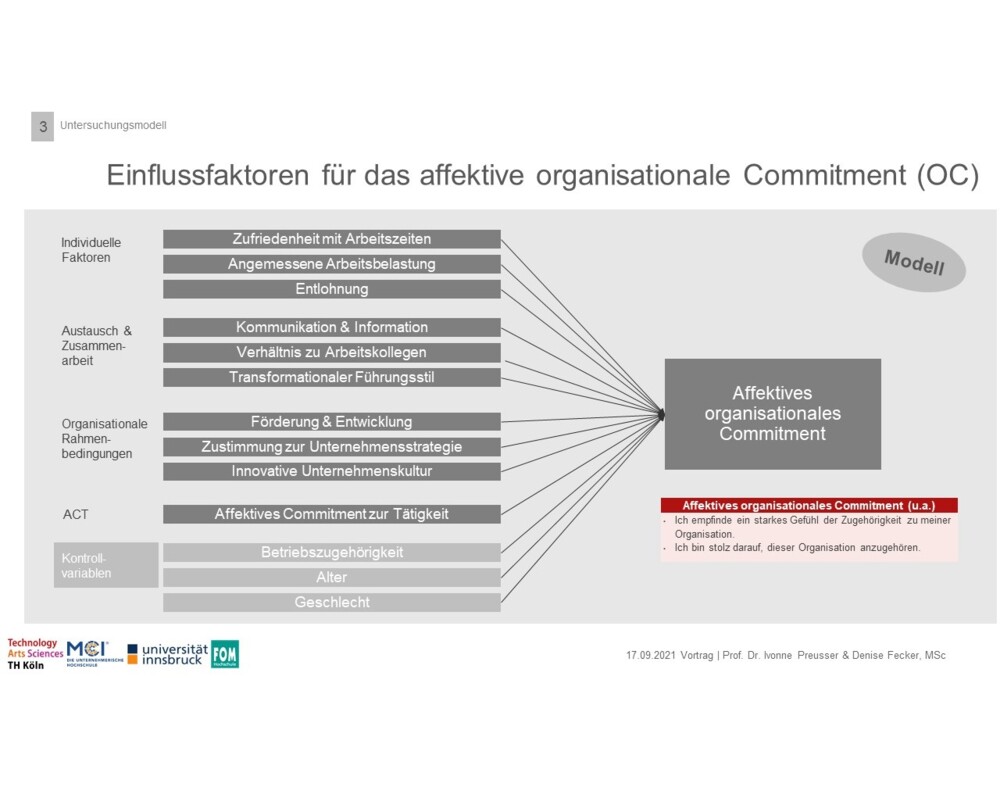
Research model 1 includes all direct possible influencing factors for the AOC. The results of the hierarchical regression analysis show the following variables as the most important levers:
In a second model, individual variables were examined with regard to moderating personal characteristics. It was found that the perception of communication and information within the ski school becomes increasingly important for the emotional loyalty of employees as their length of service increases, i.e. when they return for subsequent seasons.
Based on the findings, specific recommendations for Tyrolean ski schools can be derived.
The greatest comparative influence was found to be exerted by a transformational leadership style. In this type of leadership style, the employee is indirectly influenced and transformed in their behaviour by the charismatic behaviour of their manager (Pelz, 2016). A manager who shows trust, respect, praise and recognition to employees, as well as acting as a role model and creating a collegial atmosphere, is of great importance.
Promotion & development. Sufficient offers as well as encouragement and support for further development also play a major role in organizational loyalty for ski instructors, who also show a strong commitment to their profession. Further development offers in the form of training courses, which can improve one's own skills and thus expand the possible range of activities, have a positive effect on the attitude towards the organization.
Communication & information: Employees should be permanently involved in corporate communication. Not only the induction of new/younger ski instructors is important, but also regular exchanges with experienced employees.
Corporate strategy. Even in temporary employment relationships, the long-term corporate strategy plays a decisive role for employees and their emotional attachment to the company, as it conveys not only economic goals but also the values and attitudes of the organization, which are crucial for affective OC (Felfe 2008). Especially for Gen Y and Gen Z, who are looking for a sense of purpose, a transparent communication of the strategy should not be neglected.
The considerations on the levers of employee commitment in ski schools make an important contribution to Tyrolean tourism research. However, as studies by Spendlingwimmer (2011) and Schönewolf (2015) show, the motives for choosing seasonal work as a ski instructor are based on very individual motives. The realization that this limits their ability to retain staff should be taken into account in practice. An identification of the individual motives or the type of commitment according to Felfe (2008) was not carried out in this study and could serve as orientation for future studies. To identify different "ski instructor types", the normative and calculative components of the commitment model should also be taken into account in order to measure clear motives. Against the background of the increasing shortage of employees in tourism, it will be necessary in future to examine personnel management (in particular e.g. leadership and promotion) more closely in order to develop effective measures to promote the loyalty of snow sports instructors and seasonal employees in Tyrolean tourism.
Buonocore, F. (2010). Contingent work in the hospitality industry: A mediating model of organizational attitudes. Tourism Management, 31(3), 378-385. https://doi.org/10.1016/j.tourman.2009.04.005
Felfe, J. (2008). Employee retention. Business Psychology. Verlag Hogrefe Göttingen 2008, ISBN 9783801721329. Personal - Zeitschrift Für Human Resource Management, 04, 055. research. ebsco.com/c/uoz6h6/search/details/xgoogeshvz
Johnson, S. A., & Ashforth, B. E. (2008). Externalization of employment in a service environment: the role of organizational and customer identification. Journal of Organizational Behavior, 29(3), 287-309. https://doi.org/10.1002/job.477
Meyer, J. P., Stanley, D. J., Herscovitch, L., & Topolnytsky, L. (2002). Affective, Continuance, and Normative Commitment to the Organization: A Meta-analysis of Antecedents, Correlates, and Consequences. Journal of Vocational Behavior, 61(1), 20-52. https://doi.org/10.1006/jvbe.2001.1842
Pelz, W. (2016). Transformational leadership - state of research and implementation in practice. In C. von Au (Ed.), Effective and sustainable leadership approaches (pp. 93-112). Springer Fachmedien Wiesbaden. https://doi.org/10.1007/978-3-658-11956-0_5
Austrian Court of Audit. (2020). Report of the Court of Audit: Demand for skilled workers in tourism. Austrian Court of Audit. Available online.
Schönewolf, C. (2015). Life in the bubble [University Library of the Ludwig-Maximilians-University Munich]. DataCite. https://doi.org/10.5282/ubm/epub.27092
Spendlingwimmer, F. (2011). Dropouts and survivalists: Finding meaning at the other end of the planet. Field Research: Vol. 6. Lit-Verl.
van Dick, R. (2004). Commitment and identification with organizations. Practice of Personnel Psychology: Vol. 5. Hogrefe.