
Prepared for what lies ahead in tourism
Stay up-to-date with current, independent statistics and information on tourism in the Alpine region.
 Research

TTR: Why is this topic relevant for the Tyrolean tourism industry?

Alina Gasselich: The tourism industry has been plagued by high staff turnover for a number of years. Most tourism destinations are seasonal due to fluctuations in demand and this leads to immense employment complexity. Seasonal staff retention has numerous advantages such as lower staff recruitment requirements and higher service quality. Alpine destinations in particular have felt the effects of seasonality, as high staff turnover and a lack of qualified workers has become one of the biggest challenges for operators. Ski schools are an essential component and tourist service provider in Tyrolean winter tourism. The province has 218 full-time and 212 specialized ski schools, which employ around 7,000 ski, snowboard and cross-country instructors (also known as snow sports instructors). And yet there are hardly any studies that primarily deal with snow sports instructors as part of the tourism industry. That's why I dedicated my master's thesis to the employment of snow sports instructors and their seasonal ties to ski schools.
TTR: What are the core results of your work and what significance do they have for tourist destinations and businesses?
Alina Gasselich: A research model was developed for the study in order to gain insights into how satisfaction with certain indicators (see I1 - I4 in Figure 1) influences job satisfaction. This in turn was tested for its influence on seasonal return intentions and affective commitment. In a similar study on seasonal staff retention in ski resorts, there were differences between first-time employees and returning employees, so this factor was also taken into account and included in the analysis. However, the results of the study showed no differences between these two groups of employees.
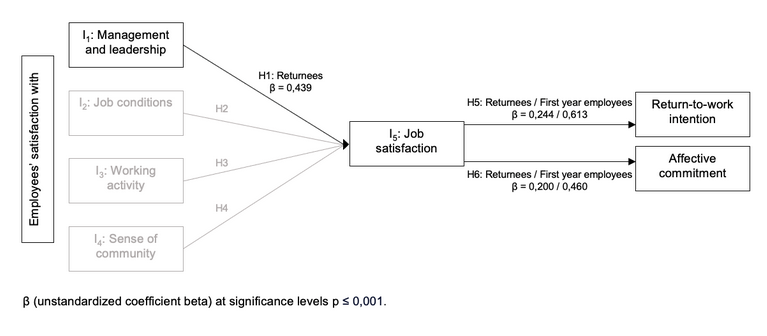
Satisfaction with the management and leadership of the ski school was the only significant indicator for the job satisfaction of returning snow sports instructors. For the first-year respondents, none of the indicators examined were decisive for their job satisfaction. Job satisfaction was an indicator of positive intentions to return as well as affective commitment to a ski school for both groups. In addition, the indicator sense of community had the highest importance rating for both groups. This study underlines the importance of job satisfaction for employee retention.
TTR: What specific recommendations for action do you make in your Master's thesis?
Alina Gasselich: First of all, you should be aware of the typical characteristics of employees, as these can already give an indication of possible needs for the employer. The study revealed a young age distribution, with 18 to 31-year-olds making up almost 95%. It can also be assumed that many snow sports instructors are not permanently settled in the destination of their ski school, as almost 60% of the participants had a non-Austrian citizenship and the most frequently mentioned scope of work was part-time employment during their studies. The sense of community can be particularly important for people who work seasonally in tourism, as they usually do not live in their usual environment and with their caregivers. All of these factors should be taken into account when creating an employment environment.
Since the analysis showed that job satisfaction is an indicator of intention to return and affective commitment, I recommend that providers monitor satisfaction with certain indicators that are meaningful for their company and employees. This can be done either through regular feedback during the season or through employee surveys at the end of the season.
Overall, this study has highlighted the interpersonal nature of this job and how important it is to strive for satisfied employees in order to achieve the retention and commitment of seasonal workers. This is of great value to the Austrian ski school system as part of the winter tourism industry.