Prepared for what lies ahead in tourism
Stay up-to-date with current, independent statistics and information on tourism in the Alpine region.
 Project

F.acT: The Tyrolean Way is now the third version of a long-term strategy process that began back in the 1970s. What is new about the "Tiroler Weg 2020+"?
Theresa Leitner-Mitterer & Hubert Siller: The 1982 tourism concept already stipulates that Tyrolean tourism policy should be designed in such a way "... that its measures make an optimal contribution to maintaining and improving the general quality of life in the province". The call for more quality instead of quantity was therefore already loud in the first Tyrolean tourism concept in 1972 after the growth euphoria of the post-war period. For many years, efforts were made to establish Tirol as a year-round destination and to meet the high quality expectations of guests while at the same time strengthening the quality of the relationship between guests and hosts. In line with the definition of sustainability, however, there are areas of tension between quality standards and the quantity required to ensure prosperity with a limited carrying capacity of people and nature. In addition, Tirol is a living, economic and recreational space at the same time.
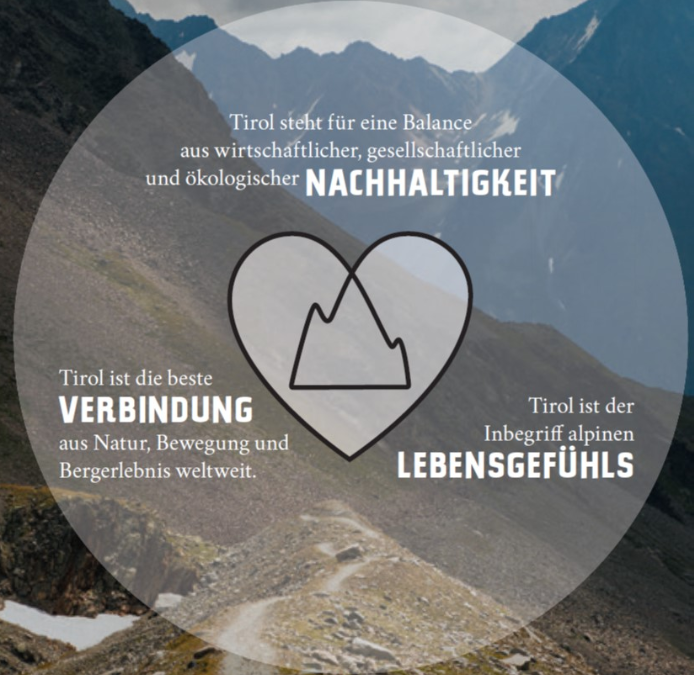
What is new about the Tyrolean way is, on the one hand, the increased participation in development, greater involvement of local people, the central focus on sustainability and its measurement. In order to involve as many stakeholders as possible in the development of the strategy and to develop a participatory process, over 100 decision-makers from both inside and outside of tourism were involved in the creation of the Tiroler Weg through discussions and two surveys of core service providers and tourism associations. Based on this exchange and building on the existing Tyrolean Way, the self-image of Tyrolean tourism was reformulated: Tirol is the best combination of nature, exercise and mountain experience in the world. It stands for a balance of economic, social and ecological sustainability and is therefore the epitome of the Alpine lifestyle. A feeling that stands for a love of nature and mountains, consistency, openness, straightforwardness and joie de vivre.
F.acT: What measures are to be implemented with the Tyrolean Way?
Theresa Leitner-Mitterer & Hubert Siller: The measures for the further development of tourism in the province are divided into the following four areas:
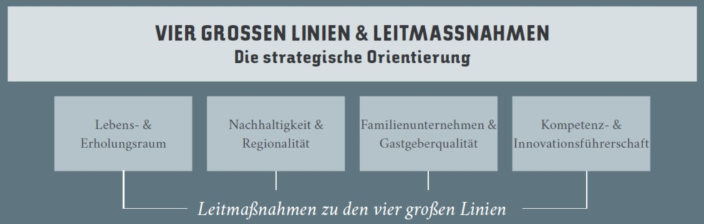
1. living & recreational space
Unlike in other regions, tourism does not take place in a resort, but in the living space of the population. Responsible use of space is therefore essential and design quality will also become increasingly important in the future. Existing instruments such as the design advisory board can make an important contribution here. In addition, more awareness should be created for architecture and the use of space. To this end, the"Bergwelt Tirol - miteinander erleben"(Tyrol's mountain world - experiencing together) programme will be further developed. This also includes visitor guidance with the help of digital tools, a clear limitation of bed growth and the promotion of increased occupancy and price enforcement, the revitalization of village centres and redensification instead of new construction, as well as (supra-)regional dialogue forums that include as many stakeholders as possible, such as agriculture, schools, associations, etc.
2. sustainability & regionality
The large area of sustainability is aimed at regional value creation in the sense of the circular economy, in which the interaction between tourism and agriculture works even better. DMOs will also face greater challenges in the future. From 2022, every destination is to develop a multi-dimensional sustainability strategy and apply for the new Austrian Ecolabel for Destinations. By 2035, all ski resorts should be climate-neutral and offset this through regional climate protection projects and 100% of on-site mobility should be converted to regenerative drive systems. In order to further strengthen regional economic cycles, cooperation between agriculture and tourism must be optimized. Measures for this would be food labeling, the increased anchoring of culinary delights as a tourism product and the networking of tourism associations, planning associations and regional management.
3. family businesses & host quality
Family-run businesses form the backbone of Tyrolean tourism. In the next 15 years, however, around 2,600 businesses will be handed over. The businesses must also deal with the current crisis situation and build up digitalization skills - and they must also be supported by the Chamber of Commerce through practical research. The topic of sustainability must also be implemented at company level, for which the WK Tirol's advisory network has continued its funding until 2025. The labor shortage in tourism was already an issue before the COVID-19 crisis. The problem has now become even more precarious. Employer brands therefore need to be strengthened and the quality of training further improved. At least we have also learned to use digital tools during the crisis, making e-learning formats easier for all age groups. This ranges from apprenticeships to further education and second-chance education. A further step is the necessary adaptation of the Private Room Rental Act, which makes the analog and digital services expected by guests possible.
4. competence & innovation leadership
The quality leadership of Tyrolean tourism is a year-round product. Instead of new developments, the existing transportation infrastructure has been continuously replaced by higher quality facilities in recent years. In addition to skiing as the central winter product, alternative offers must also be further developed. In summer, the focus is still on hiking, but also increasingly on cycling in all its many facets. However, the focus is on tranquillity in the mountains and barrier-free offers are also being further expanded. In addition to the traditional services for guests, the destinations themselves are also to increasingly shape the regional leisure offer. The aim is to continue to focus on local markets as core markets and also increasingly appeal to local guests. Long-distance markets will be used as risk protection and for the equalization of the seasons in cooperation with Österreich Werbung. In addition, practical destination research and the Tyrol Landlord Academy are important components for expanding competence and innovation leadership. This also includes the development of a Tirol dashboard for the holistic recording of economic, social and ecological processes as well as satisfaction in tourism. The digitalization offensive aims to turn Tirol into a smart destination where all offers can be booked online on the Tirol Experience Platform. This requires an Open Data Hub Tirol as an open digital data infrastructure. Innovations are to be driven forward with the help of the Tourism Tech Innovations Lab and the registration system is to be completely digitalized.
TTR: What do you personally see as the biggest challenges in actually putting the Tyrolean way into practice?
Theresa Leitner-Mitterer & Hubert Siller: As this is a Tyrol-wide mission statement for tourism that affects many stakeholders, it is crucial to drive its implementation forward and make it visible. In the spirit of "You can't manage what you can't measure", we have therefore developed the basis for a multidimensional measurement of success. This Tirol dashboard is based on the destination criteria of the Global Sustainable Tourism Council (GSTC-DC) and includes key figures for the areas of economy, society, ecology and satisfaction. In addition to the familiar parameters of overnight stays and arrivals, length of stay, bed occupancy and revenue per bed (economic indicators), further KPIs are to be recorded. These include, for example, tourism intensity, tourism awareness among locals, the proportion of year-round jobs in tourism (social indicators), the tourism footprint, the proportion of public transport in on-site mobility and renewable energy in total energy consumption (ecological indicators), guest satisfaction, their recommendation rate and employee satisfaction. These key figures should help us to actively manage and promote sustainable development - together with all tourism players and stakeholders - to increase the quality of life of Tyroleans and subsequently contribute to the global Sustainable Development Goals (SDGs). The Tyrolean Way should therefore be seen as a long-term process that can never be fully achieved in line with the definition of sustainable tourism development.
Editor, publisher and media owner: Province of Tyrol, Tirol Werbung, Tyrolean Chamber of Commerce & Association of Tyrolean Tourism Associations
Strategy team "The Tyrolean Way": Hubert Siller (head), Theresa Mitterer-Leitner, Florian Phleps, Ulrike Reisner, Ralf Roth, Ingrid Schneider, Franz Tschiderer, Fabian Erhart