

Prepared for what lies ahead in tourism
Stay up-to-date with current, independent statistics and information on tourism in the Alpine region.
 Inspiration

F.acT: Everyone is talking about AI at the moment. Do you see artificial intelligence as a curse or a blessing? Where can AI support us and where do you see its limits?

Alexander Fritsch: Artificial intelligence (AI) holds enormous potential and challenges for the tourism industry at the same time. On the one hand, it offers considerable advantages through the automation of processes, the improvement of customer service and the provision of tailored recommendations. For example, chatbots can process customer inquiries efficiently and booking systems can make dynamic price adjustments using predictive analytics. AI can also help to optimize operational processes and thus achieve sustainability goals.
On the other hand, there are risks such as the output of incorrect information and data protection concerns. It is essential that companies sensitize their employees to the competent use of AI in order to ensure that it is used responsibly.
F.acT: Responsible AI - what exactly does that mean?
Holger Sigmund: Responsible AI means making sure that artificial intelligence is developed and used ethically and fairly, transparently, safely, sustainably, responsibly and inclusively. Ethical and fair refers in particular to working conditions and wages in the programming and training of AI systems themselves. Transparency and security, e.g. in terms of data protection and possible misuse. Sustainable refers to the high energy and water consumption resulting from the enormous computing power behind AI queries.
In tourism, AI also offers the opportunity to create user-friendly solutions that make travel safer, more pleasant and more sustainable. Good and practical examples are the use in visitor guidance, for optimizing the course of the journey (acceleration and braking) in rail operations, in controlling air traffic or the flow of traffic on the road (AI-controlled traffic lights) or in avoiding food waste in the hotel and catering industry. This is because AI is particularly good at recognizing patterns and can calculate efficiently and quickly with large amounts of data.
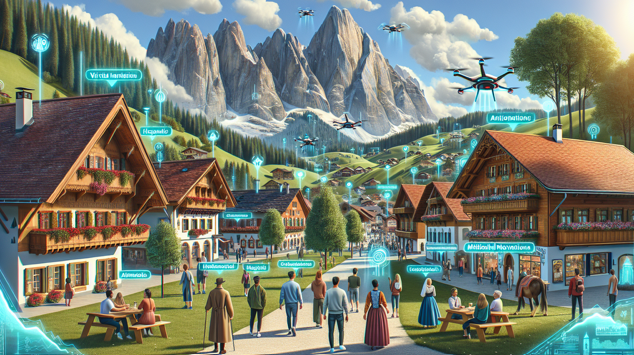
F.acT: How do you see the implementation of AI in tourism in 2040? What will have become established by then and what role will the human factor still play?
Alexander Fritsch: It is generally impossible to predict the future, because we are all shaping it together. However, we expect far-reaching changes in the industry over the next few years: fully personalized travel experiences will become the norm, with AI taking individual preferences and needs into account. Virtual assistants will plan and book trips, while intelligent systems will optimize hotel operations and maximize guest comfort.
Despite these advances, the human factor will continue to play a central role. Personal interaction and human service will remain essential, especially in situations that require empathy and individual attention. AI will not replace humans, but will enhance their skills and take over repetitive tasks, leaving more time for personal contact.
It will be important to secure the trust of guests. Therefore, training employees in the use of AI is crucial in order to use the technology effectively. Our recommendation is that companies should start small and identify specific use cases in order to continuously adapt to the rapid pace of development.