

Prepared for what lies ahead in tourism
Stay up-to-date with current, independent statistics and information on tourism in the Alpine region.
 Research

F.acT: Why is this topic relevant for the Tyrolean tourism industry?

Marie Meisinger : The Austrian hotel landscape is still dominated by family-run individual hotels, and these businesses in particular often struggle to keep pace with digital developments. They often lack the necessary know-how and equity to make the improvements themselves or to commission them. In the long term, however, it is an essential part of a hotel's competitiveness to make its offering more digital and to market it. A key component of digitalization in hotels is their website. If it is of good quality, customer satisfaction will improve, customer confidence in the offer will increase and purchase intentions will rise. Accordingly, online bookings also increase with an improved website. For hotels, the quality of the website should therefore be of central importance.
In order to support hotels in improving their website, I developed simple and cost-effective improvement measures as part of my master's thesis, which are easy to implement, especially for family-run individual hotels.
F.acT: What are the core results of your work and what significance do they have for hotels?
Marie Meisinger: The thesis compares the websites of individual hotels with 4 - 5 stars in the Black Forest and Tyrol. They have a similar target group due to similar conditions and are therefore considered competitors. In this way, the hotels can be shown opportunities for improvement, the implementation of which will enable them to keep pace with the competition.
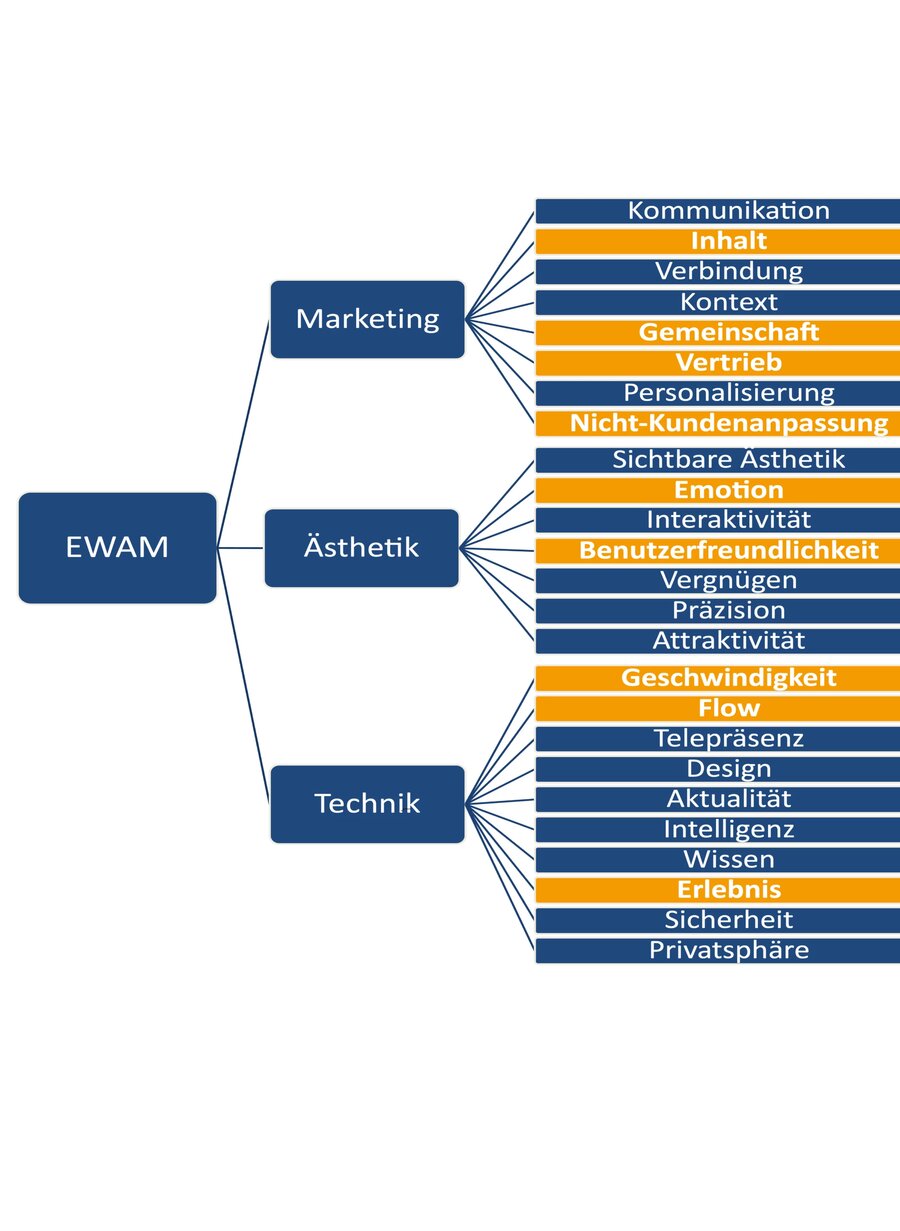
In order to analyze the hotel websites, the Extended Website Analysis Model (EWAM) was developed and applied (see diagram).
This model is used to examine whether the websites of the Black Forest and Tyrolean hotels exhibit all the quality features defined therein and in which points they differ. The result shows that the websites of the Black Forest hotels have room for improvement in 25 of a total of 89 quality features examined, for example in terms of content, speed or the experience on the websites.
It should be emphasized that there are also two extensive quality features that could be improved in both regions. This means that hotels should improve their own websites in order to achieve the aforementioned benefits, such as more direct online bookings via the website, and thus maintain their long-term competitiveness.
F.acT: What specific recommendations for action do you make in your Master's thesis?
Marie Meisinger: The following recommendations for action were derived from the potential for improvement identified:
Basically, it can be said that many improvement measures can be implemented free of charge or at low cost and with little effort. Almost all website agencies that manage the websites of the hotels surveyed offer the hotels the opportunity to create new pages on the website themselves and fill them with content such as photos, texts, videos, etc. This enables the hotels to make many improvements themselves. This enables the hotels to implement many improvement measures themselves and free of charge.
An illustrative example of this is the careers page: in times of labor shortages, no hotel can do without drawing attention to the benefits for employees on the website. A page with "Frequently Asked Questions" can be similarly important in order to save valuable time when answering guest inquiries, as they can already find the answer on the website. Many similar examples are presented in the paper.
There are also points where, depending on the context, external expertise is recommended for advice and implementation, as these points contribute enormously to customer satisfaction. This includes, for example, installing a search function that allows guests to easily find any content they are looking for on a website. However, most measures can be easily implemented by hotels themselves with a little time investment.