
Prepared for what lies ahead in tourism
Stay up-to-date with current, independent statistics and information on tourism in the Alpine region.
 Research

Why is this topic relevant for the Tyrolean tourism industry?

Carolina Federle: The hotel industry is a central component of the Tyrolean tourism industry and the employees are in turn a central component of the guest experience. Especially in times of skills shortages, it is important to understand how employers can support their employees.
What are the key findings of your work and what significance do they have for tourist destinations and businesses?
Carolina Federle: The results of the work have shown that the emotional labor that receptionists experience on a daily basis is strongly influenced by the behavior of the customers and the support of the company. A distinction can be made between three strategies for dealing with emotional labor. You can either allow your natural feelings (Naturally Felt Emotions), try to empathize with the guest (Deep Acting), or suppress your own feelings (Surface Acting). In most cases, two of these strategies are combined, but there were also participants who used only one of the strategies or all three. Furthermore, receptionists used coping mechanisms such as social support and sports to deal with the consequences of emotional labor, especially after work hours.
There is often a lack of awareness of the effects of emotional labor, especially on the employer side, which further increases the burden. This often leads to dissatisfaction and frequent resignations, especially when employees feel a lack of appreciation, unrealistic expectations or an excessive workload. Therefore, measures taken by the company can help to reduce the effects of emotional labor, as most participants generally had a positive attitude towards working at the hotel reception.
What specific recommendations for action do you make in your Master's thesis?
Carolina Federle: To support employees in coping with emotional labor, a three-stage model based on the Conservation of Resources (COR) theory was designed. This theory states that people want to minimize cognitive resource losses and build up resources in stress-free times in order to achieve well-being.
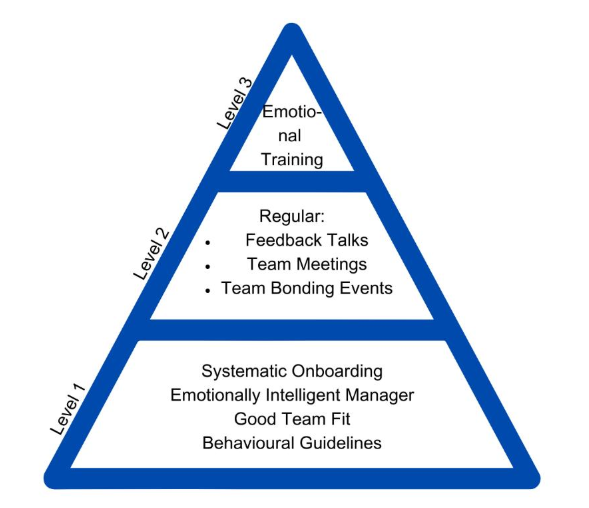
Level 1: Minimization of resource losses with the aim of giving employees confidence in dealing with customer problems.
Measures:
Level 2: Restoration of resources, with the aim of establishing support systems to reduce emotional stress.
Measures:
Level 3: Build up a surplus of resources with the aim of creating well-being and positive stress (eustress).
Measures:
Of course, these measures are associated with effort and costs, which is why it is recommended to ensure level 1 and then build on it if possible. The measures seem very simple, but even these were often not in place in the companies where the participants worked.