
Prepared for what lies ahead in tourism
Stay up-to-date with current, independent statistics and information on tourism in the Alpine region.
 Inspiration
The course "Business Plan & Start-up" takes place in the 2nd semester of the Master's degree course "Entrepreneurship & Tourism". Course director Dr. Christoph Engl is always on the lookout for real projects in order to follow the MCI's claim "Bridging university & business". However, the aim is often not to focus on flagship tourism projects, but rather to support smaller initiatives, less well-known projects and, above all, sustainable initiatives.
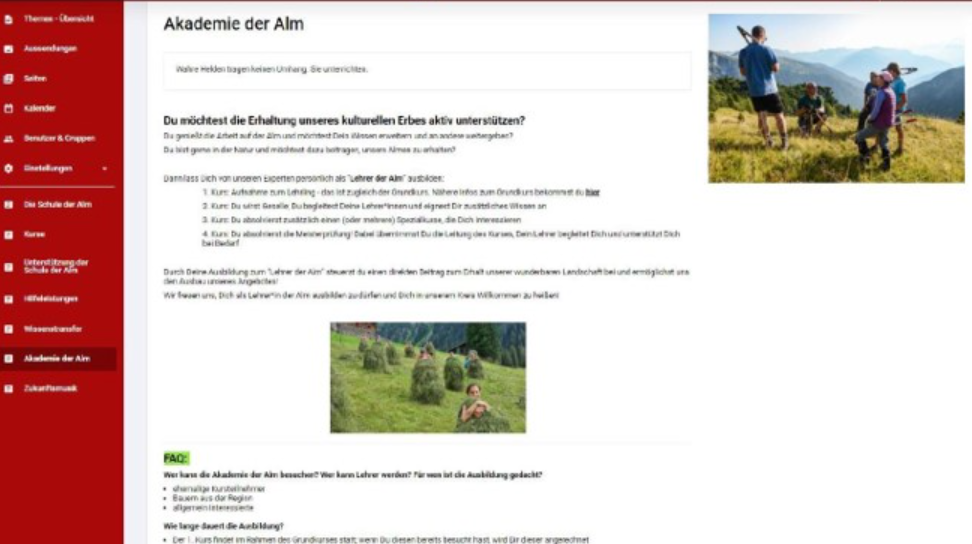
This is how the idea of working with the Schule der Alm, an association that offers meaningful vacations in the Valsertal valley on Helga's Alm, came about. In 3 days, the participants learn about the beauty, but also the hard work of alpine farming, landscape conservation, nature conservation, flora and fauna. In return, they offer their labor and help to preserve mountain meadows and biodiversity. As part of the collaboration, the objectives for the course were defined in advance with the association. The central question for the students was to analyze the core elements of the School of the Mountain Pasture and to depict these in a business plan. The aim was to simulate a start-up and to draw up and evaluate options for action for the association.
The course started with a theoretical input from Mr. Engl on the business plan: why is it needed, what does it have to contain and how is it created? This was followed by a presentation of the Schule der Alm, its activities and employees by Werner Kräuter, the chairman of the association. This gave the students the opportunity to ask questions and gain detailed knowledge about the advantages and challenges of the association. In a further phase, this content was reflected on in small groups and additional contacts were made with participants in order to include this side as well. Building on all this input, initial concepts were developed in small groups and ideas were refined and concretized with the help of individual feedback and coaching from the course instructor. At the end of the course, the final concepts were presented to the board of the Schule der Alm. The freedom to work on the concepts resulted in very different ideas for the future development of the Schule der Alm.
Several groups identified the underlying values of the Schule der Alm - openness, common good, authenticity and deceleration. In order to take up these values in the future, some students thought about how volunteers could be recruited and involved even more in the future. To this end, an online platform for volunteering was developed, for example, where information can be shared and communicated with each other via various roles. On the one hand, this enables a better connection between active association members and former and future participants. But it could also improve internal communication in order to better plan and coordinate activities.
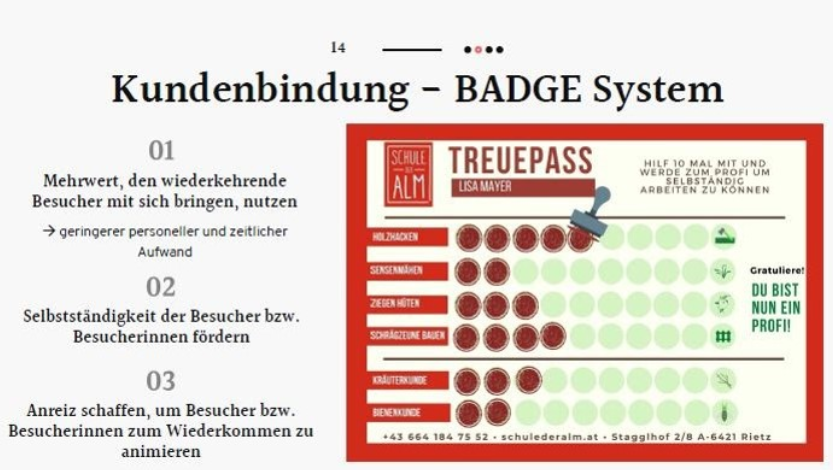
Other business plans addressed customer loyalty among former participants as a central challenge and essential component of the School of the Alpine Pasture. In terms of transformative experiences, there is often a strong connection to the Valsertal, the people involved and the mountain landscape after participating in the Alpine pasture course. This bond is to be better utilized by introducing a badge system in the form of a loyalty pass. This will allow participants to try out further activities after completing the "basic course", deepen their knowledge and thus strengthen their loyalty to the association. At the same time, the students attempted to quantify the volunteer work required and to acquire long-term motivated volunteers for this purpose. This is particularly important as the alpine pasture season is normally limited from June to September.
Other students took up the topics of experiencing nature and slowing down, which have experienced an enormous boom not only, but especially due to the COVID-19 crisis. As the participants currently have to spend the night in St. Jodok, authentic overnight accommodation in huts in the Valsertal valley was considered, as well as other activities such as goat hikes.
The results were then discussed with the association members and serve as a basis for the further development of the association, which will be decided at the next general meeting in the fall. The course therefore represents a win-win situation for both sides. The students had the opportunity to get to know a real project outside of traditional tourism and to put their ideas, creativity and problem-solving skills to the test. The development of the business plan for the Schule der Alm was thus able to combine theoretical principles with the practical problem and promote the students' entrepreneurship skills. On the other hand, the Schule der Alm received a status quo analysis of its offer and values as well as numerous ideas for the further development of its activities.
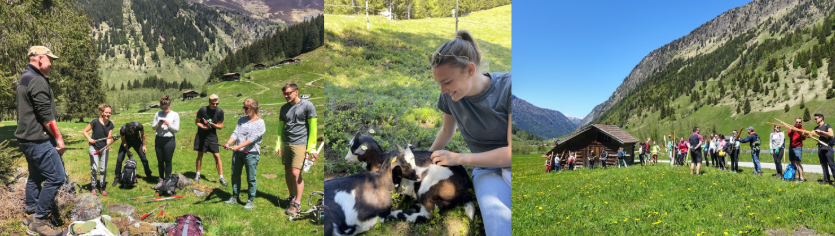
This year, the course also had to take place online. On the one hand, this had the advantage that many members of the association were able to join the presentations via video conference, resulting in a lively exchange and an exciting discussion. On the other hand, however, it had the disadvantage that the students were unable to actively experience the "Schule der Alm" product during the semester. This was made up for at the end of the semester with a visit to Helga's Alm in Valsertal. Due to the easing of restrictions, it was possible for the students to lend a hand, pick up the scythe and get to know Helga's goats and the people behind the project in person. In times of online teaching, this was a particularly intense experience. Once again, it became clear that it is essential, especially in tourism education, to leave the classroom - in this case a virtual one - and enable direct experiences and actively incorporate real, practical and social problems into teaching.
"Working with the students is one of the highlights of the Schule der Alm. It was wonderful to see how committed the young people were. It was also a pleasure to discuss things with them and get to know their many great ideas." Werner Kräutler, Chairwoman of the Schule der Alm
"The collaboration with the students is one of the highlights of the Schule der Alm. It was wonderful to see how committed the young people were. It was also a pleasure to discuss things with them and get to know their many great ideas."
Werner Kräutler, Chairwoman of the Schule der Alm