

Prepared for what lies ahead in tourism
Stay up-to-date with current, independent statistics and information on tourism in the Alpine region.
 Research
Kathrin John was awarded the DGT-ITB Science Prize in the category "Best thesis on sustainability in tourism" for her master's thesis in 2023. Congratulations to her!

Why is this topic relevant for the Tyrolean tourism industry?

Kathrin John: The issue of sustainability is omnipresent in all areas of society, especially nowadays. In tourism in particular, the development towards a more sustainable travel industry is a fundamental necessity in order to prevent the tourism industry from being robbed of its own foundation. While tourism can have a detrimental impact on environmental, social and economic areas, it is also dependent on their integrity. In the context of sustainable tourism development, travel behavior in particular plays a central role, which can act as a potential driver as well as an obstacle. In Tyrol, too, the negative effects of careless traveler behavior are already apparent, both in terms of nature and society. However, there is currently speculation in research circles as to whether the emerging Generation Z will trigger a positive change in this respect.
This group of the "travelers of tomorrow" has a particularly strong awareness of sustainability compared to previous generations. However, a positive attitude towards sustainability is not always a guarantee of correspondingly sustainable behavior. This attitude-behavior gap can also be observed among travelers of the apparently more sustainable Generation Z. In the tourism context in particular, the gap between attitude and behavior appears to be more pronounced compared to consumption practices in other, everyday areas of life. However, a clear consensus on specific influencing factors that cause this discrepancy has not yet been established.
As this topic is of particular relevance to tourism practice, I investigated which factors influence the attitude-behavior gap on the part of Generation Z in the tourism context as part of my master's thesis. Based on relevant studies in the field of behavioral research, a research model was developed to examine the influence of various variables on travel behavior. The results should, on the one hand, show how the attitude-behavior gap on the part of Generation Z can be empirically defined and, on the other hand, make recommendations for action for tourism practice in order to reduce the attitude-behavior gap investigated.
F.acT: What are the core results of your work and what significance do they have for tourist destinations and businesses?
Kathrin John: The results of the study show that the very positive attitude (Attitude towards Sustainable Tourism) of Generation Z towards sustainable tourism is not reflected to the same extent in their actual travel behavior (Sustainable Travel Behavior). Attitudes were identified as rather weak indicators of travel behavior, although a stronger indirect influence of attitude on behavior was observed via the behavioral intention component. It was also shown that, in addition to attitudes, social norms (Perceived Role of Social Norms) and perceived behavioral control can have an indirect and direct influence on travel behavior (see Figure 1).
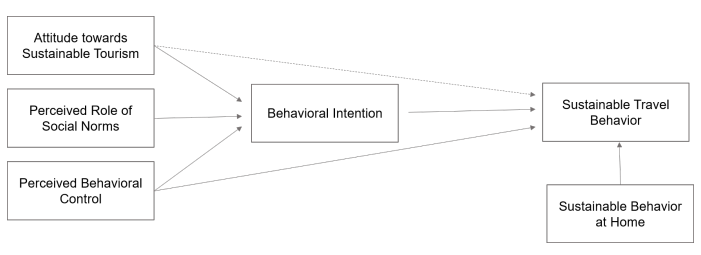
The interviewees perceived various obstacles to the implementation of sustainable travel behavior, such as a lack of alternative or more sustainable transport options as well as excessive financial and time expenditure, which, in the view of the interviewees, is associated with planning sustainable trips. It also became clear that respondents mainly associate travel with relaxation and fun, which makes sustainability concerns when traveling recede into the background. It was also interesting to note that the more frequently respondents carried out sustainable practices at home, the more frequently these were also practised in a travel context. Nevertheless, it was shown that environmentally friendly practices such as recycling or energy-saving measures are implemented significantly more frequently at home than when traveling. This additional discrepancy between behavior at home and behavior while traveling (also known as the "home-away gap") increases the complexity of the attitude-behavior gap in the tourism sector and in turn represents a challenge that should not be ignored by tourist destinations and businesses.
What specific recommendations for action do you make in your Master's thesis?
Kathrin John: The results of the study provide several recommendations for tourism practice. Due to their positive attitude towards sustainable tourism and a strong intention to travel (more) sustainably in the future, Generation Z can be seen as a valuable target group for sustainable tourism.
All in all, a balanced commitment from industry and travelers is essential to promote the sustainable development of the travel industry as such and thus secure the essential basis of tourism in the long term.