
Prepared for what lies ahead in tourism
Stay up-to-date with current, independent statistics and information on tourism in the Alpine region.
 Inspiration

Q.act: To what extent are alpine pastures in Tyrol declining compared to Austria (number and area) and what are the reasons for this?

Our popular cultural landscape only exists because the land is farmed. If this were not the case, we would have one thing instead of open alpine pastures: forest. But we are clearly losing alpine pastures. In Tyrol, the decline in alpine pastures over the last 20 years is fortunately still relatively low at around six percent. The situation is different throughout Austria: Here, alpine pastures have decreased by around 13 percent over the years. Alpine pasture management is enormously complex, the work is arduous and in most cases it is not possible to manage the pastures mechanically, but only with the help of grazing animals. There is a lack of labor on the farms and often also a lack of financial incentive. High-quality food is produced on alpine pastures, but it is hardly competitive on the market. There is a constant debate about the need to make food cheaper - but as you can see from our consumer behavior, it has hardly any value for us anyway.
F.act: Why are mountain pastures so important for tourism?
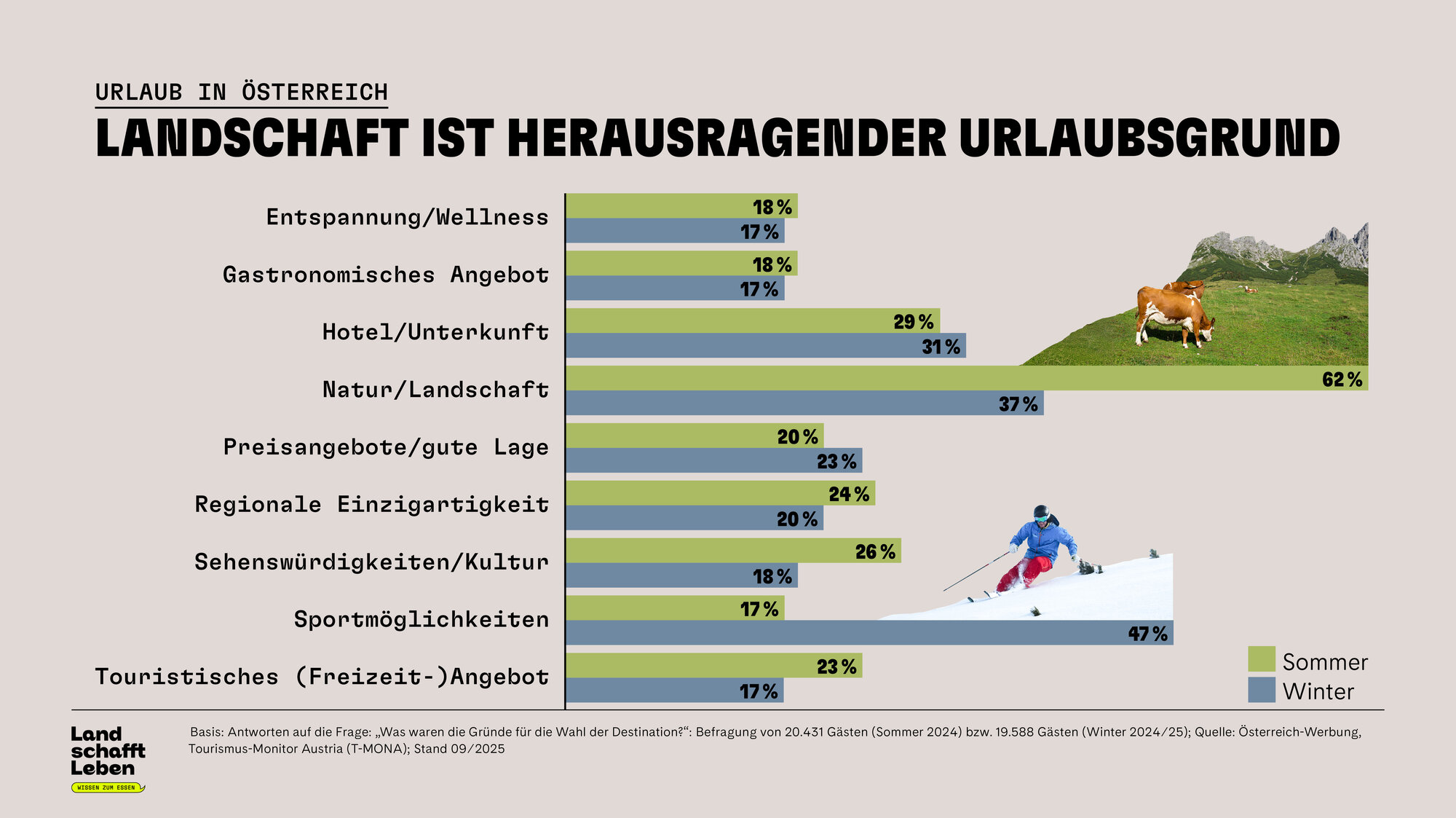
Hannes Royer: If alpine pastures disappear and our cultural landscape becomes overgrown, tourism will no longer have a future, because the main reason for vacationing in Austria is the landscape. Our alpine pastures in particular attract numerous tourists every year, both from abroad and from Austria itself. So you could say that the alpine pastures are the jewel in the crown of Austrian tourism. They not only play an incredibly important role for summer tourism, but also for winter tourism. Without the cultivation of these areas, there would be no ski slopes and thus the main reason for winter vacations in Austria would be lost.
F.act: And vice versa - does agriculture need tourism?
Hannes Royer: Yes, definitely. Nine farms close every day in Austria. In the Alpine region, this development has progressed somewhat more slowly so far, as tourism provides an additional income there, either directly or indirectly. As a result, agriculture in these regions is still relatively well preserved. Agriculture and tourism need each other - if one works, so does the other. We absolutely must preserve this closely linked symbiosis.
F.act: How can tourism support agriculture in the conservation of mountain pastures?
Hannes Royer: We need more Austria on our plates. We need a clear commitment from the food service industry to local food. Until 2023, for example, quality, sustainability and origin were among the main criteria for food procurement in the wholesale trade. However, this has changed massively. Today, more than half of the meat in the food service industry does not come from Austria and we are seeing a strong trend towards the cheapest products. This is why we have been calling for mandatory origin labeling in the food service industry for years. So that every consumer can decide for themselves what they really want on their plate. Fortunately, there are already some businesses that voluntarily disclose the origin of their ingredients - and they almost exclusively use local food. With more Austria on our plates, we keep the added value in the country and support our farmers in continuing to produce food and preserve our cultural landscape.