
Project

Airbnb in Tyrol

An analysis of the sharing offer
How important is the leading sharing platform Airbnb in Tyrol?

Previous research

As part of a project funded by the Tourism Research Center of the Province of Tyrol, the importance and significance of Airbnb in Tyrol was examined for the first time. While the literature mainly focuses on the urban phenomenon, there are hardly any studies on the role of the sharing platform in rural areas. Only Switzerland has continuously collected data on Airbnb since 2014. These studies show that the number of properties has risen from 3,000 in 2014 to 49,000 in 2018 and 53,000 in 2019. Due to COVID-19, there was a decline to 47,000 properties on offer in 2020. The largest supply is in the canton of Valais. Overnight stays and turnover are also recorded on the demand side. In Austria, on the other hand, there is only one study for Vienna with figures from 2017, which shows a strong concentration on the city center and the rental of entire residential units. Due to the higher income compared to regular rentals, Airbnb is also withdrawing apartments from the domestic housing market in Vienna. This phenomenon can also be seen in many other major cities.

Objective & approach

For the Tyrol region, the question arises as to what role Airbnb plays for a rather rural region far away from large cities. In order to answer the question of whether Airbnb has created new supply or whether this platform merely creates an additional marketing channel for existing supply, Airbnb data was obtained via the company Transparent. This included around 150,000 data records on Airbnb offers in the whole of Tyrol aggregated by tourism associations for the period from March 2017 - July 2021.

Results

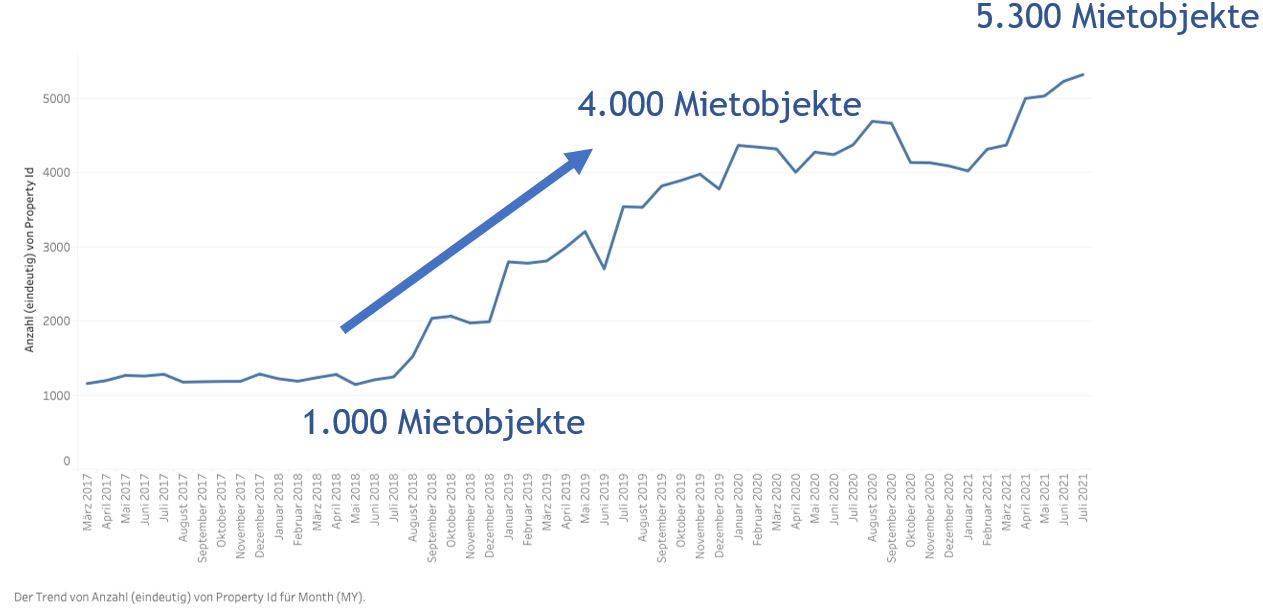
The data shows that Airbnb offerings have also increased significantly in Tyrol in recent years, rising from just over 1,000 rental properties to over 4,000 before the Covid-19 pandemic. Most recently, 5,300 rental properties were registered in July 2021.

Airbnb development Tyrol for download

In Tyrol, hotel beds account for over 50% of the total number of beds, but only around 15% of accommodation providers. Vacation apartments, on the other hand, account for over a third of the beds on offer, but just under 70% of businesses. The remainder is accounted for by private accommodation and other accommodation (camping, mountain huts, spa and recreation homes, etc.). In Tyrol, there is still the challenge that Airbnb offers are not shown separately in the tourism statistics of the provincial government and therefore it is not possible to draw conclusions from Airbnb beds to apartments or private accommodation - as in the official statistics. If this Airbnb supply is compared with the classic hotel bed supply, it can be seen that the hotel industry, with around 170,000 beds, has far more weight than the Airbnb beds with around 24,000 beds. This means that the beds rented out via Airbnb are roughly on a par with private accommodation and far below vacation apartments (commercial and private) with around 125,000 beds. This means that there are 7 hotel beds in Tyrol for every bed rented out via Airbnb (which in turn can appear in various accommodation categories in Tyrolean tourism statistics). There are 178 Airbnb listings for every Tyrolean resident.

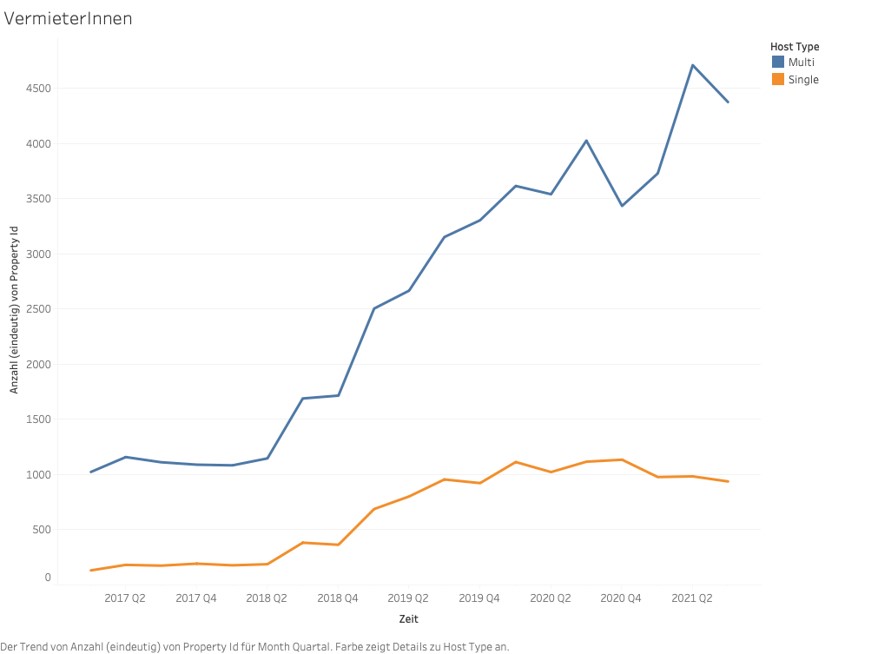
If we look at the Airbnb offer in detail, we see a majority of"multiple hosts". This means that one person rents out several units via Airbnb as opposed to a"single host", who only rents out one unit. This trend can also be seen in the long-term development, which has continued to increase over the years.

Airbnb Host type for download

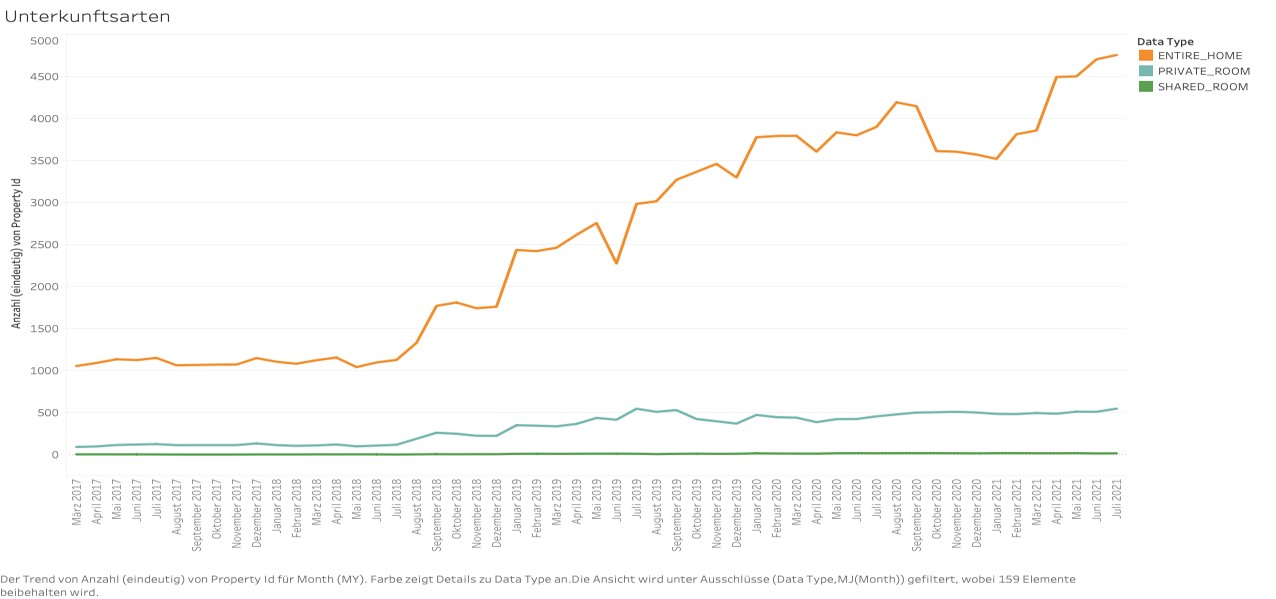
In terms of accommodation types, Airbnb distinguishes between fully rented units (Entire Home), individually rented rooms (Private Room) and individually rented beds (Shared Room). This shows the high proportion of fully rented apartments. Only very few rooms and hardly any individual beds are rented out. If the offer is differentiated again according to the type of accommodation, the clear dominance of vacation apartments becomes apparent. Categories such as houses, chalets, bed & breakfasts and glamping only play a minor role in Tirol.

Airbnb Unit type for download

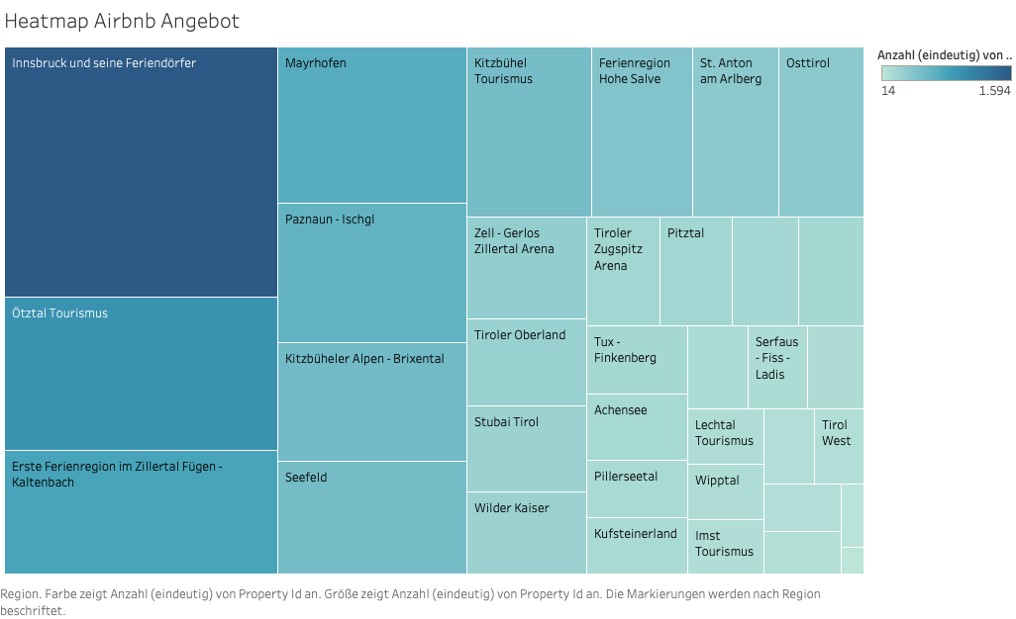
The spatial distribution of Airbnb listings according to tourism associations shows a clear concentration in the classic tourism-intensive regions. Most of the top 10 regions in the Airbnb listings are also in the top 10 of the classic overnight stay statistics, with the exceptions of Serfaus-Fiss-Ladis, the Wilder Kaiser and Stubai. While most Airbnb listings were found in Ötztal at the beginning of the analysis period, Innsbruck and its vacation villages dominated in 2019-2020. In July 2021, the three regions of Ötztal, Innsbruck Tourismus and the Erste Ferienregion Zillertal were roughly on a par.

Heatmap Airbnb offer

Many of the offers listed on Airbnb can also be found on other platforms, so-called cross-listings. The data provider Transparent registers the platforms Booking.com, Vrbo and Tripadvisor. 60% of the listings on Airbnb can therefore also be found on these booking platforms, the majority of them on Booking (51%), Vrbo (43%) and Tripadvisor (30%).

Conclusion

The high proportion of multiple hosts, the rental of entire units, as well as the many cross-listings and their concentration on the classic tourist regions from 2017 suggests that Airbnb rentals in Tyrol are handled very professionally and that it does not correspond to the original Airbnb idea of renting out your apartment in the meantime when you are on vacation or hosting a guest at your home for a fee. Only a very small contribution is made in Tyrol by private rooms and hardly any shared rooms. This data analysis thus comes to similar results as in Andorra or Switzerland (Domènech et al., 2019; Domènech & Zogal, 2020). It is therefore reasonable to assume that Airbnb is more of an additional sales channel for existing businesses than a means of creating new accommodation options.

Outlook

In order to be able to follow the development of Airbnb further and to be able to shed light on the demand side, there has been an innovation in the Registration Act since 2020 that if units are rented outside of one's own living area, they are considered commercial rentals. In addition, booking platforms have had to report their turnover to the tax authorities since 2021. This means that this data could also be systematically evaluated in the future, although this is currently failing due to the lack of data quality. From 2023, a new law on reporting on digital platforms will come into force in all EU member states. This includes higher penalties for platforms that do not provide adequate data quality. The first data is therefore expected in 2024.

Literature reference:

Domènech, A., Larpin, B., Schegg, R. & Scaglione, M. (2019). Disentangling the geographical logic of Airbnb in Switzerland. Erdkunde, 245–258. https://doi.org/10.3112/erdkunde.2019.04.01

Domènech, A., & Zoğal, V. (2020). Geographical dimensions of airbnb in mountain areas: The case of Andorra. Journal of Rural Studies, 79, 361-372. 10.1016/j.jrurstud.2020.08.051


Dr. Birgit Bosio

Position: University lecturer

Research focus: Tourism trends, Service Design, Cusomer Experience, Alpine Tourism, Sustainability & Tourism

E-mail: birgit.bosio@mci.edu

Monica Nadegger MA

Position: PhD student

Research focus: new forms of organizing, digitalization, communication, materiality & tourism

E-mail: monica.nadegger@mci.edu

Denise Fecker MSc

Position: PhD student

Research focus: winter sports tourism, leadership, employee retention, organizational commitment, new work

E-Mail: denise.fecker@mci.edu

Market research

Prepared for what lies ahead in tourism