
Prepared for what lies ahead in tourism
Stay up-to-date with current, independent statistics and information on tourism in the Alpine region.
 Inspiration

F.acT: Why are mires so important for biodiversity in Austria?

Felix Lassacher: Mires are a very complex construct (habitat) and take on a variety of functions. This also differs depending on the type of mires. Fens are supplied with water via groundwater or a watercourse and (usually) still have a low peat thickness. Raised bogs, on the other hand, are fed purely by rainwater and have a high peat thickness of sometimes 5-10 meters. As a rule, a raised bog develops from a fen. This means that when peat mosses grow, making the soil acidic and the bog grows above the groundwater level due to peat formation, it is no longer fed by groundwater but only by nutrient-poor rainwater. It becomes a raised bog. In the transitional stage, these are also referred to as transition mires, as they have aspects of both habitat types.
In terms of climate protection, they bind carbon. Mires cover around 3% of the earth's surface (land mass), but around 30% of the "earth-bound" carbon is stored in this habitat. In addition to the function of "carbon storage", mires also have the effect of evaporative cooling. On hot days, it can be up to 5° cooler on the moors. This cooling effect of moors is extremely valuable for the environment. In addition, moors purify water, which is very important for the water balance. In the course of the increasingly frequent heavy rainfall caused by climate change, moors can have a retention function. Moorland areas (especially fens and transitional moors) can absorb and retain water during heavy rainfall events and moorland areas can reduce surface runoff velocities due to their surface structures (Bult-Schlenken complex). In naturally water-saturated, functioning raised bogs, water retention through water storage is hardly possible.
They also play a decisive role for biodiversity, as they provide a habitat for rare plant and animal species. Here too, there are differences depending on the type of moor. Calcareous fens are the most "species-rich" fen habitats. They can be recognized, for example, by the cotton grass meadows or the abundance of orchids. Low alkaline bogs, on the other hand, are less species-rich due to their pH value and are comparable to raised bog complexes. Plants that develop here are highly specialized. They have to find nitrogen by alternative means, e.g. as carnivorous plants.
In addition to their function as a habitat, moorland areas (also due to their rarity, especially in the valley area) can be seen as valuable biotope networks, so-called stepping stones. Migratory birds, for example, find resting places and food on these wetlands.
F.acT: What is the state of the moors in Tyrol and Austria?
Felix Lassacher: Generally speaking, there is hardly any habitat type that is in such a poor state as peatlands. Peat was mined here until the 1950s. In the post-war period, it was primarily used as a heating material. Due to the emergence of alternatives such as oil, it was later only used for medicinal baths (moor baths) in a few areas, such as the Schwarzsee. For a long time, moorland was a disadvantage for agriculture as it required more work and was less productive. At the time of reconstruction after the two world wars, there were even subsidies for draining the moors (the aim was to create a 10th federal state). As a result of these developments, over 90% of the peatlands in Austria and Central Europe are now drained.
Today we still use peat as potting soil. However, this is now imported from the Baltic states and northern Germany. It is important to know that peatlands can be destroyed extremely quickly through drainage, but revitalization is extremely costly and time-consuming. On average, a moor only grows 1 mm per year. This is why more and more efforts are being made to revitalize moors.
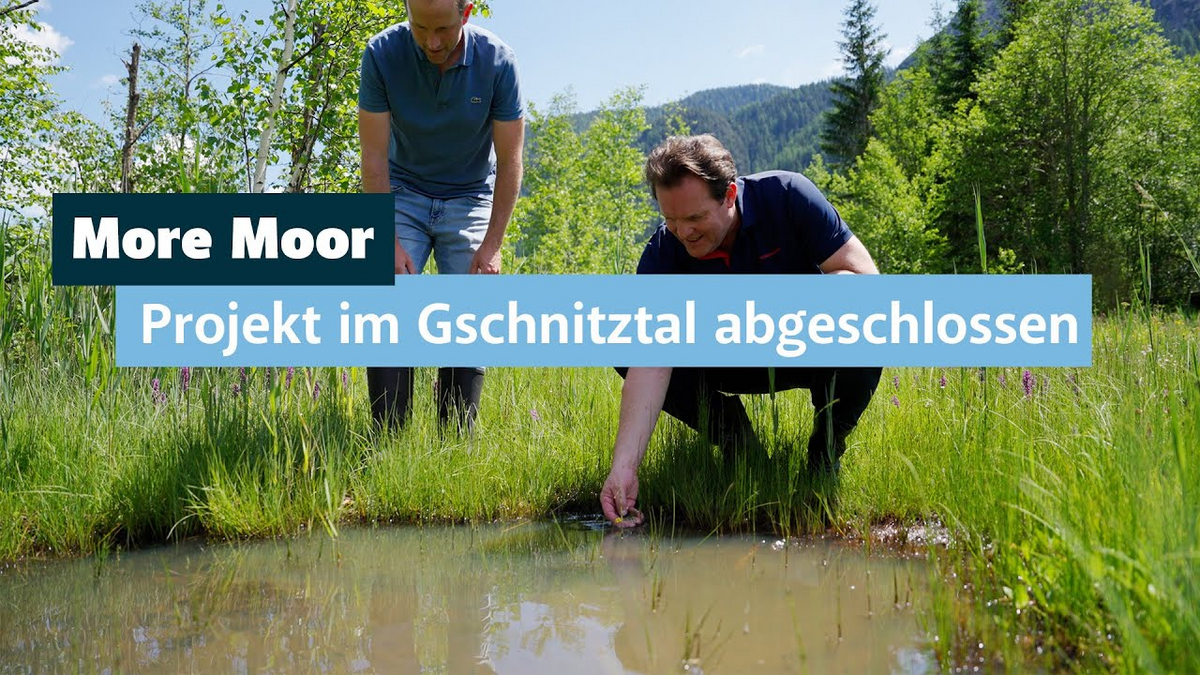
The importance of moors has long been known in research. The Karwendel moors were the first to be revitalized 20 years ago, making them one of the first in Austria. During the pandemic, a separate project was initiated by the provincial government to renature selected moorland sites. In consultation with the landowners, who are almost exclusively farmers, 10 hectares of moorland were revitalized throughout Tyrol(report submitted by the province of Tyrol). This required a lot of dialog and persuasion.
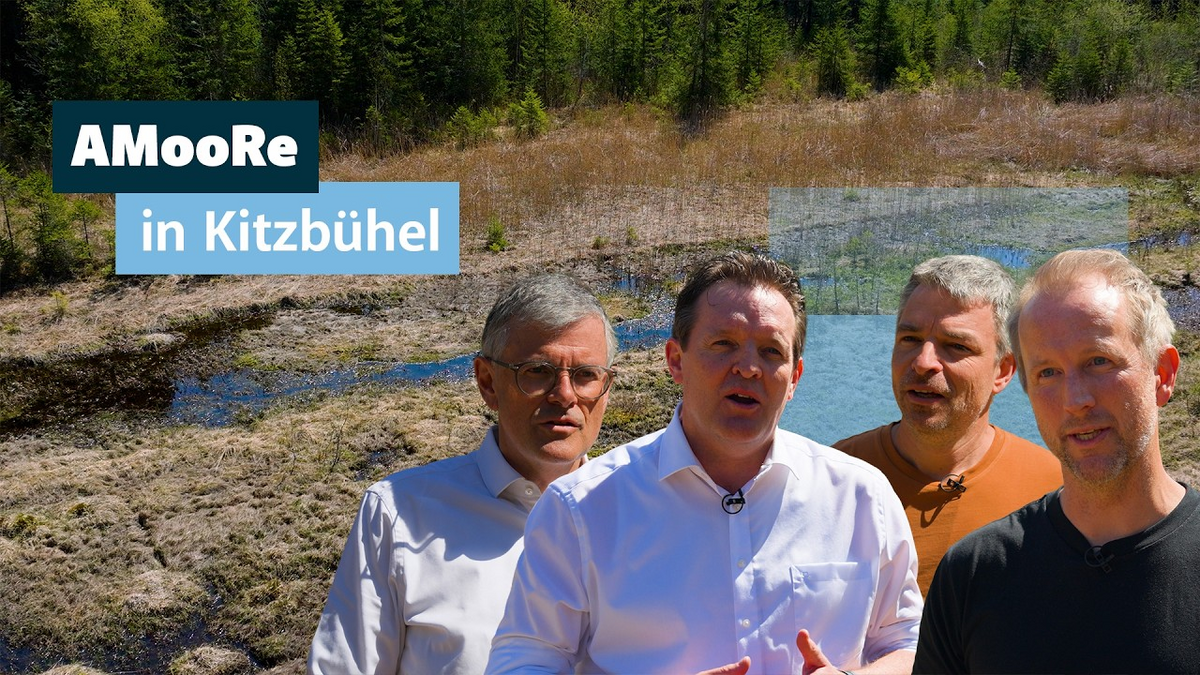
Nevertheless, we received a lot of encouragement for this project and it almost became a self-runner. This was followed by an Austria-wide moorland protection strategy 2030+, in which all the federal provinces were involved. This collaboration gave rise to the idea of writing the application for an Austria-wide EU Life project. In 2024, we were then awarded the contract for the EU Life project AMooRe with funding of € 44 million for the whole of Austria.
The revitalization of peatlands requires a lot of preparatory work (basic surveys). In addition to the installation of hydrological gauging stations - which record the water level in the moor for at least one year - the habitats must also be mapped and their deficits analyzed. The soil is also sampled and evaluated. The revitalization measures are then defined on the basis of this fundamental data. There is no "one fits all" solution here. This is followed by long-term monitoring, where the vegetation is also recorded, soil samples are taken and levels are recorded in order to continuously monitor the condition of the moor.
We have had great success so far. The revitalization is working very well and we are getting good feedback from the landowners. The University of Innsbruck will also carry out targeted measurements of greenhouse gases. The aim is to determine at what point a damaged moor becomes a "CO2 reservoir" again through revitalization measures. In any case, overwatering of the moor area must be avoided. In this case, a peatland would emit methane, another climate-relevant greenhouse gas. Peatlands must remain climate-friendly in the future due to changing climate conditions.
F.acT: How can tourism actively support peatland restoration?
Felix Lassacher: In general, there needs to be much more awareness and knowledge about the importance of peatlands. We are therefore happy to have any partner who thinks about the issue of peatlands. This can take many different forms. We are currently working together with Sonntag.plus and Natopia on increased public relations and awareness-raising for the Kitzbühel region (AMooRe focus 2026). In a first step, the target group is school classes, but in further steps, municipalities and tourism associations as well as landowners (farmers). Many municipalities already have information about peatlands in their municipal area and display this on their websites. A link to the AMooRe project is also desirable here.
Tourism associations can also support the topic. On the one hand through information and event formats for guests and locals, but also through volunteer projects such as in the Karwendel Nature Park (Team Karwendel). They can also play an active role in revitalization, as was the case with the Reither Moor near Seefeld. Moors still play a relatively minor role in the visual language of tourism advertising. This could also be a starting point. In some regions, such as in the Ehrwald basin, a viewing platform over the Rossmoos is also planned together with the municipality. A visitor platform is also to be built in the Wildschönau and connected to an existing hiking trail. This is another way of making moors accessible without damaging them and at the same time imparting knowledge via information boards. Excursions are also planned for the future. We are also planning a stronger exchange with the Climate Alliance and the KLAR regions. Good work on the topic of moors is already taking place in some regions. It is also interesting to see that we are constantly receiving private sponsors from a wide range of sectors who would like to support our projects financially. Anyone who is interested is welcome to contact me. The AMooRe project will run until 2033 and we still have a lot to do.