Prepared for what lies ahead in tourism
Stay up-to-date with current, independent statistics and information on tourism in the Alpine region.
 Inspiration

F.acT: Why is the topic of calculating the climate footprint at destination level relevant for Switzerland?

Christian Baumgartner: Climate change is currently one of the biggest challenges facing society, and of course it also affects tourism. According to a government resolution, Switzerland should not emit more greenhouse gases by 2050 than natural and technical reservoirs can absorb. This means net-zero emissions by 2050 and this also applies to tourism. Concrete concepts on how to achieve net-zero emissions in tourism do not yet exist, and Switzerland's "Long-term climate strategy" (Federal Council, 2021) does not specifically address tourism. The three Graubünden destinations of Arosa, Davos and Valposchiavo are now facing up to this responsibility and - with the support of myclimate and the Graubünden University of Applied Sciences - are looking for a model approach to comprehensive climate protection in tourism.
F.acT: What exactly is your research project about?
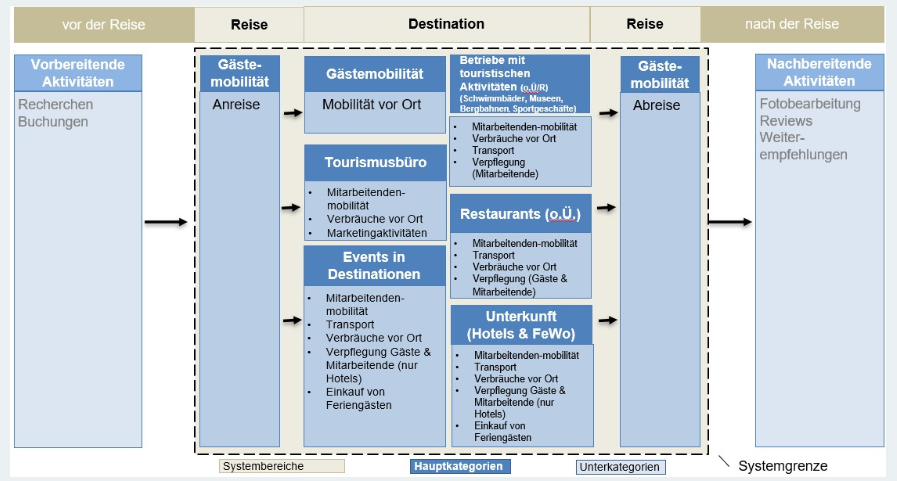
Christian Baumgartner: With the research project, we want to create a method for the comprehensive calculation of the tourism climate footprint for the three model regions of Arosa, Davos and Valposchiavo, as well as ongoing monitoring through modeling. At the same time, we are also developing a model for the comprehensive systematic reduction of the climate footprint in a comprehensive partnership between the destination and service providers. The climate-relevant measures not only represent a (climate) policy necessity, but in many cases can also lead to a reduction in the operating costs of the service providers. This model is intended to offset the unavoidable emissions through regional (CDM-compatible) measures. At the same time, we are investigating which suitable instruments in sustainability communication and incentive mechanisms ('nudging') can be used to win over real and potential guests as allies for climate neutrality. In this way, climate neutrality can also be used as an awareness-raising measure for guests and as an important marketing argument for the positioning of destinations. In the calculation, we attach importance to completeness and relevance, applicability and minimum accuracy. In addition, a geographical delimitation and a system delimitation are carried out. Where available, the data is carried out as a complete survey, in some cases collected as examples and extrapolated for the destination.
F.acT: What challenges do you face when collecting data?
Christian Baumgartner: On the one hand, this concerns the calculation of travel to and from the destination, which accounts for the majority of emissions (German Environment Agency, 2020; UNWTO & ITF, 2019). At the same time, there is very little systematically collected data in this area. Current destination certifications such as the Austrian Ecolabel (2023) or TourCert Austria (2023) set a mandatory criterion for their collection. The optimal solution for recording travel mobility would be to introduce the means of transport section on the registration form. If the home address and the means of transport are available, useful calculations can be made with statistical figures on the distribution between electric, petrol and diesel cars or average consumption and emissions. However, as this does not yet exist, we have to resort to approximate calculations such as random surveys and extrapolations or the analysis of cell phone data. Initial trials of the latter are currently underway in Arosa with the support of 42hacks and Swisscom (42hacks, 2023).
Unlike in commercial accommodation, there is no obligation to register in - private - vacation apartments. Therefore, there is hardly any robust data on occupancy times, which, in conjunction with the sometimes very high density of vacation apartments in some destinations, leads to major inaccuracies in both the emissions of the accommodation and the mobility data. At this point, the project provides for extrapolations from average occupancy times (FSO, 2023) in combination with random surveys in the respective destination.
As soon as the climate footprint survey has been rolled out across the board, double counting in neighboring destinations must be avoided. For example, the local mobility of an overnight guest in one destination could be counted as day tourism in the neighboring destination. In principle, emissions caused by activities that take place outside the destination should not be counted in the system boundary of the destination. These emissions then belong to the system boundary of the neighboring destination or where the day tourism took place.
Q.acT: What strategies and recommendations can be derived from the results?
Christian Baumgarnter: The defined goal is climate neutrality for the participating destinations. We speak of climate neutrality when human activities have no net impact on the climate system. To achieve such a state, the remaining emissions must be offset by the removal of emissions (carbon dioxide) and the regional or local biogeophysical effects of human activities that influence, for example, the surface albedo or the local climate must be taken into account (IPCC, 2018).
The KlimDest project promotes the avoid-reduce-invest decarbonization approach. The aim is to avoid CO2e emissions wherever possible or to continuously reduce the CO2e footprint with active measures in the destination and with service providers. Responsibility is taken for unavoidable CO2e emissions by investing in climate protection projects. In the medium and long term, the destinations should pursue a net-zero target.
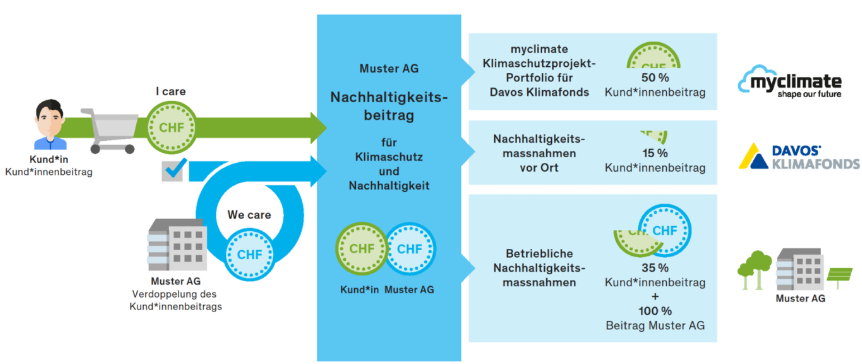
The myclimate "Cause We Care" programme makes it possible to consistently pursue the decarbonization approach both at destination level and with individual service providers. Guests and customers are offered the opportunity to voluntarily make an additional carbon offset contribution when they stay overnight, make a purchase or purchase a service. If this climate protection contribution is paid, the company from which the service was purchased doubles the amount. The doubled amount flows into the service provider's own sustainability fund and can be used for ecological sustainability measures within the company itself.
In addition, climate protection projects are supported in order to implement the use of renewable energy, energy efficiency measures or the reduction of methane emissions. Another focus is on climate communication with guests. Based on surveys in Arosa, we know that 70% of guests are willing to pay for compensation for transport-related emissions. However, they prefer local to global compensation projects on other continents. The nudging approach plays a central role here. Information must be presented simply and attractively, and compensation offers must be integrated directly into the booking process. The offsetting offer should give consumers the option of splitting their offsetting between different projects. In this way, both groups can be reached and an overall greater willingness to participate in offsetting can be achieved.
The implementation of the recommendations could lead to a significant increase in the offsetting of transport-related emissions in tourism by combining different types of intervention. This would not only be an important step for the destination of Arosa to achieve its goal of climate neutrality, but also for the reduction of global atmospheric emissions. Once again, it has been shown that the concept of offsetting has great potential and ways can be found to utilize it by engaging tourists as allies in the fight against climate change. There is no single solution to solve the climate crisis, but a combination of sophisticated, multifaceted, complementary measures can make a decisive difference.