

Prepared for what lies ahead in tourism
Stay up-to-date with current, independent statistics and information on tourism in the Alpine region.
 Research

F.acT: Why is this topic relevant for the Tyrolean tourism industry?

Elisa Neubauer: The internet has significantly changed the distribution of products in the tourism industry. Consumers have a variety of different online channels at their disposal to search for information and buy tourism products. Online booking platforms have become increasingly important in recent years. Despite the efforts of hotels to increase direct reservations via their own hotel websites, the online booking platform Booking.com dominates the European market for hotel bookings. Although a listing on Booking.com can increase one's own visibility in the market, the cooperation is viewed critically due to the often high commissions. Consumer behavior in online hotel bookings is therefore also relevant for the Tyrolean tourism industry.
F.acT: What role does the concept of "consumer empowerment" play in the context of online hotel bookings?
Elisa Neubauer: The concept of "consumer empowerment" is playing an increasingly important role in the context of online hotel bookings because consumers are increasingly demanding personalized products and services. Offering the opportunity to customize and tailor the hotel stay according to individual wishes and preferences at the time of booking can give an online booking channel a competitive advantage over the competition. Personalization options also give consumers a certain amount of control over the booking and decision-making process and can ultimately lead to higher customer satisfaction.
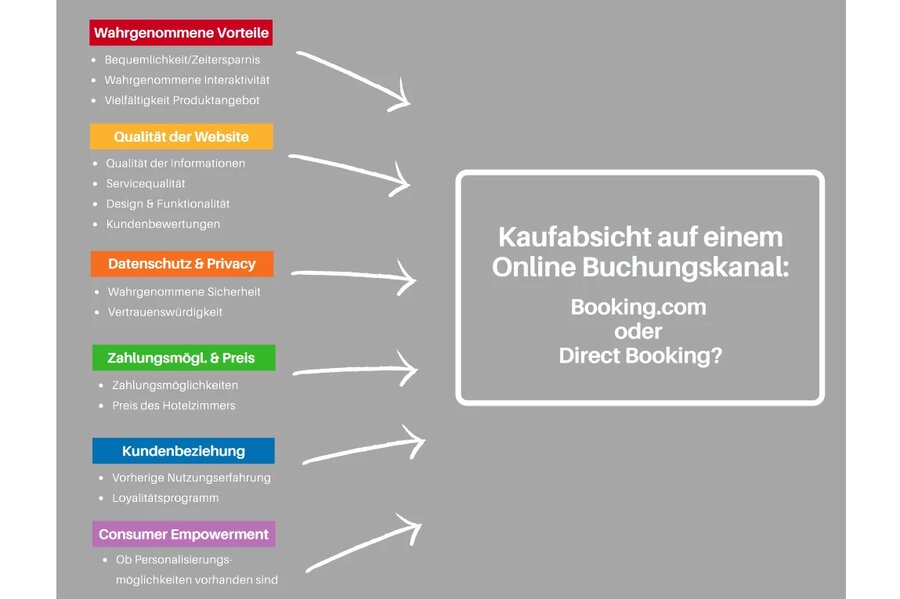
F.acT: What are the core results of your work?

Elisa Neubauer: As part of my master's thesis, I investigated how six different factors (see Figure 1) influence consumers' decision to book either directly via a hotel website or via Booking.com. An online survey was conducted and out of 180 participants, mostly from South Tyrol, Germany and Austria, 140 used Booking.com and 40 used a hotel website to book their last hotel stay.
Decisive factors for the choice of booking channel
The results of the online survey showed that Booking.com users prefer the booking platform, as booking is perceived as more time-saving, more convenient and more exciting and also offers a wider range of products. Other decisive factors for both booking channels were previous experience of using the channel, i.e. familiarity with its booking process, loyalty programs offered and the ability to save personal data and preferences on a profile for future bookings.
Consumer empowerment in online hotel bookings
The concept of "consumer empowerment" and the personalization options for the stay were also examined in more detail as part of the empirical study. Even though this factor did not significantly influence the choice of one of the two booking channels, 61% of participants still felt it was important to have the option of tailoring their stay to their needs and preferences at the time of booking. In this context, 79% of participants stated that they would like to choose the location of the hotel room in the hotel. 58% stated that they would like to be able to choose wellness services during the booking process and 47% would like to be able to choose personal preferences for meals. Adding additional products or services to the hotel booking was perceived as less important, with the three most frequently mentioned additional services being hotel transfers (mentioned by 71%), public transport tickets (59%) and excursions (51%).
F.acT: What significance do the results have for providers of tourism services/products and what specific recommendations for action do you make in your Master's thesis?
Elisa Neubauer: According to the results of this study, providers of tourism services and products should ensure a simple, time-saving and user-friendly booking process. Interactive features, such as virtual views or virtual tours of the hotel or a destination, can lead to a website being perceived as more exciting. Attention should also be paid to offering loyalty programs as well as the option to create personal data and preferences for future bookings on a personal guest profile. The ability to personalize the stay is especially perceived as positive if it is accompanied by increased convenience/convenience and does not involve additional effort, including adding additional services to the hotel booking.