
Prepared for what lies ahead in tourism
Stay up-to-date with current, independent statistics and information on tourism in the Alpine region.
 Research

F.acT: Why is this topic relevant for the Tyrolean tourism industry?

Victoria Albertini: The Alpine region and Tyrol are characterized by numerous community model destinations in which many independent players - from tourism associations and mountain railroads to hotels, restaurants and municipalities - work together to shape the tourism offering. These decentralized, non-hierarchical structures make decision-making processes increasingly complex and place high demands on cooperation, coordination and leadership, which must ensure a common goal.
My master's thesis makes a valuable contribution to understanding how strategic decisions are actually made in practice in destinations with numerous stakeholders and what role informal interactions and processes play in this.
F.acT: What methodological approach did you use in your work?
Victoria Albertini: A qualitative, explorative research approach was chosen in order to gain the best possible insights into the decision-making and consensus-building processes in the management network of the destinations studied. The study is based on eleven guided expert interviews with key decision-makers from the Tyrolean destinations of Stubai and Innsbruck, including political representatives, executives and officials of the TVBs as well as stakeholders from booking-relevant providers in the destinations.
The interview data was analyzed using qualitative content analysis according to Kuckartz.
F.acT: What are the core results of your work and what significance do they have for tourist destinations and businesses?
Victoria Albertini: The results show that decision-making processes in the management networks of destinations are increasingly based on an interplay of formal and informal structures: Informal discussions in small groups serve to prepare formal decisions by collecting ideas, coordinating positions and building consensus. Only then are decisions officially adopted in formal bodies - such as the boards of the TBVs or political committees. This indicates a hybrid decision-making process, whereby clear boundaries between formal and informal structures are not always recognizable. Based on the results, I was finally able to derive a four-stage funnel model to illustrate the decision-making processes in tourism management networks, which shows a typical sequence of dynamic decision-making processes and the interplay between informal decision preparation and formal decision-making.
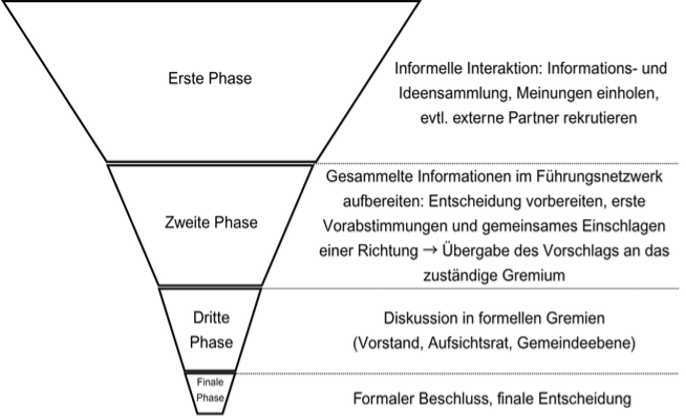
Victoria Albertini: Shared and uniform objectives and a high level of trust between the stakeholders make decision-making processes and consensus-building much easier. For the stakeholders in the destinations, this means that informal networks are not a contradiction to professional leadership, but rather a necessary complement to it.
F.acT: What specific recommendations for action do you make in your Master's thesis?
Victoria Albertini: Based on the results, eight recommendations for action were developed to optimize decision-making processes and for effective collaboration in management networks in destinations:
Establish common, shared goals as a strategic foundation to guide future decisions.
Promote trust as a social infrastructure, as trust is a basis for open communication and consensus-oriented cooperation. Trust must be built up in a targeted manner.
Integrate reflection and learning processes, for example by integrating structured feedback and learning processes in order to continuously develop the network.
Adapt governance structures to the context of the destination: Structures, committee sizes and decision-making channels should be adapted to the respective circumstances of the destination.
Involve external players at an early stage in order to identify potential problems or conflicts as soon as possible.
Professionalization through digitalization, with inter-organizational systems that increase the efficiency and transparency of decisions and enable structured planning, coordination and information exchange.
Dealing professionally with personnel changes, both new hires and departures.
Strengthening diversity and bridging functions, as diversity enriches the network and knowledge, perspectives and the interests of different groups are brought into the management network.
These recommendations are intended to increase the quality, transparency and legitimacy of decision-making processes in management networks, sustainably improve cooperation and thus promote innovative and resilient destinations.