

Prepared for what lies ahead in tourism
Stay up-to-date with current, independent statistics and information on tourism in the Alpine region.
 Research

F.acT: Why is this topic relevant for the Tyrolean tourism industry?

Kai Bader: Digitalization and effective marketing are inextricably linked today. Traditional marketing activities are no longer effective without the addition of digital marketing. However, according to the Digital Dossier published by the Federal Ministry for Digital and Economic Affairs (BMDW), only 34% of Austrian SMEs use search engine optimization and only around a quarter use digital advertising measures such as Google Ads. The hotel industry is also seriously lagging behind in the area of digital communication and digital marketing.
Small and medium-sized tourism businesses, which include the majority of Tyrolean companies, are particularly affected. This is problematic because travelers today prepare and make their purchasing decisions primarily via digital channels. A strong and sustainable competitive position therefore depends crucially on the online presence of hotels. But there is a "digital divide" here, which manifests itself in the thoroughly digitalized decision-making processes on the customer side and the still rather traditional marketing mindset on the company side. My intention with my master's thesis was to create an empirical basis for gradually narrowing this gap.
F.acT: What are the core results of your work and what significance do they have for hotel companies and political decision-makers?
Kai Bader: Based on an empirical sample of 219 Tyrolean SME hotels, I was initially able to prove that Tyrolean SME hotels predominantly use digital marketing with a medium intensity. On average, they use five marketing channels. However, the range is high at 13: there are hotels that only use one or two digital marketing channels. Others, on the other hand, use up to 13 different channels simultaneously. The following finding is also interesting: 75% of the hotels surveyed have their digital marketing channels (partially) managed externally. Only a quarter implement digital marketing completely in-house.
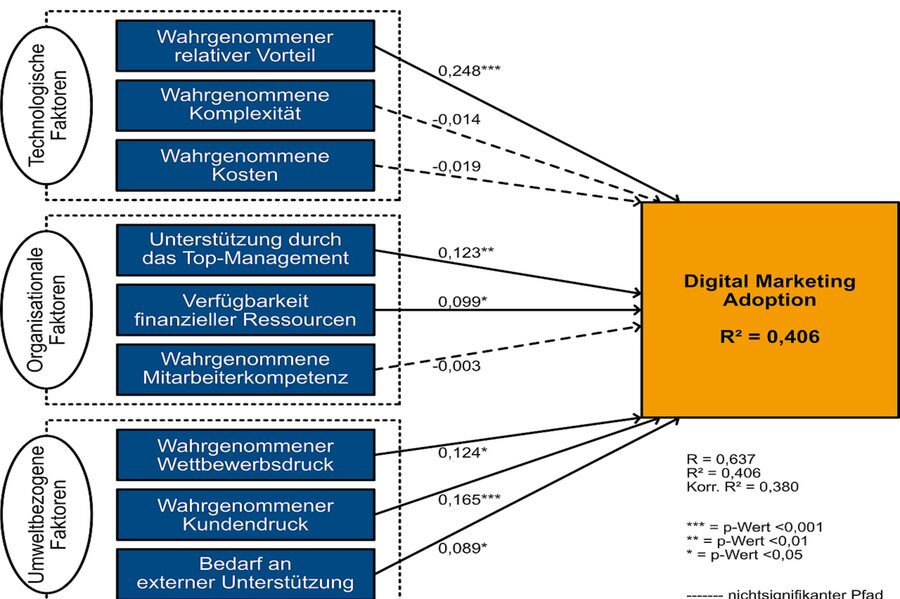
In my study - as the title of my work suggests - I looked for factors that would allow me to predict whether a hotel would use digital marketing or not. I examined a total of nine such factors. And I was able to show that six of them have a significant impact on the adoption of digital marketing (see Figure 1).
Organizational and environmental factors have the greatest influence on the adoption of digital marketing. In the organizational context, the factors support from top management and the availability of financial resources proved to be significant. In addition, all three environmental factors examined, i.e. perceived competitive and customer pressure and the availability of external support, were significant predictors. With regard to the technological context, perceived relative advantage was found to be a significant driver for digital marketing.
Based on the study results, decision-makers can develop measures that effectively promote the introduction of digital marketing in Tyrolean SME hotels.
F.acT: What specific recommendations for action do you make in your Master's thesis?
Kai Bader: First of all, the study results highlight the central role of managers. An important task is therefore to sensitize management staff to the benefits of digital marketing. I was also able to show that a lack of employee skills, for example, can lead to a dependency on external service providers. Investing in training programs to improve the skills of your employees in dealing with digital marketing is therefore recommended.
There is also a need for measures on the political side. For example, the expansion of subsidies for digital marketing or the organization of attractive financing options for investments in digitalization measures. Another focus should be the creation of offers for further and advanced training in the context of digital marketing. Managers in particular should be considered as a target group, as they set the course in the company and therefore need to be convinced first.