
Prepared for what lies ahead in tourism
Stay up-to-date with current, independent statistics and information on tourism in the Alpine region.
 Inspiration
The course schedule for the 2nd semester Master's in Entrepreneurship & Tourism at MCI Tourism includes the course "Service Design". Even though many students have already heard of touchpoints, customer journeys or personas, few have an exact idea of what to expect in this course. Four lecturers have been teaching this course for 6 years now. Two of them have made service design their profession and work daily with global companies to improve their services and products, while the other two have a scientific background. This mix and the opportunity to plan and teach this course together offers many advantages.
Since last year, when MCI Tourism switched to online teaching at the beginning of the summer semester due to the corona crisis and we as a team of lecturers had exactly one day to make this switch, this format has already been carried out online for the second time in 2021. In order to offer students as real a situation as possible, it has always been our aim to work with real partners. This year it was the Knappenwelt in the Tyrolean lowlands, an outdoor mining museum in Tarrenz near Imst, which often reached its capacity limits due to the association structure and the involvement of many volunteers. The students' task was to work out improvements for the Knappenwelt in the course of a 3-day service design sprint while working to a very tight budget.
Following the Double Diamond, the students were given a brief theoretical introduction to the topic of service design at the beginning, as well as an initial introduction to Miro, an online tool for collective teamwork. This tool contained the entire structure of the course, presentations, links and workspaces for the individual groups. After an introduction to the miners' world by Jürgen Kiechl, the students began to sift through journal articles prepared by us lecturers on the subject of museums and staging as well as videos and links to the miners' world (DISCOVER).
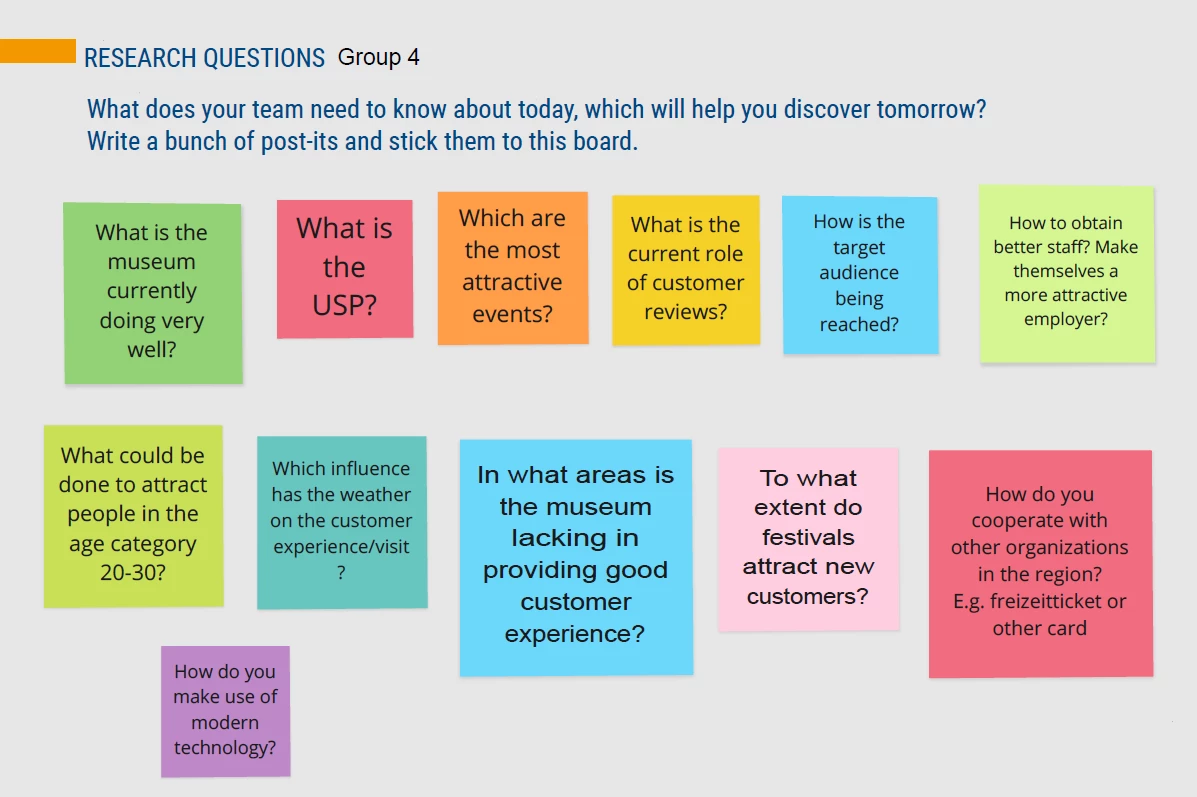
In addition to initial desk research, interviews were also conducted with members of Knappenwelt in breakout rooms. This enabled the students to better understand the current situation and identify problems. The first task was to record problems in the miners' world on the basis of figures, data, facts and findings from the interviews on digital research walls in Miro in order to derive research questions. Since it is not always clear from the outset what the actual problem is, you should make sure that you want to solve the right problem (DEFINE).
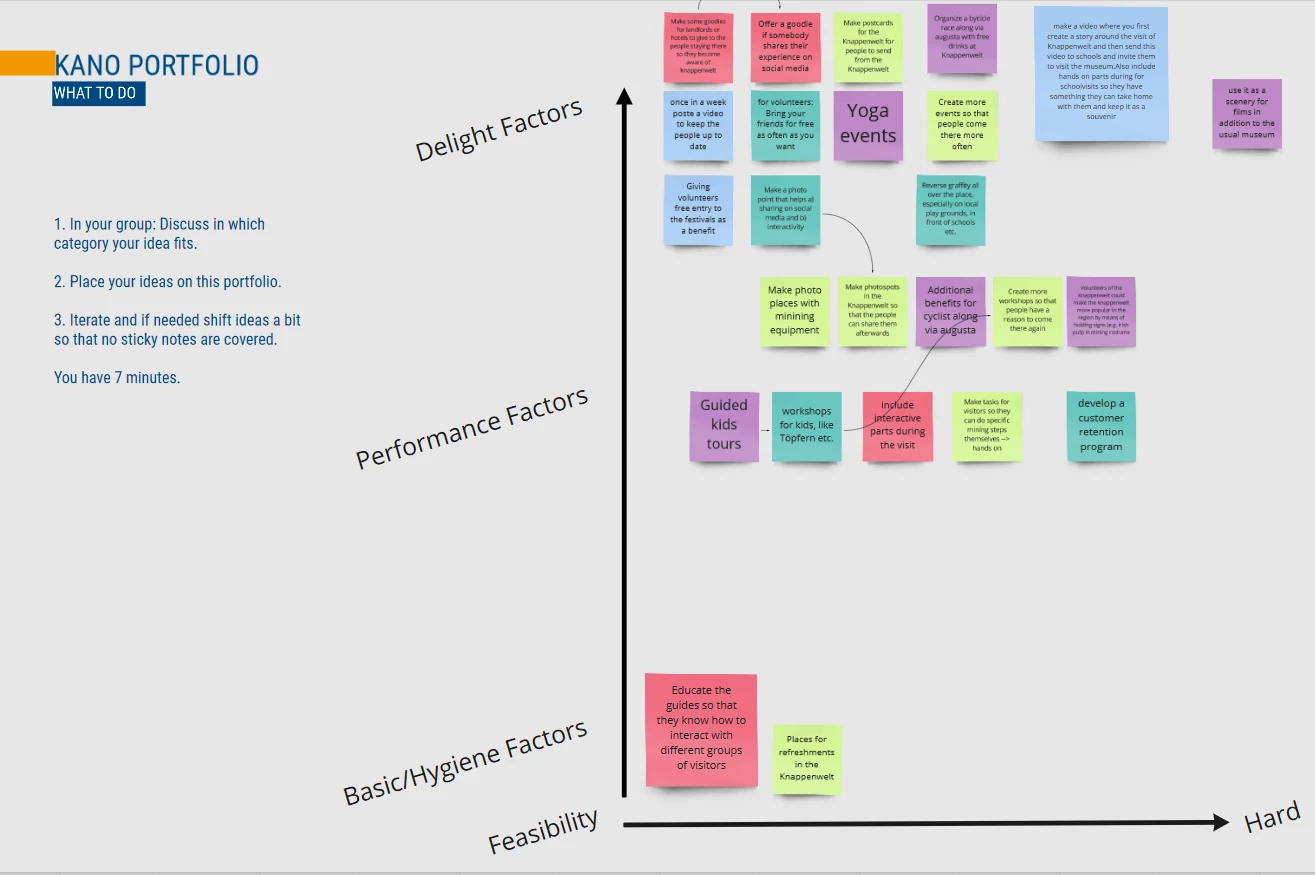
After the students had spent a long time working on the problem itself, we only then moved out of the problem space and into the solution space. This is easier said than done, as the students often already had the "right" solution at hand when working on the problem. At the beginning of the ideation process, we used our swarm knowledge and created as many ideas as possible with the help of the Crazy 8. No obstacles should be placed in the way of creative thinking in order to produce as many different ideas as possible in a short space of time. These ideas were then divided into a matrix using the Kano model. At least two of these ideas were selected as the basis for further prototyping (DEVELOP).
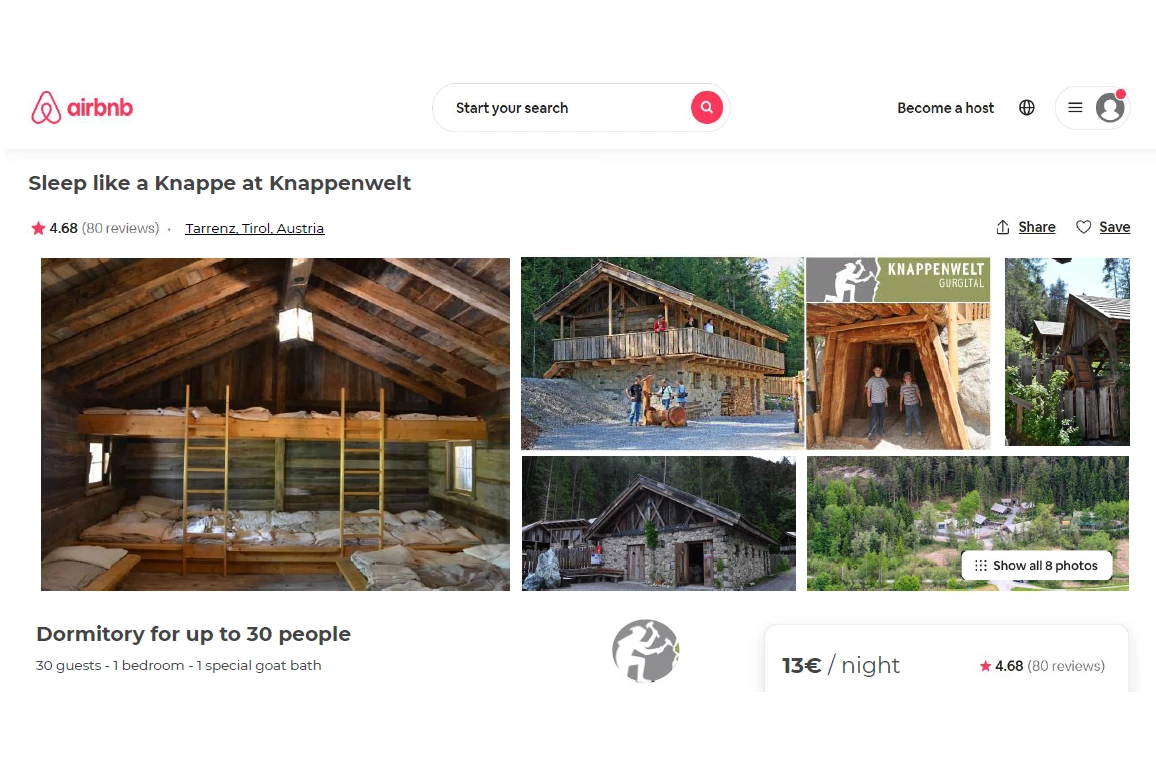
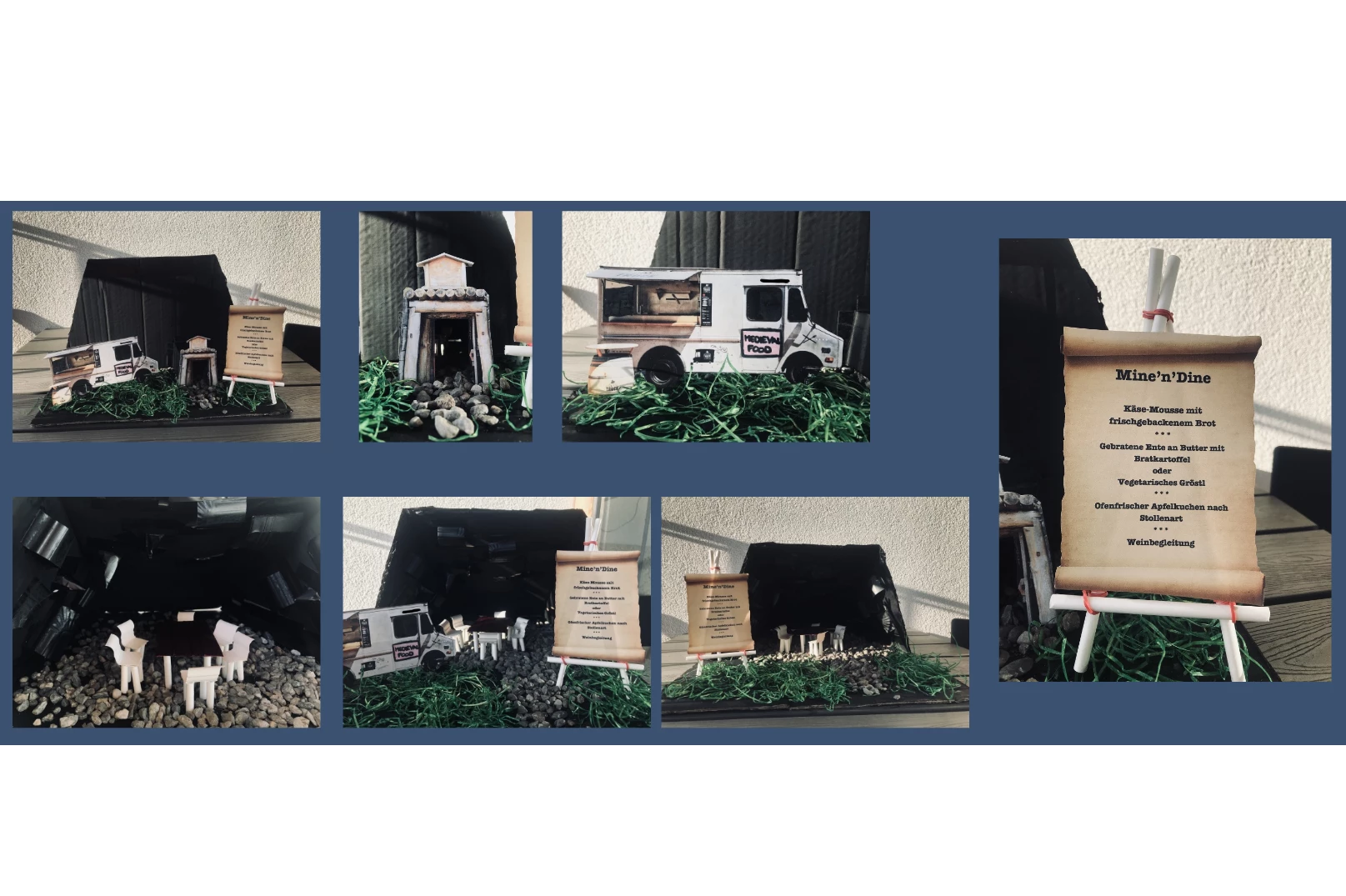
The aim of prototyping is to concretize the idea and make it tangible so that it can be tested in a further step. Students were able to try out different types of prototyping such as service ads, desktop walkthroughs, investigative rehearsals or wireframes for digital services. In several test rounds, students were able to try out their ideas and obtain valuable feedback from families, friends, acquaintances, fellow students or the experts at Knappenwelt and adapt and develop them accordingly. This very quickly revealed real weaknesses and new aspects, which even led to the realization that some ideas simply didn't make sense (fail fast, fail cheap). The ideas included renting out the location via Airbnb, escape games in the mine, Mine'n'Dine offers, food truck festivals and culinary concepts for the lack of on-site gastronomy, the miners' crew card as an incentive for volunteers, a better connection of the Knappenwelt to the Gurgeltal cycle path, blacksmith workshops where you can create your own souvenirs or even an engagement or wedding ring, a murderous dinner party, an improved social media presence or a Knappenwelt shuttle for better connections.
At the end of the course, there was a 3-minute pitch in which each group was allowed to present the process from problem to solution to the members of the Knappenwelt. It was great to see how many creative and, above all, feasible ideas were brought to life in a very short space of time.
"Wow, so many ideas. We had already thought about some of them ourselves, but many others were new." (Maria Schwarz)
"It was really surprising to see how much professionalism and energy the students brought to the course. Even during the break, the thoughts continued and we discussed various ideas. " (Jürgen Kiechl)
"Great ideas, all of them. They all have a solid basis." (Werner Kräutler)
"Hats off to the passion and energy that was put into this short time." (Iris Rataitz-Kiechl)
"Full of strengths in all 12 project ideas. Although as many of the projects as possible can be put into practice. The students have invested an incredible amount of passion and brainpower." (Peter Hild)
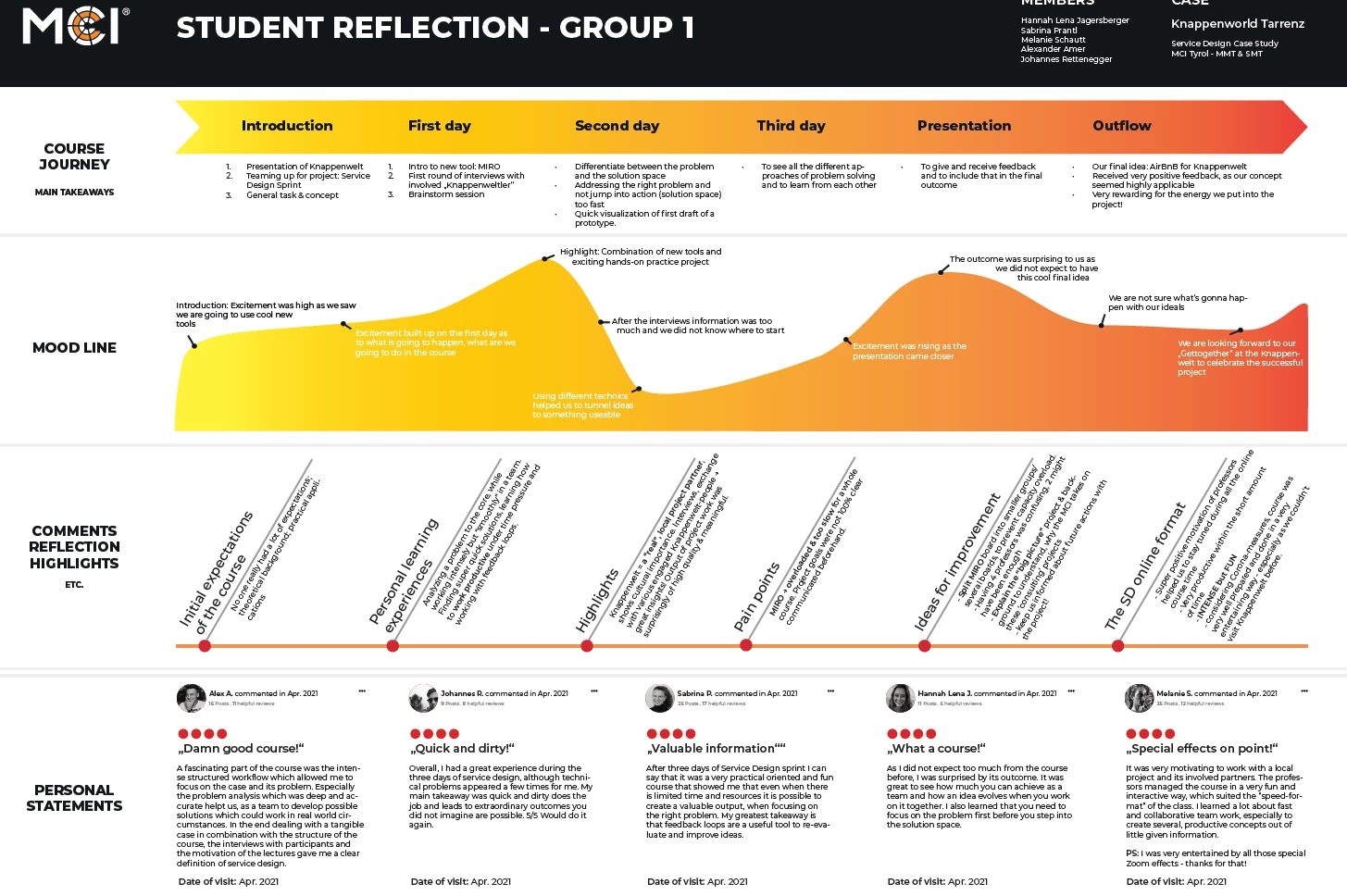
After three extremely intensive days, it was important to let the whole thing sit and take effect. In a subsequent Student Journey, the students reflected afterwards in a creative form - as a video, Prezi or Journey Map - on their learning experience, the most important insights, but also highlights and pain points. Students appreciated the interactivity of the course, the collaboration with Knappenwelt and, above all, the people behind it. Being able to actively work on a real project rather than producing something for the drawer gave the students additional motivation. Some of them were even surprised by their own creativity. However, the sprint format was also very demanding and students had to work under great time pressure. The students also learned how to let go of perfectionism and thus achieve greater efficiency.
"It was challenging, captivating, interesting and educational at the same time." (Master's student)
"Dealing with a concrete case in combination with the structure of the course, the interviews with the participants and the motivation of the lecturers gave me a clear definition of service design at the end." (Master's student)
"We found it great to see how the same process led to so many different perspectives on the task and in the end to so many different elaborations."
With this in mind, we would like to thank Knappenwelt for the great collaboration, our two service design experts Klaus Schwarzenberger from More than Metrics and Markus Hormeß from WorkPlayExperience and, of course, the students for their commitment.
Hopefully in the fall, the situation will allow us to get to know each other personally and, as a thank you from Knappenwelt, a meeting on site in Tarrenz with the students and those responsible at Knappenwelt will be possible. The students will then be able to see the initial implementation of their ideas for themselves.