

Prepared for what lies ahead in tourism
Stay up-to-date with current, independent statistics and information on tourism in the Alpine region.
 Research

F.acT: Why is the topic of "overtourism" relevant for the Tyrolean tourism industry?

Marion Mitterstätter: Income from the Tyrolean tourism industry accounts for an estimated 17.5% of the province's total gross value added and is therefore of great importance to the economy as a whole. In order to secure this income in the long term, sustainable tourism development is essential for Tirol. Anyone who deals with the topic of tourism trends has certainly come across the term overtourism several times. It has been used in literature and the media since 2016 to draw attention to the problem of "too much" tourism. Overtourism is therefore fundamentally based on the assumption that the intensity of tourism is too high. However, a closer analysis of the literature reveals that the meaning of the term is much broader and more complex. In addition, the phenomenon is usually associated with popular urban destinations such as Barcelona and Venice. In contrast, there is very little literature on overtourism in rural destinations, although a boom in rural tourism is to be expected due to various developments, such as the trend towards active and cycling vacations. In order to enable sustainable tourism development in Tyrol, it is necessary to better understand overtourism and the resulting problems for the local population in rural destinations.
F.acT: What are the core results of your work?
Marion Mitterstätter: In order to answer the research question, a quantitative study was carried out on the tourism awareness of the local population in a rural destination. Similar to Tyrol, my home region of Überetsch-Unterland in South Tyrol is also a rural destination, which is why the survey was conducted there. Locals from two municipalities with different levels of tourism intensity were asked about their perception of the effects of tourism.
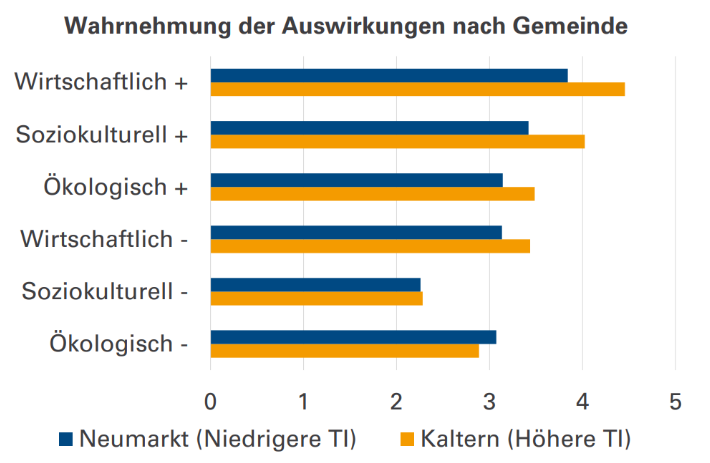
The results showed that people who live in the municipality with the higher tourism intensity and are therefore more likely to be affected by overtourism in their main environment have a more positive attitude towards tourism than people from the other municipality. Due to this result, contrary to expectations, tourism intensity is not a suitable objective measure to determine overtourism. In addition, the results showed that some negative impacts of tourism are perceived more strongly by locals than others, making them the main risk factors for overtourism in the rural destination. These are increased traffic and parking problems, selective overcrowding in the destination, rising land and property prices and an increase in the general cost of living.
What specific recommendations for action do you make in your Master's thesis?
Marion Mitterstätter: The results of the empirical studies show that overcrowding is a major risk factor for overtourism in the destination. This results in the recommendation to carry out frequency measurements in order to be able to measure and observe overcrowding with tangible data. This applies not only to well-visited places and attractions, but also to traffic on busy roads. These measurements will then be used to develop visitor guidance programs. The aim is to distribute tourists more sensibly in terms of time and space and thus counteract overcrowding and traffic problems. The perceived price increases, which the locals blame on the development of tourism, are to be checked for their actuality. This review should then be followed by awareness-raising among the local population. Residents should be informed about whether, why and how the rising cost of living is occurring. This transparency should improve the attitude of locals towards tourism. The responsibility for the above-mentioned recommendations for action should be sensibly distributed at regional or municipal level. Effects that affect a larger area, such as the increased cost of living, should be dealt with at regional level. The destination management organization and the regional government are important players here. At municipal level, it is primarily the tourism associations that should implement these implications.
As tourism intensity was identified as an unsuitable measure of overtourism in this study, it is also recommended that other objective determinants of the phenomenon be found in order to recognize it at an early stage.