
Prepared for what lies ahead in tourism
Stay up-to-date with current, independent statistics and information on tourism in the Alpine region.
 Project
The Wipptal and its side valleys are an insider tip for locals for hiking, ski touring and tobogganing. However, the region is little known, especially among young visitors. Students in the 2nd semester Master's in Entrepreneurship & Tourism dealt with this challenge. Instead of just learning about the theory behind the service design approach and the concepts, methods and processes behind it, the students in the "Service Design in Tourism" seminar worked on a specific practical project and experienced what a service design process can look like.
Over three days, the students go through a service design sprint and start with an initial introduction to the topic of service management and some of the concepts behind the approach and the question of how they are differentiated. This is where the theoretical input ends. The focus quickly turns to the practice-oriented problem and TVB Wipptal presents the region to the almost 45 students for the first time. In addition to geographical knowledge - where is the Wipptal actually located and what does it include? - the students gain an insight into the existing offers, structures, strategies and also the central challenges of the region.
This year's challenge was to develop sustainable products for a "young target group" in the Wipptal region. The framework for this is predetermined. While a fictitious but realistic budget of €10,000 has been set, there are no limits to creativity and the wealth of ideas. After a Q&A session, initial, rough research questions are defined and a guideline for expert interviews is prepared. Online surveys were then conducted to further deepen knowledge about the region from the perspective of various stakeholders in the region - from the TVB to accommodation providers, cable cars, ski schools, protected area managers and the Austrian Alpine Association. After this first round of data collection, the students had the task of traveling to the region and experiencing and documenting the offer themselves with the help of autoethnography or interviewing other stakeholders such as guests, employees or service providers. This spends a considerable amount of time identifying the right problem instead of prematurely looking for solutions to the - perhaps - wrong problem.
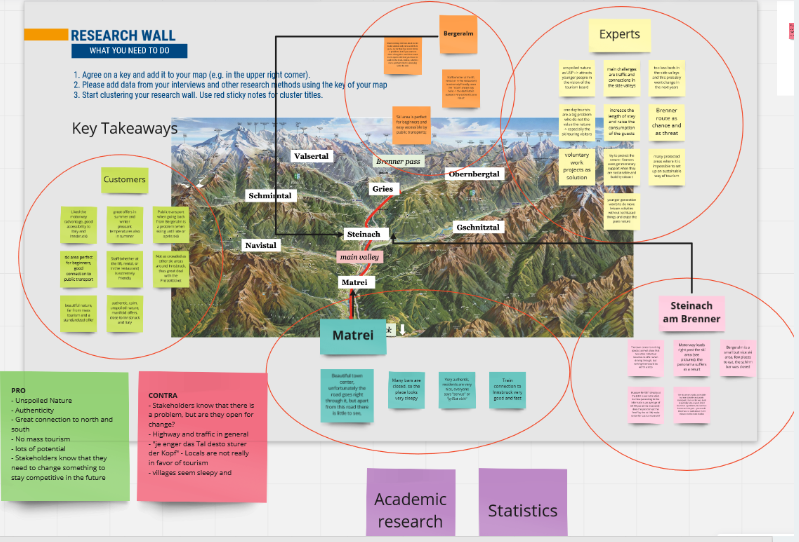
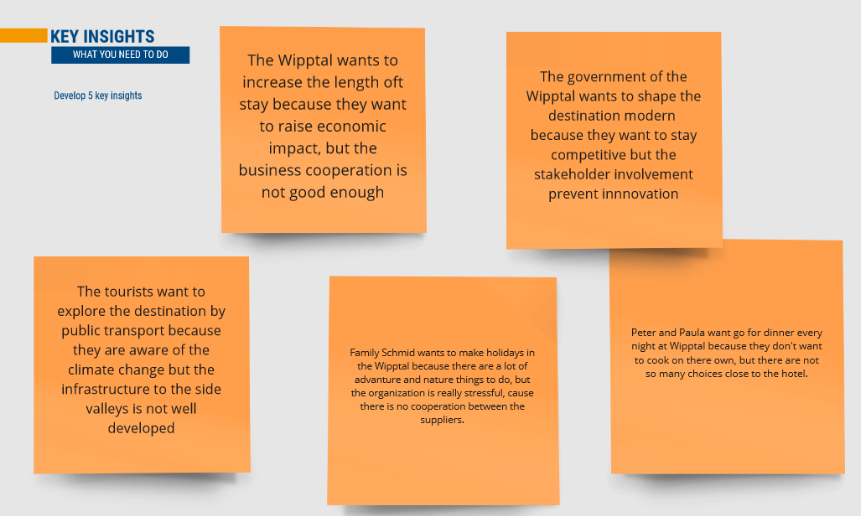
On the second day of the seminar, all these findings were collected in a digital collaboration tool called Miro, visualized on a research wall and the flood of data was reduced to the essentials and prioritized. Based on this, key insights were defined as problems and"How might we..." questions for possible solutions were formulated (see the following images as examples).
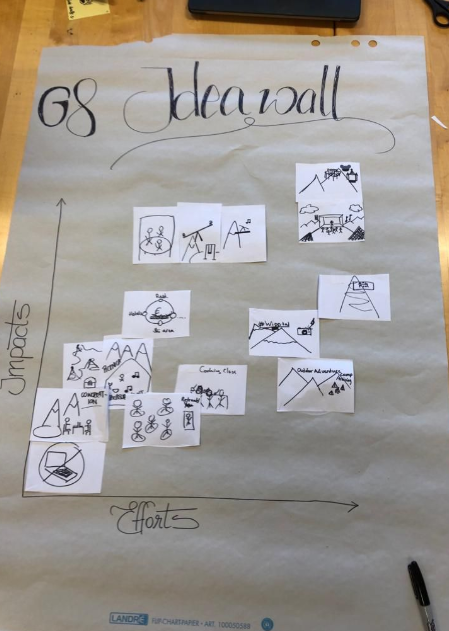
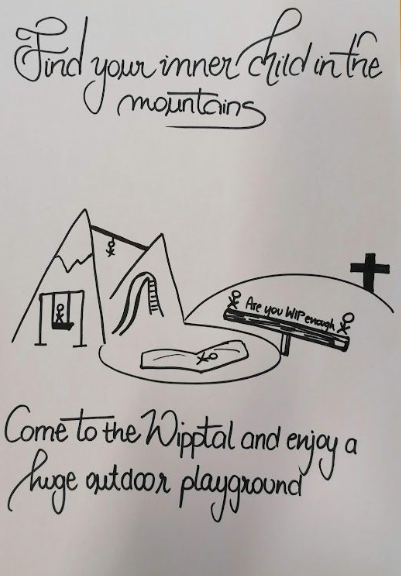
Once the various problems have been clearly defined, the transition from the problem space to the solution space takes place in the classic process. Based on the HMW questions, ideas are now collected individually using the Crazy 8 method and then discussed in the group. In order to prioritize these ideas, they are positioned on an idea wall using the Impact-Effort Matrix. The first round of prototyping also starts on the second day in order to subject the ideas to an initial practical test. True to the motto "fail early, fail cheap", the students have to subject their concepts to several tests, as experience has shown that only 20% of the ideas actually work in reality. The first round involved creating a service ad, i.e. a poster that visualizes the basic idea. As the attention span for a poster is only a few seconds, the students have to get to the heart of three of their ideas in the shortest possible time.
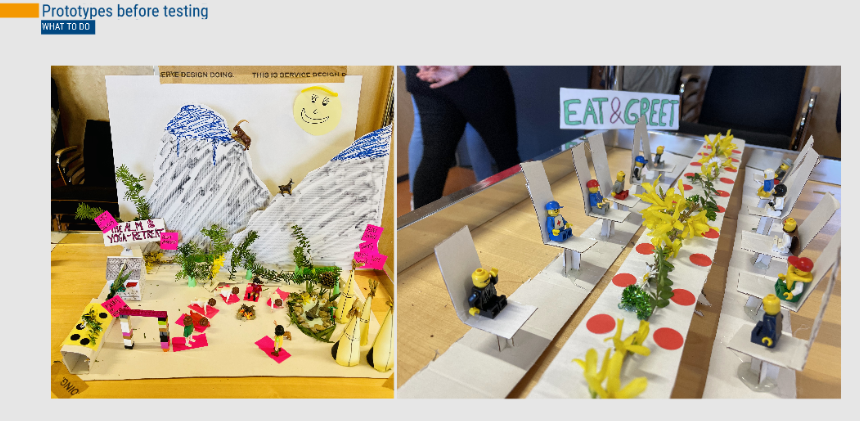
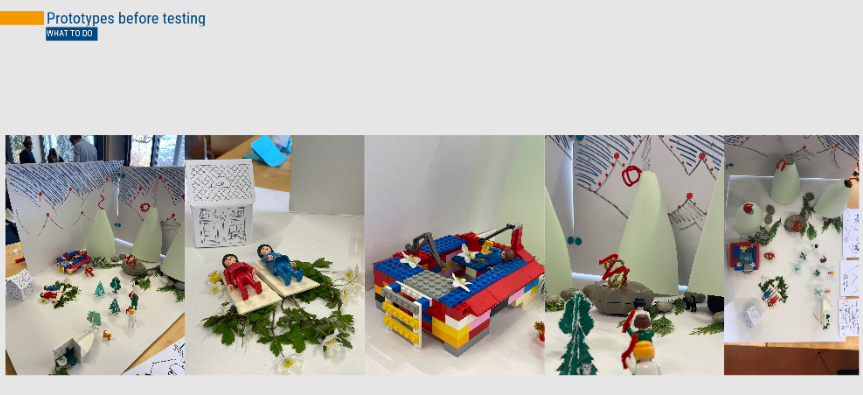
Day 3 is all about further tests for practical and implementation suitability. In order to be able to test the immaterial and intangible service offerings similar to a physical product, different prototypes are built for better visualization. This can be done using desktop walkthroughs, Lego Serious Play or cardboard prototyping, for example. What at first seems like a craft and play session quickly turns out to be a useful and simple method for playing through various ideas for services in visualized form. This allows extensive feedback to be obtained and the prototypes developed to be continuously improved as part of further iterations.
The students received feedback for their prototypes in hybrid form - partly in person and partly online from experts in the fields of tourism, sustainability and the young target group. This feedback was incorporated into the existing prototypes, different ideas were combined, new aspects were added or existing ones modified in order to develop better solutions. The day concluded with a presentation in the form of an elevator pitch, in which the students had to present their final prototype in just 3 minutes. The students had to give each other feedback on the presentation and choose their favorite. Team 1 won with the project "A bed in the Wipptal", an overnight stay in the great outdoors. Other exciting ideas included a Silent Nature Festival, a seesaw as an Insta-spot for young people, a combined gondola dinner with a concert at sunset on the Bergeralm called Wippdown, an Alpine pasture & yoga retreat, WippWorkation, a geocaching tour on Spotify or a strategy process as an event in the valley "Together, not alone".
"It was particularly interesting for me to find out what potential young people see in tourism in the Wipptal. It was nice to hear that it is also increasingly important to young people that a vacation destination offers unspoiled nature. There were many exciting ideas, some of which we will certainly take up and pursue further."
Helga Beermeister, Managing Director of the TVB Wipptal
We would like to thank the TVB Wipptal and in particular Judith Hammer and Helga Beermeister as well as Andreas Pittl from Almi's in Obernberg and the many other interview partners and testers. We would also like to thank our colleagues Markus Hormeß from work.play.experience and Klaus Schwarzenberger from Smaply for their many years of excellent cooperation!