
Project

Big data use in tourism organizations

Background

In addition to the increasing relevance of big data for tourism research, large and linked data sets offer great potential for destinations and tourism companies. These datasets often show the real behavior of guests and not their reflected behavior, such as data from downstream surveys (Li et al., 2017; Yang et al., 2015). However, recent studies show that many tourism companies have digital data but do not know how to use it strategically. Therefore, MCI Tourism and HES-SO Valais-Wallis have investigated the use and analysis of data in tourism organizations (TO).

Central question

How do tourism organizations (TO) in Tyrol and Switzerland already use data strategically and where do challenges arise?

Approach

At the beginning of 2019, tourism organizations in Tyrol and Switzerland were contacted by email and invited to take part in an online survey. From a total of 34 Tyrolean and 443 Swiss TOs (N=477), a sample of 83 tourism organizations (16 Tyrolean TOs, 67 Swiss TOs) or a response rate of 17% (Tyrol 47%, Switzerland 15%) was achieved.

The survey included the already available data sources on the one hand, but also their active use. In addition, reasons for data collection or hurdles for the lack of use were investigated and it was asked whether the TOs pursue an active data strategy.

Results

  • Both Swiss TOs and Tyrolean TOs have a large amount of data at their disposal.
  • The majority of Swiss (78%) and Tyrolean TOs (68%) use addresses from newsletter registrations and website usage data (CH 47%, Tyrol 64%) or from customer inquiries (CH 35%, Tyrol 87%). Almost half of Swiss TOs use data from events and functions, while Tyrolean TOs use data from social media (64%) and from brochures or telephone inquiries.
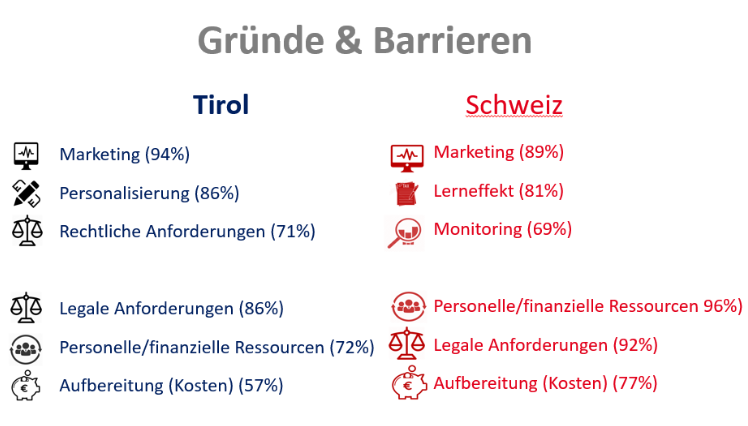
  • Use for marketing is the most important reason for collecting data. For Swiss TOs, the second most important reason is to learn from the data, followed by monitoring. For Tyrolean TOs, on the other hand, the development of personalized offers is in second place and legal requirements in third place.
  • A lack of financial and human resources prevents TOs from using their data, followed by legal requirements and costs for processing and use.
  • Only a minority of Swiss (22%) and Tyrolean TOs (27%) have a clear data strategy and just under 60% are considering taking action in this direction in the future.

Conclusion

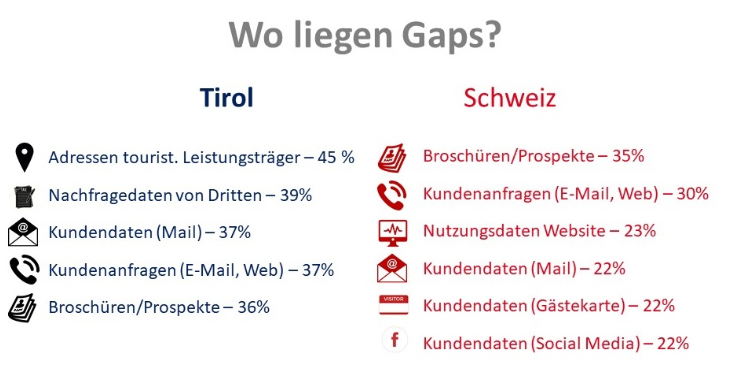
  • In many cases, there were major differences between the availability and use of data. Although the Tyrolean TOs have more data, the Swiss TOs use their data more efficiently.
  • A data strategy combined with expertise in data analysis helps to uncover the hidden treasure in the data. However, if there is not enough time for this, as is the case with many tourism organizations, the potential remains untapped.
  • Evaluating existing data should be a much higher priority for DMOs. In addition, cooperation with other stakeholders offers the opportunity to overcome financial and personnel barriers in the area of data use.
  • The strategic value of meaningful and timely data usage and data sovereignty for the TO will form the basis for a competitive advantage in the future.

Literature

Li, X., Pan, B., Law, R., & Huang, X. (2017). Forecasting tourism demand with composite search index. Tourism Management, 59, 57-66.

Yang, X., Pan, B., Evans, J. A., & Lv, B. (2015). Forecasting Chinese tourist volume with search engine data. Tourism Management, 46, 386-397.


Article in Tourismuswissen Quarterly

Dr. Birgit Bosio


Position: University lecturer

Research focus: Tourism trends, service design, customer experience, Alpine tourism, sustainability & tourism

E-mail: birgit.bosio@mci.edu

Monica Nadegger MA


Position: PhD student

Research focus: new forms of organizing, digitalization, communication, materiality & tourism

E-Mail: monica.nadegger@mci.edu

Prepared for what lies ahead in tourism