

Prepared for what lies ahead in tourism
Stay up-to-date with current, independent statistics and information on tourism in the Alpine region.
 Research

F.acT: Why is this topic relevant for the Tyrolean tourism industry?

Vittoria Sartori: Tourism destinations are complex systems made up of numerous stakeholders with different objectives, but who have a common interest in increasing the destination's competitiveness. Tourists perceive destinations holistically and come into contact with several tourism businesses during their stay. This networking requires cooperation and coordination between the players, who at the same time compete for the tourists' individual budgets. In such a context, coopetition - the simultaneous interplay of cooperation and competition - proves to be a relevant strategy for strengthening the competitiveness of destinations. Understanding how and why local competitors cooperate is particularly important for Tyrolean destinations, where the size of the community, geographical proximity and strong interpersonal relationships play a crucial role in shaping the dynamics of cooperation.
F.acT: What methodological approach did you use in your work?
Vittoria Sartori: In view of the exploratory research question, a qualitative approach was chosen. Sixteen semi-structured interviews were conducted with key players in the tourism industry operating in the alpine destination of Madonna di Campiglio, including representatives of hotels, restaurants/mountain huts, ski schools, ski and bike rentals, the ski lift company and the local DMO. All interviews were conducted in Italian and analyzed using a structuring (deductive) qualitative content analysis according to Mayring (2015). This approach made it possible to identify patterns and categories within the data and to link empirical evidence with existing theories on coopetition. The qualitative design enabled an in-depth investigation of the context-specific and relational dynamics between the actors.
F.acT: What are the core results of your work and what significance do they have for tourist destinations and businesses?
Vittoria Sartori: The results show that coopetition in Alpine tourism destinations takes many forms. It occurs both horizontally - between similar actors such as hotels - and vertically - between actors from different sectors such as hotels and ski schools. These relationships are mostly informal, unplanned and arise from personal trust and social ties rather than strategic decisions. In small, community-oriented destinations, coopetition relationships develop as spontaneous and implicit agreements that evolve over time according to seasonal dynamics.
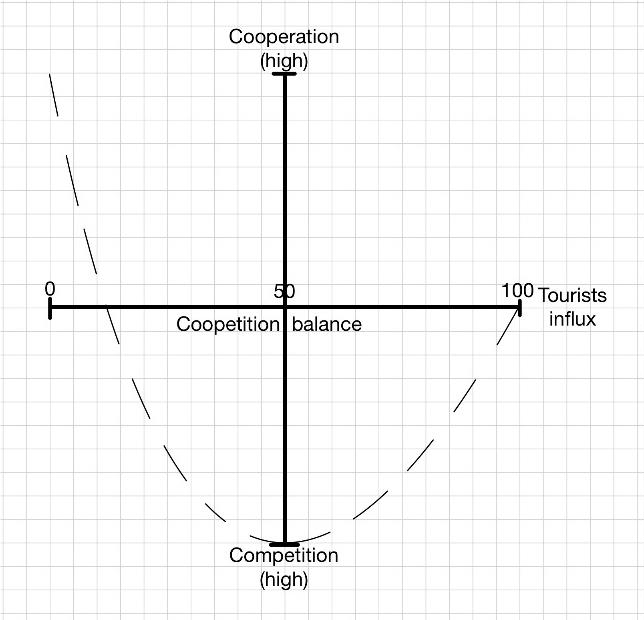
This study has shown that the intensity of cooperation and competition varies depending on the volume of tourists: In the high season both forces are balanced, in the low season competition intensifies, and in times of crisis (e.g. COVID-19) cooperation reaches its peak as stakeholders join forces to help the destination recover from such a crisis. I have illustrated this dynamic in a diagram (see below), where you can see from right to left how the "coopetition curve", i.e. the intensity of cooperation and competition, changes depending on the volume of tourists.
Vittoria Sartori: Motivations for collaboration include improving the overall tourism experience, sharing resources and knowledge, reducing costs through joint action and maintaining the attractiveness of the destination. Social and trust-based motives emerged as key drivers, while the role of the DMO was seen as supportive but not central. Stakeholders expressed a desire for greater involvement in decision-making processes and more opportunities for bottom-up collaboration.
F.acT: What specific recommendations for action do you make in your Master's thesis?
Vittoria Sartori: Based on the results, the work provides several practical recommendations for destination managers and stakeholders in the tourism sector:
Overall, the study underlines the importance of transforming spontaneous, informal collaborations into structured and strategically coordinated relationships. Strengthening such networks can improve both the competitiveness and resilience of tourism destinations.
This research contributes to the understanding of coopetition in tourism destinations and highlights its relevance for the Alpine context. It provides both theoretical and practical insights on how to foster cooperation between tourism stakeholders while maintaining healthy competition, which ultimately improves the overall performance and sustainability of destinations.