
Prepared for what lies ahead in tourism
Stay up-to-date with current, independent statistics and information on tourism in the Alpine region.
 Research
Stefan Brida was awarded the Tyrolean Science Prize 2021 for his work - congratulations!

F.acT: Why is this topic relevant for the Tyrolean tourism industry?

The vacation hotel industry in Tyrol was particularly hard hit during the Covid-19 crisis. The low profitability, combined with the current high inflation and high level of debt, is putting the industry under severe pressure.
As recent studies show, dynamic pricing (DP) - a pricing system in which consumer prices are differentiated over time based on a computer-based algorithm and determined according to a specific market situation - can help to significantly increase revenue potential. Nevertheless, many hoteliers are concerned that their guests will not accept the price system when it is introduced. In my work, I have attempted to explore this dilemma for the first time.
F.acT: What are the key findings of your work & what impact do they have on hotel businesses in the Alpine region?
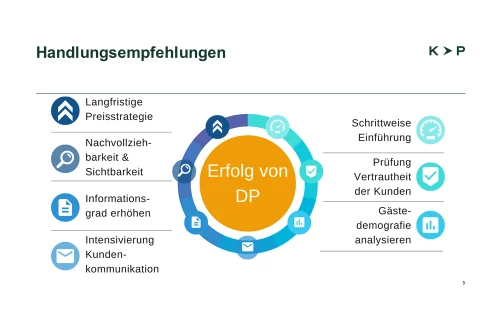
With a sample of 719 guests from the vacation hotel industry, I was able to empirically prove that 58% of respondents perceive DP as "rather fair" to "very fair" on average and that fairness concerns are relatively low at 8%. Another exciting finding for hoteliers is that hoteliers can directly influence the perception of fairness with the level of information provided by the pricing system. This means that the more and better information is made available to guests, the better DP's perception of fairness.
The differences in guest demographics are also interesting. In particular, guests from Germany and the Netherlands, guests with a low income level and a rather older group of guests had concerns about fairness at DP. No differences were found in terms of gender, reason for travel (business vs. leisure) or frequency of travel.
Furthermore, a significant positive correlation between familiarity and the fairness perception of DP was empirically proven. This means that the more familiar customers are with DP, the fairer it is perceived to be. Conversely, this also means that the more hotels use DP, the fairer it will be perceived in the future.
F.acT: What recommendations do you have for hotel businesses in the Alpine region in connection with dynamic pricing?
With my work, I was able to show that the sales and profitability potential of DP clearly outweighs the risks associated with guests' perception of fairness. The study also shows that with the right measures in the areas of customer communication, pricing strategy, price information & employee training, the acceptance risks of guests can be directly influenced during the introduction. For this reason, I have summarized the 7 elements for successful customer-oriented dynamic pricing as a guideline for the hotel industry, which should considerably simplify the introduction of DP in the future.
I am convinced that due to the current challenges in the industry, the future of the vacation hotel industry undoubtedly lies in DP.