Prepared for what lies ahead in tourism
Stay up-to-date with current, independent statistics and information on tourism in the Alpine region.
 Project
As part of the “Service & Experience Design” course, students in the “Entrepreneurship & Tourism” master’s program at MCI Tourism participate in a design sprint. Rather than learning about service design in theory, students are encouraged to experience firsthand how a design sprint works. To this end, a new topic—including a industry partner—is selected each year to make this experience as realistic as possible while simultaneously generating ideas for the industry partner, creating a win-win situation for both students and the industry.
After developing service improvements for individual tourism partners in previous sprints—including a museum (Knappenwelt Tarrenz), destinations (Innsbruck Tourism, Wipptal Tourism Association), attractions (Alpenzoo Innsbruck), and organizations (Austrian Alpine Club), this year’s focus was on a more systemic topic centered on the issue of “equal pay.” Together with the Equal Pay Network, the following challenge was defined for the course: “How could services, processes, or coordination mechanisms related to a specific actor in the tourism sector be redesigned to reduce the emergence of wage inequality over time?”
The Agenda
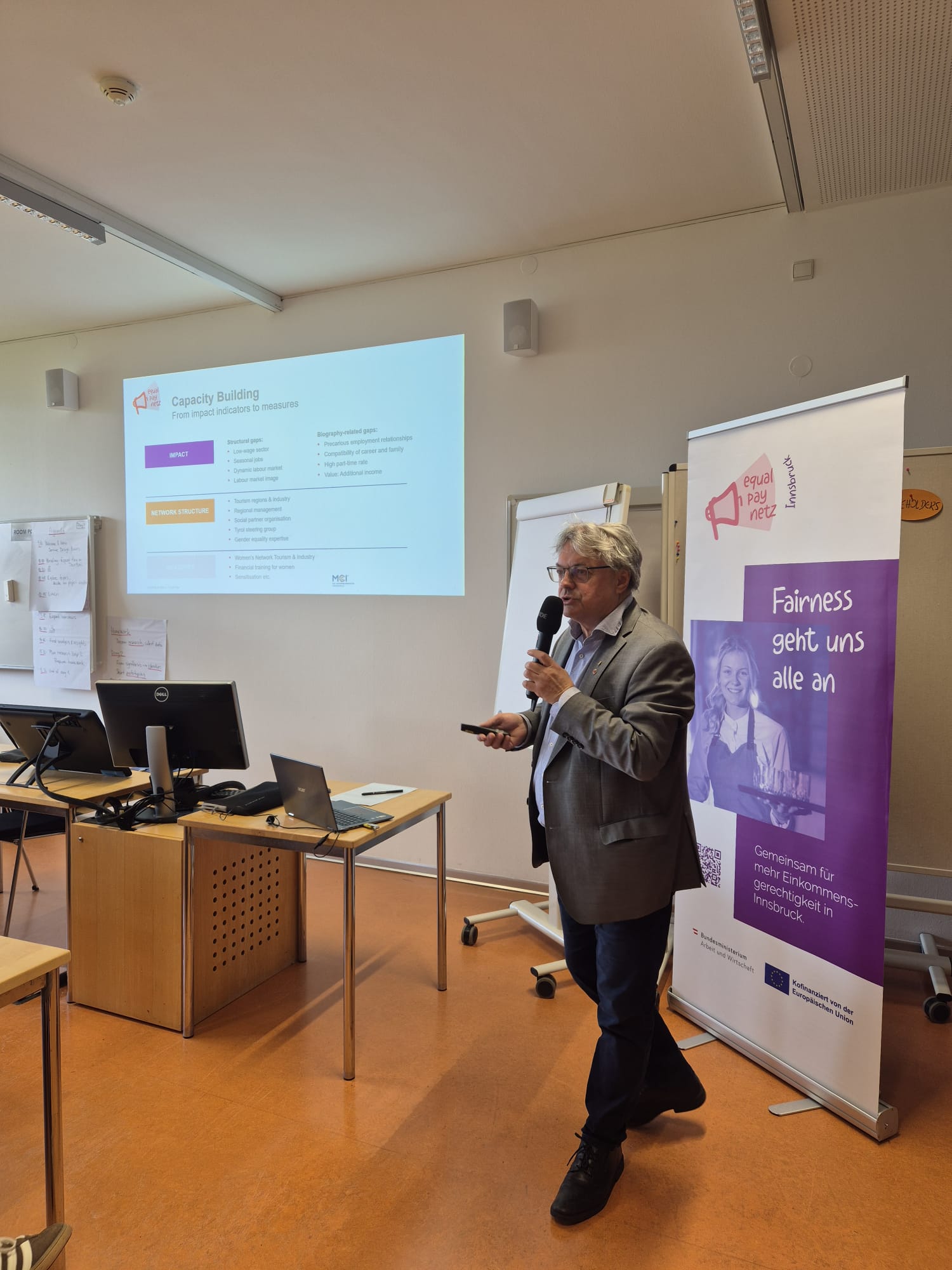
After a brief introduction to the course format and the topic of service design, the students attended two expert presentations: one by Armin Erger (Tyrol Chamber of Labor) on the topic of equal pay, and another by Christian Putzer (Equal Pay Network) on the project itself. In a further “Topic Immersion” session, pre-curated content (academic papers on the topic, studies, relevant websites, etc.) was processed in advance using AI to delve deeper into the topic. At three stations, students discussed the stakeholders involved (ecosystem), personas (affected individuals), and so-called “life journeys” as career milestones. In a subsequent step, the students had the opportunity to interview experts from various fields on the topic of equal pay and learn more about the subject.
The insights from these interviews were then categorized into problem areas with the help of AI, and the 12 student groups were assigned to these areas to ensure the broadest possible coverage of different topics. In their self-directed study, students had to build upon their previous experiences to, on the one hand, establish an AI-based research framework (AI Workspace) and, on the other hand, define the mechanisms behind equal pay. In addition, contextual interviews were conducted with tourism employees across various industries to map and document their “life journeys” as career paths.
All of this diverse data and these insights were visualized on the second day on a Research Wall, and key findings were identified for each tourism sector (hospitality & food service, cable car industry, sporting goods retail & rental). Based on these, three research questions (formulated as “How might we?” questions) were defined for each group, for which the individual student groups could then develop proposed solutions. In this way, the challenge—which was initially defined in rather general terms—was broken down into more concrete problems.
Ideation was carried out using creative techniques such as the Crazy 8. This method allows for the rapid generation of many solutions, which are then clustered in an Idea Portfolio based on impact and feasibility. After selecting the most promising ideas, initial physical prototypes were built and tested within the groups as a first step. A second round of testing was conducted with another group of experts, who provided the students with realistic feedback and additional input. Based on this feedback, the ideas were revised and refined once more and subsequently presented to the experts.
Award-Winning Projects
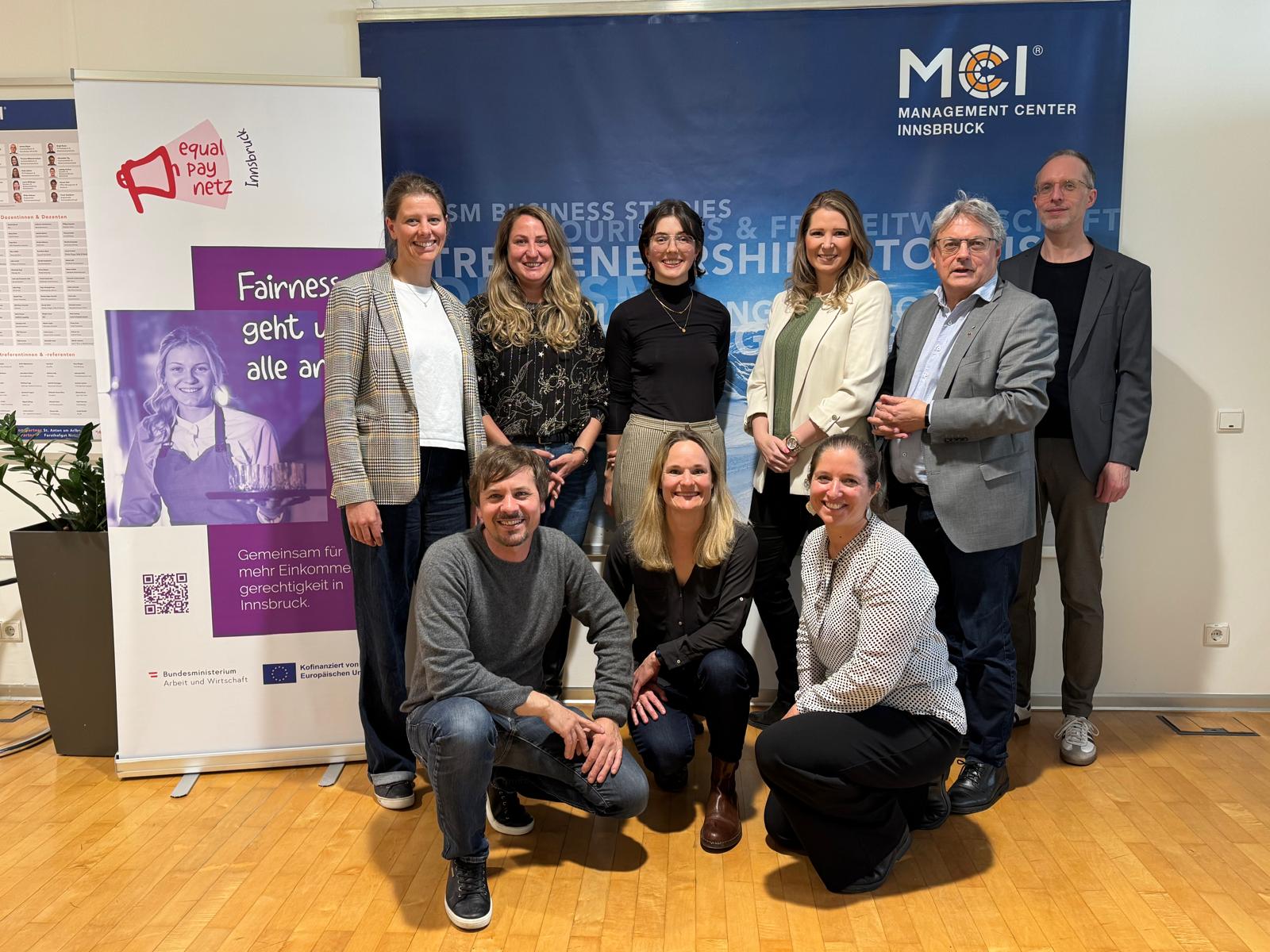
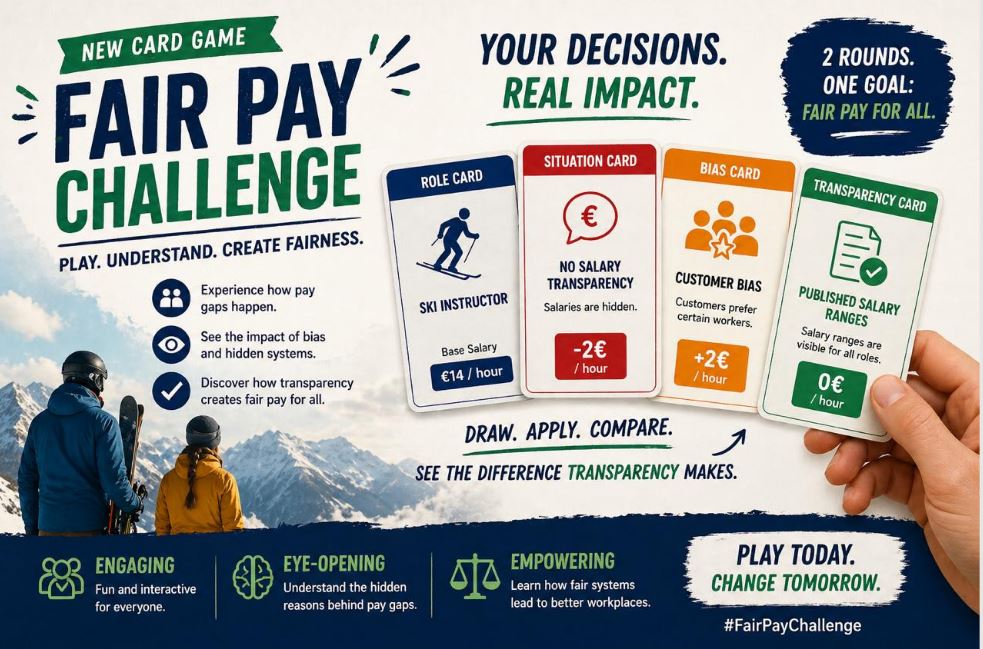
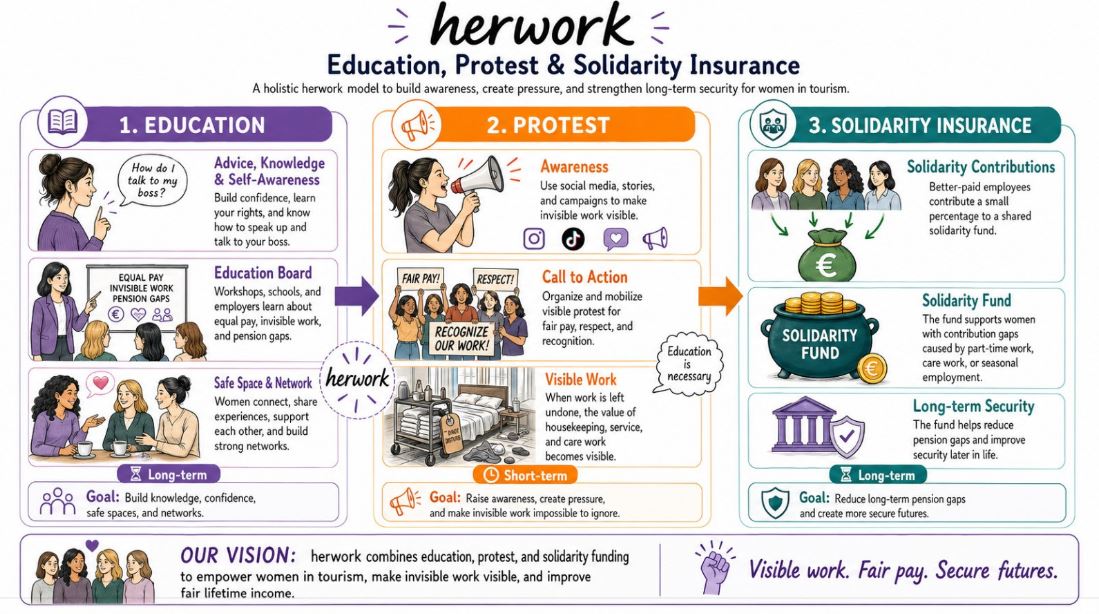
The jury—consisting of Christian Putzer, Julia Fenneberg, Nicole Ortler, and Maria Salchner—had to make their selection from a total of 12 groups. First place went to the card game “Fair Play Challenge,” which impressed the jury with its tactile and simple design, addresses the issue of equal pay in a playful way, and encourages discussion within ski schools. We congratulate the team led by Noah Bernardi, Marie-Antonia Bierbaumer, Lara Hadlauer, Federico Morandini, and Lisa Tipotsch on their exciting project. Second place went to the “herwork” project, which combined two ideas into a single final solution and thus best incorporated the feedback from the testing rounds. Third place went to the “Bring Your Child to Work” event, which raised awareness of the connection between the workplace and childcare to make hidden care work visible.
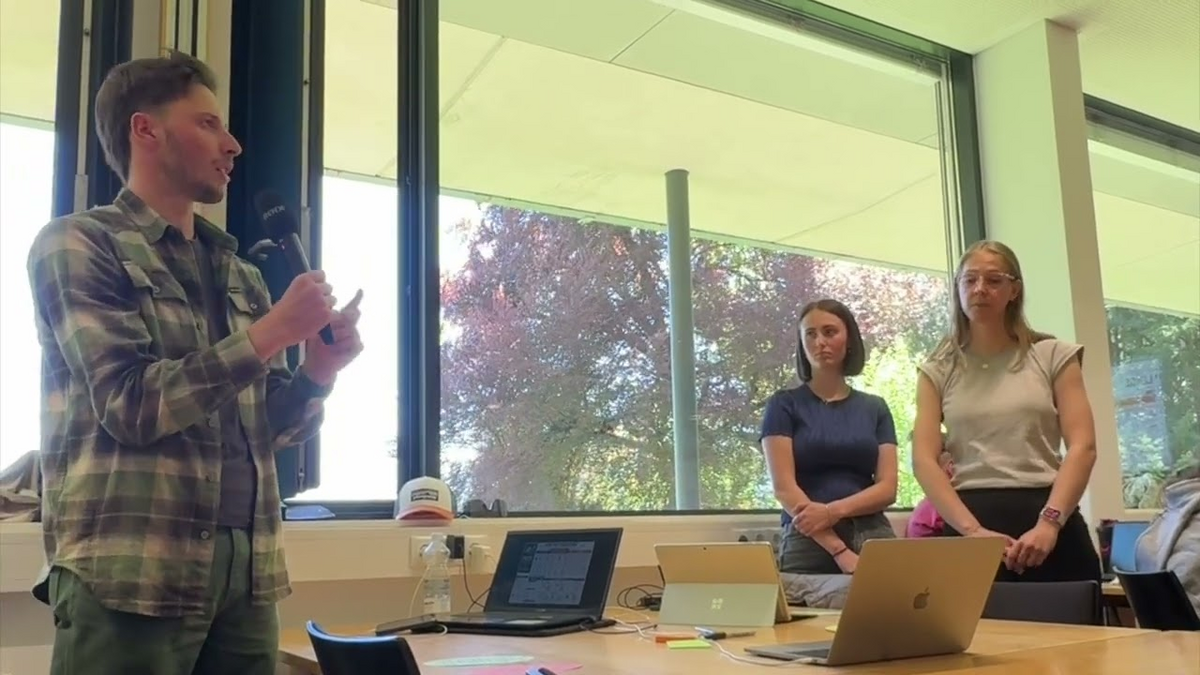

Since Design Sprints are often focused solely on improving tourism products and services, the topic of “Equal Pay” presented certain challenges for both the instructors and the students. Experience has shown that the approach of not teaching service design in the traditional way, but rather guiding students through the Double Diamond process themselves using a real-world example, initially leads to a certain degree of overwhelm among students. "At first, this course combined with this project was complete chaos for me. I didn’t understand either the ultimate goal of the project or how the topic of the gender pay gap in tourism fit into the ‘Service & Experience Design’ course. Over the course of the days, things slowly became clearer, and we as a team—or rather, I—knew what we were working toward: a prototype. Overall, I found the course’s approach, with all its practical elements, very engaging.”
“I (…) wasn’t very interested in the topic at first, as it seemed like something that had already been discussed many times without leading to real change. Over time, however, things started to make more sense, which surprised me. I began to see the topic from a different perspective, and it became more interesting and meaningful than I had expected. What I found especially valuable was that we developed this new perspective together as a team. We came up with our own ideas, solutions, and opinions in a natural way, without forcing it, which made the learning process more effective.”
We also received positive feedback from the partners:
“The student target group is of great importance to the Equal Pay project, especially since these individuals—as future leaders in the tourism industry—are already addressing the issue of gender equality as part of their education. Independently exploring the various sub-topics related to the main theme of “Equal Pay” raised the students’ awareness of issues such as child care, wage transparency, financial literacy for women, modern work-time models, and more. The intuitive approach, utilizing modern scientific methods in a practice-oriented setting under the guidance of professors and tourism experts, enabled the development of realistic and innovative solutions. The objectives of the EPN project were thus excellently achieved.” Christian Putzer, Regional Director for Innsbruck/Tyrol
“The students engaged in an in-depth exploration of the topic. And it is precisely this early and practical engagement with gender equality that is important. After all, we need the innovators of tomorrow who will incorporate these aspects into their thinking to create a fair working world.” Lisa Keiler, Project Manager, VerNetzT – Work-Life Balance Network Tyrol, Regional Management Innsbruck-Land
"The Service Design Sprint has once again shown just how valuable collaboration and co-creation with young people are! For me, it was refreshing and enriching to see how seriously and professionally the students approached this complex topic, while at the same time managing to highlight perspectives and viewpoints that stem from very different backgrounds and viewpoints—and are all the more valuable for designing truly innovative and out-of-the-box solutions.”Lena Obermair, Impact Hub Tirol
“The top-rated concept proposal stands out with an analog, low-barrier approach that works immediately in a diverse work environment. Through gamification, the card game provides easy access to complex topics, overcomes linguistic and cultural barriers, and actively promotes exchange and awareness within the team. It was precisely this combination of accessibility, scalability, and immediate applicability that was decisive for the evaluation.” Julia Fenneberg, Fberg Marketingsolutions
We would like to thank everyone involved who supported us so energetically during this year’s sprint, including Christian Putzer from Equal Pay Netz as this year’s project partner, Armin Erger (Tyrol Chamber of Labor), Julia Fenneberg (Fenneberg Marketing), Lisa Keiler (VerNetzt/Regional Management Innsbruck-Land), Lena Obermair (Impact Hub Tyrol), Nicole Ortler (Tirol Werbung), Julia Gschwentner (Tyrol Chamber of Commerce), Maria Salchner (Idealtours), Veronika Steger (Frauen im Brennpunkt), Stephanie Haselwanter (MCI Tourism), and our external editor Markus Edgar Hormeß (WorkPlayExperience).