


Prepared for what lies ahead in tourism
Stay up-to-date with current, independent statistics and information on tourism in the Alpine region.
 Research

Why is this topic relevant for the Tyrolean tourism industry?

Martin Tusch: Family businesses play a central role in Tirol due to their economic importance. Many Austrian family businesses are located in the tourism industry in particular. Family-run tourism businesses often strive for succession within the family, which entails long-term interaction between the transferring and acquiring generations. However, the perception of risks can vary between the different generations. The study of risk perception deals with organizational and emotional decision-making processes that result in psychologically and socially conditioned actions. Knowledge about the risk behavior of both generations has a lasting impact on companies. Conflicts and wrong decisions can be prevented through the targeted disclosure of individual perceptions regarding specific decisions and the risks associated with them. This supports the successful handover of family businesses, which is ultimately not only a great benefit for the individual companies, but also for the Tyrolean tourism industry as a whole.
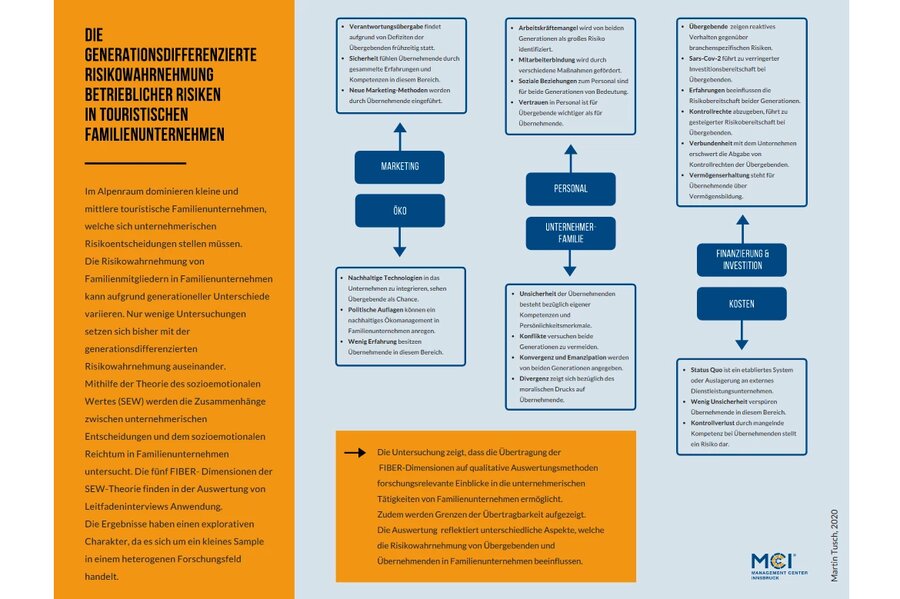
What are the key findings with regard to generationally differentiated risk perception and what significance do they have for Tyrolean family businesses?
Martin Tusch: The results of the study show that the generations involved may have opposing views on upcoming decisions - they assess the risks that may be involved in very different ways based on their knowledge and experience. As a result, misunderstandings arise and risky decisions are made in order to preserve family peace. Future generations will have to deal with the consequences of these decisions in the long term. In addition to this visualization, the work serves as an incentive for family businesses to invest in proactive intergenerational communication. Detailed results can be found in the figure.
What specific recommendations for action do you make for family businesses in your master's thesis?
Martin Tusch: In order to facilitate the transfer of control rights in family businesses, it is beneficial to strengthen trust between family members. The research results make it clear that trust in the transferee triggers a feeling of security in the transferor, which makes strategic decisions in different areas of the company easier. Furthermore, open communication of motives and emotions regarding individual decisions is recommended. In this way, conflicts can be avoided and personal feelings and risk attitudes can be openly discussed. It makes sense to invest in social relationships with staff. A healthy working atmosphere facilitates the handover process and increases the acceptance of those taking over. In addition, the knowledge of the transferring generation proves to be a valuable resource. This knowledge should therefore be consciously passed on as part of the internal succession process. In this way, the generation taking over can benefit from the transferor's wealth of experience. As a result, risk decisions can often be assessed more adequately.