

Prepared for what lies ahead in tourism
Stay up-to-date with current, independent statistics and information on tourism in the Alpine region.
 Inspiration
65,700 registered users, two thirds of them international guests, 700 speakers, 400 virtual events, 3,513 exhibitors from 120 countries, over 1,000 media representatives and travel bloggers from 54 countries. That's what ITB NOW 2021 was like. We were there virtually for you and have summarized selected conference contributions:
Despite the crisis, the mood at ITB 2021 was consistently positive and optimistic. According to experts, the global desire to travel remains strong. This is shown by various studies. According to IPK International 's World Travel Monitor (WTM ), 62% of global travelers still want to go on vacation abroad in 2021. Travelers from 60 countries were surveyed. Vaccination readiness is also very high at 90%. Those who do not want to travel abroad do not cite financial reasons for this, but the risk of Covid-19 infection. Statista comes to similar conclusions (see ITB Trend Report Chapter 1). According to their analyses, 70% of respondents from Germany, the USA and China want to travel in 2021. 37% are currently planning a trip. Due to the coronavirus crisis, people are looking for places where they can feel comfortable and where they will be looked after.
The domestic market and local markets will recover faster from the crisis than long-distance travel. The same applies to leisure travel as opposed to business travel. However, there is also a difference between the regions. While business travel intentions in Europe are rather restrained, Americans and Asians are more willing to go on business trips again soon (see WTM). When it comes to vacation trips, beach vacations are very popular, followed by city breaks and vacations in nature. Among Asians, city breaks are even in first place. However, city tourism also needs to reinvent itself and offer meaningful encounters instead of pure mass tourism. The topic of visitor guidanceis therefore becoming increasingly important for both outdoor activities and city breaks. Currently, cities such as Beijing still rely heavily on domestic tourism. Among Europeans, the preferred vacation destinations for 2021 are Spain, Italy, Germany and France. Americans and Asians also prefer to travel to their own continent. According to experts, the VFR (visiting friends & relatives) sector will also experience a major boom (see WTM).
In the industry, all signs are currently pointing to recovery after the long dry spell. TUI sees 2021 as a transition year and 2023 as a return to pre-corona levels. Customers are demanding greater flexibility, which, according to DER Touristik, is also having a major impact on the liquidity of travel companies. There will therefore have to be massive changes in the industry. A high degree of flexibility in terms of booking and cancellation conditions will continue to be crucial. According to TUI, 80% of its customers have booked a flexible rate since the beginning of February. At DER Touristik, the figure was 70%. However, this also has a strong impact on the liquidity of many travel companies and therefore business models must also change.
A study conducted by ITB and Travelzoo in January 2021 (8,000 respondents in Canada, China, France, Germany, Spain, the UK and the USA) shows that European travelers in particular have lost their trust in the travel industry in many cases. The picture is quite the opposite in the USA and China (see ITB Trend Report Chapter 9).
The crisis has led to an increased awareness of sustainability among both suppliers and consumers (see ITB Trend Report Chapters 2-6). The effects of the climate crisis have been pushed back by the current crisis, even though its effects were clearly visible in 2020. As a result, the question of greater sustainability generated much discussion. Euromonitor International compiles a sustainability ranking at destination level, in which Austria takes third place behind Sweden and Finland. Social sustainability in particular has gained in importance during this crisis. In one session, it was shown that sustainability certification in a hotel can lead to increased turnover. The company FlockEO is launching a website for eco-destinations. The start-up mycabin is picking up on the nature trend, creating a link between camping enthusiasts and landowners and farmers (see ITB Trend ReportChapter13).
Overall, the experts agree: the fear of the pandemic has led to the value of trust moving to the top of the list. When traveling, guests want to feel the connection again that they have had to do without since the start of the pandemic. Connection to hosts, but also to nature - because the pandemic has made it clear that we humans are part of nature and must show consideration for it. As far as hosts are concerned, they are now more in demand than ever, not only in the luxury hotel sector, to take care of their guests and offer them a safe "nest" and ultimately satisfy the need for safety.
Never before has the topic of safety (see ITB Trend Report Chapter 10) and health been more in focus than now. People are avoiding large gatherings, which is why luxury tourism in particular is predicted to have a safe future.
From human touch to human tech
In order to restore the "old" feeling of carefree travel even in coronavirus times, companies and tour operators are focusing on digital transformation and innovation. Digital touchpoints along a journey across national borders should ensure smooth and safe mobility. In the ITB keynote speech "From Human Touch to Human Tech", Christian Warneck, Vice President of Airline Solution at Amadeus Germany GmbH, will present a digital customer journey in times of coronavirus. Digital technologies should help to create a harmonious collaboration between information, safety and a smooth travel experience. What can this look like in practice? From an interactive travel map with the respective country-specific corona rules, to automatic reminders for testing before departure, to contactless check-in via selfie cam and passport photo - it should be as easy and convenient as possible for travelers to cross national borders safely. Health documents (such as test results or vaccination certificates) are always with them - conveniently on their smartphone. The process then continues at the destination. Using a barcode, restaurants and tour operators can easily check the test results at the entrance and thus offer a high level of security with little waiting time. The overarching goal of all measures is to restore the smooth flow of travel even in times of coronavirus - so that vacations are not only safe, but also comfortable and uncomplicated.
Digitalization is therefore acting as a catalyst during the crisis. According to Phocuswright, online penetration will reach 75% by 2024 (see ITB Trend Report, Chapter 11). Skift presented the most important tech trends in travel for 2025 (see ITB Trend Report, Chapter 12) and emphasized the customer experience in particular. In the future, only technologies that not only make travel safer but also better will remain.
This crisis has confronted society with death and reminded us that life is limited and small things should be valued more. Dr. med. Jeffrey Mc Cutchan (specialist in psychiatry & psychology) explains how to deal with this confrontation and the feeling of fear in classical anxiety therapy: become aware of the fear - deal with the actual fear - deal with the consequences of the fear - help to regain a more relaxed state of mind. Body and mind go hand in hand here - so a holistic approach would advocate starting your vacation with a spa treatment instead of stress at the airport.
Vacations are urgently needed now - everyone needs a break from the pandemic year. People need places where they can recharge their batteries to restore body and mind. Hygiene now plays a major role in people's sense of security. The trend has long since moved away from mass tourism towards smaller accommodation, more privacy and less anonymity.
Even before coronavirus, travel was not the same for everyone. Many different groups still face discrimination based on their skin color, sexuality or origin. But how can tourism, which stands for freedom and the expansion of horizons, combat these inequalities? In the panel discussion " Tourism & Human Rights: Multiple Experiences of Discrimination and Inequalilty and How to Fight It", speakers Stephanie M. Jones (Founder and COR of the National Blacks in Travel & Tourism Collaborative), Tobias Sauer (freelance journalist), Sandi Robinson (Area Director of Sales & Marketing at Godfrey Hotel Chicago) and Iaia Pedmonte (Founder and Editor of Gender Responsible Tourism) provide insight into the problems, but also the solution for a more equitable tourism. For marginalized groups, the problem starts with the journey.
Tobias Sauer explains that it is up to the destinations and agencies themselves to actively engage and establish safe and equitable practices. Once the problem has been identified, NGOs and experts can help to create fairer and more inclusive structures and thus fundamentally change the industry. Although the representation of diversity also plays a major role for potential travelers, purely "cosmetic" marketing campaigns are not enough here. New marketplaces, new channels and a redistribution of resources and profits towards small, local tour operators are needed, as Stephanie M. Jones reports in her example of black tour operators in the USA. This is the only way to dispel prejudices and create an economically sustainable livelihood for affected groups. All panel participants agree that there is still a long way to go before inclusive, fair and equitable tourism is achieved, but the industry has great potential for further development through awareness, education, exchange and a commitment to active change.
Another trend observed by many travel experts: Long-term stays at vacation destinations for remote working (see ITB Trend Report Chapter 8).
Work + Vacation = Workation
The pandemic has shown: Working from home is possible and works (not in all jobs, but in many). This development has led the younger generation in particular to realize that it is not only possible to work from home, but also from a vacation destination. The range of explicit travel programs for "digital nomads" is growing steadily - hotel rooms with a specially equipped workplace, special 1-2 year visa programs for "workationers" are made possible. The special thing about digital nomads for the tourism industry: they stay for a long time, earn money and want to experience something in the destinations while spending money. Demand from workationers is expected to grow in the future.
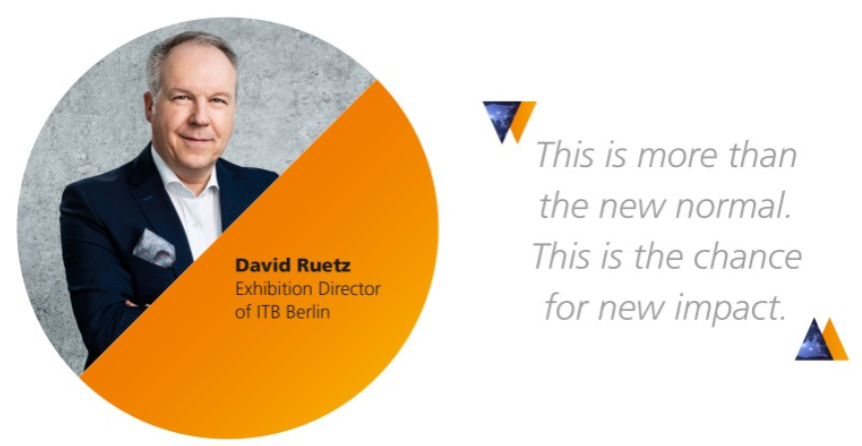
The trend towards digitalization, for which the Covid-19 crisis has acted as a catalyst, will continue. Even though the online format has worked well, the plan is to meet in person again next year in Berlin. The date has already been set: March 9-13, 2022, so a hybrid system is very likely. This means that there will be no return to the old normality in the travel industry. "The future will be hybrid and the future will be different." (ITB Now, 2021) According to Phocuswright, a recovery in the industry will vary greatly from region to region. While a rapid stabilization of the situation is predicted for China by 2023, this will take longer in Germany or Japan. In any case, we will have to get used to contactless travel using biometric identification and digital identities and increased security measures for a few more years. There is more demand than ever for smart connections between personalization of services and artificial intelligence with the help of blockchain. The topic of data security will therefore play a decisive role in the smart travel chain in the future, especially when it comes to health data.