


Prepared for what lies ahead in tourism
Stay up-to-date with current, independent statistics and information on tourism in the Alpine region.
 Research

Why is this topic relevant for the Tyrolean tourism industry?

Lukas Prehal: The COVID-19 crisis has clearly shown that classic crisis management tends to be neglected in family-run companies due to a lack of resources. Unlike large companies, some of which have their own risk management department, external crises cannot be managed in the affected group of entrepreneurs due to their unpredictability in terms of their extent, probability of occurrence and speed, as the necessary resources are lacking or are preferably used to create value. This inevitably leads to areas such as organizational resilience and organizational learning gaining in importance in the course of crisis management.
In Austria, 88% of tourism businesses are family businesses in the broader sense (KMU Forschung Austria, 2020). While the focus of this paper is on the family-run hotel industry, the content and approach can also be applied to other tourism and non-tourism family businesses. In Tyrol, where every third euro is earned directly or indirectly in the tourism and leisure industry, almost every fourth full-time job is created and 17.5% of Tyrol's total gross value added is generated directly, this topic is therefore extremely relevant even after the COVID-19 crisis.
What are the core results of your work and what significance do they have for the hotel industry?
Lukas Prehal : The crisis overtook us, which is why family-run hotels had to make quick decisions. This time pressure sometimes led to inefficient ad-hoc measures. As the primary concern was to secure liquidity, staff cuts were made, which in turn can pose a post-COVID-19 challenge. Nevertheless, the study clearly showed that strategic crisis management for more efficient crisis management will not be implemented in the future for the reasons mentioned above. Organizational resilience plays a role here insofar as a resilient company mitigates the negative effects of a crisis and enables managers to make effective and sustainable decisions, especially in the emergency phase of a crisis.
Once the initial shock had been overcome, the situation began to be addressed. Resources freed up due to the lack of guests during the pandemic led to optimizations in existing process landscapes and even changes to the organizational system. During this time, offers were rationalized, generated and improved, and partnerships were intensified, newly established and the existing network in the tourism destination strengthened. This process of organizational learning is therefore directly linked to the development of resilience at a personal, organizational and destination level. Resilient organizations promote the resilience of a destination and vice versa, the same effect takes place. This applies both to providers of direct tourism services and providers of indirect services, as can be seen very clearly from the fact that many hotels used the time without guests to make planned investments in fixed assets and thus generate orders in the construction industry.
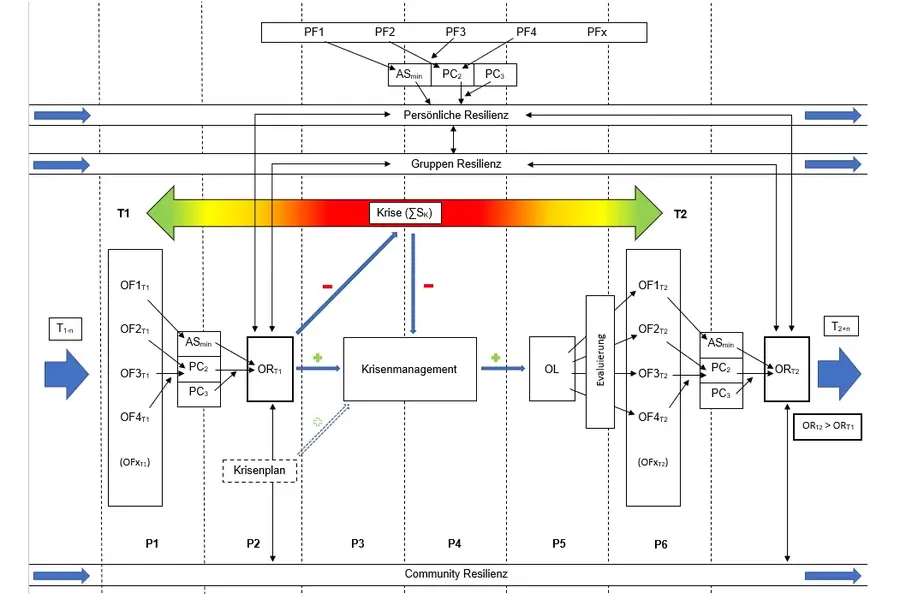
The diagram shows how personal (PFx) and organizational resilience factors (OFx) are used with the help of the Positive Appraisal Style Theory (PASTOR) to strengthen organizational resilience (OR) and thus be able to respond better to crises. The learning effects that result from a crisis help to further develop the organizational resilience factors after successfully overcoming it. This is more of an ongoing process than a one-off one.
What specific recommendations for action do you make in your Master's thesis?
Lukas Prehal: This paper presents a guideline for building organizational resilience, which is intended to help managers in the family-run hotel industry, but also other family businesses, to cope efficiently with crises and unforeseen disruptions and to emerge stronger from such situations. This is not so much a rigid procedure, but rather a flexibly applicable tool and suggestion for promoting organizational resilience in practice. In addition, managers are advised to define a general crisis plan for faster and more efficient decision-making. This should be formulated once in such a way that it serves as the company's first line of defense for every crisis without significantly restricting essential functions.