


Prepared for what lies ahead in tourism
Stay up-to-date with current, independent statistics and information on tourism in the Alpine region.
 Project
This project was carried out in cooperation with the MCI Family Business Center and the Leisure and Tourism Research Center at the LFUI.
Germany is the most important source market for tourism in Austria, and Generation Y in particular is described as a promising market segment (Löw, 2019; Strozzi, 2018). Furthermore, as the role of family businesses in tourism is undisputed (Austrian Federal Economic Chamber, 2018; Zehrer, 2017), this research project examines the significance of the special features of family-run hotels for Generation Y.
The aim of the research project is to survey potential customers of the "early Generation Y", who are considered a solvent clientele, because their needs and values in relation to family businesses lead to sustainable product and service development in family-run tourism businesses.
Following a literature analysis on research into the development of offers by family businesses and Generation Y, a qualitative survey was conducted with 20 people from Generation Y (people born between 1980 and 2000, living in Germany).
Excerpts from the results:
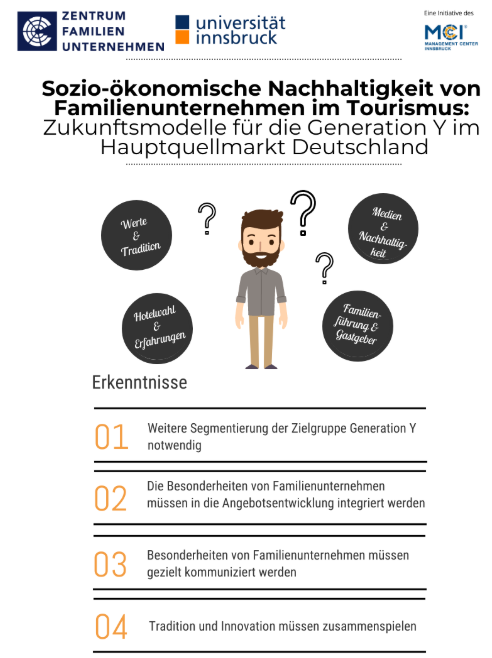
This project illustrates that the special features of a family business such as tradition, loyalty to guests and employees, regionality and authenticity contribute to differentiation, the development of competitive advantages and the strengthening of customer relationships. It is essential to integrate the special features of family-run businesses into the offering and to communicate them. Generation Y is characterized by a socio-politically critical attitude, increased use of the internet and social media, as well as a focused interest in sustainability (Moskaliuk, 2016; Viswanathan & Jain, 2013), which family-run companies can use in their communication. The large group of Generation Y should be further segmented according to psychographic and behavioral criteria.