

Prepared for what lies ahead in tourism
Stay up-to-date with current, independent statistics and information on tourism in the Alpine region.
 Project
This project was carried out in cooperation with the MCI Family Business Center and the Leopold Franzens University of Innsbruck.
Due to their size, small-structured family businesses in the tourism industry face challenges and disadvantages in an increasingly changing and saturated market, which makes a clear strategic orientation essential (Kelliher & Reinl, 2009; Peters, 2001). An intensive examination of one's own strategic orientation therefore brings significant competitive advantages over the competition (Aldehayyat, Al Khattab, & Anchor, 2011; Chrisman, Sharma, Steier, & Chua, 2013; Chua, Chrisman, & Sharma, 1999; Sharma, Chrisman, & Chua, 1997).
The aim of the project is to conduct a baseline study on the status quo of the strategic positioning of family businesses in tourism, to analyze their problem areas and to create a portfolio of strategic options for family businesses in tourism. Based on the problem areas, solutions for family-run Tyrolean tourism businesses are to be developed and published in the form of recommendations for action. These guidelines are intended to sensitize family businesses to the necessity of strategic planning and to demonstrate hands-on measures on how a strategic orientation can be achieved. In this way, the project aims to contribute to strengthening the competitiveness of family-run tourism businesses in Tyrol.
Both quantitative and qualitative methods were chosen to answer the research question and the recommendations for action in this project. This resulted in a mix of methods consisting of questionnaires, guided interviews and focus groups. A total of 119 companies in eight Tyrolean regions were surveyed between May 2017 and October 2018. The participating TVB regions were Pillerseetal, Vorderes Zillertal, Hall-Wattens, Tiroler Oberland, Paznaun-Ischgl, Achensee, Innsbruck and its vacation villages and Wilder Kaiser.
Excerpts from the results:
The study shows that planning efforts at company and destination level are essential.
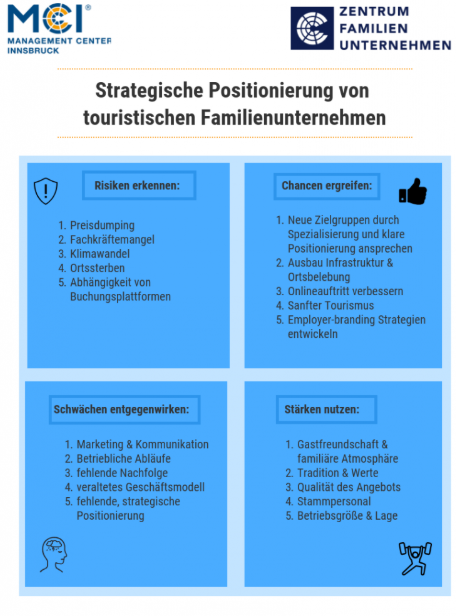
The following specific recommendations for action are derived:
Aldehayyat, J. S., Al Khattab, A. A., & Anchor, J. R. (2011). The use of strategic planning tools and techniques by hotels in Jordan. Management Research Review, 34(4), 477-490. doi.org/10.1108/01409171111117898
Chrisman, J. J., Sharma, P., Steier, L. P., & Chua, J. H. (2013). The Influence of Family Goals, Governance, and Resources on Firm Outcomes. Entrepreneurship Theory and Practice, 37(6), 1249-1261. doi.org/10.1111/etap.12064
Chua, J. H., Chrisman, J. J., & Sharma, P. (1999). Defining the Family Business by Behavior. Entrepreneurship Theory and Practice, 23(4), 19-39. doi.org/10.1177/104225879902300402
Kelliher, F., & Reinl, L. (2009). A resource-based view of micro-firm management practice.Journal of Small Business and Enterprise Development, 16(3), 521-532.
Peters, M. (2001). Growth and internationalization: Survival opportunities for small and medium-sized tourism enterprises. Management and Corporate Culture: Vol. 6. Vienna: Linde.
Sharma, P., Chrisman, J. J., & Chua, J. H. (1997). Strategic Management of the Family Business: Past Research and Future Challenges. Family Business Review, 10(1), 1-35. doi.org/10.1111/j.1741-6248.1997.00001.x