Project

Succession in tourism family businesses

In a detailed survey, an overview of the state of scientific research on the transfer of Tyrolean family businesses was compiled and analyzed.
Anita Zehrer, Center for Family Business (2017-18)

This project was carried out in cooperation with the Family Business Center.

Background

In Tyrol, 99.7% of companies are classified as SMEs and therefore represent the majority of the economic structure (Amt der Tiroler Landesregierung, 2013). The tourism sector in Tyrol has an above-average proportion of family-run businesses. The handover or succession of a business is a critical phase for family businesses (Spelsberg & Weber, 2012). Only a small proportion of companies manage the transfer within the family over several generations (Davis & Harveston, 1999; Kets de Vries, 1993). In many companies, too little attention is paid to company handovers (Zellweger et al., 2012).

Objective

The aim is to survey the status quo of business handovers of family businesses in Tyrolean tourism and to analyze influencing factors, challenges and success factors during the handover.

Central questions

  • How many family businesses are planning a handover in the next few years?
  • What are the decisive reasons for the handover within or outside the family?
  • What time frame do family-run tourism businesses consider for the handover process?
  • What key challenges do family-run tourism businesses face when handing over the business?
  • Which factors are important for family-run tourism businesses in the handover process?
  • Which internal and external factors influence the transfer of the business?

Procedure

The survey of the status quo is based on studies and internal projects of the Family Business Center, partly in cooperation with the Tyrolean Chamber of Commerce and current master's theses of the Management Center Innsbruck. Extensive research of external studies, scientific journals and relevant literature complements the status quo.

Results

  • The tourism industry is affected by a particularly high handover intensity of family businesses. In Tyrol, the choice of successor is still open for 45% of businesses. Internal successions are on the decline, with only 1 in 3 businesses making the leap to the next generation.
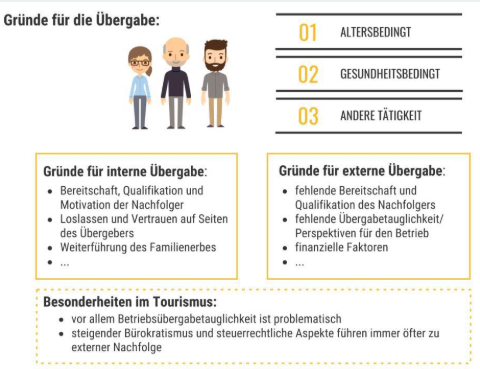
  • The reasons for the handover are mostly age-related.
  • In tourism, the planned duration of the handover process of more than 4 years is significantly longer than the actual duration of max. 1-2 years.
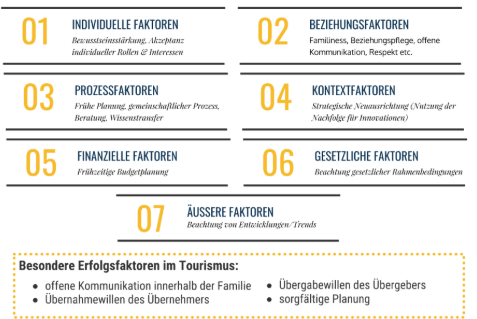
  • With regard to the factors influencing the succession process, the literature largely discusses individual, relationship and process influencing factors, while contextual, legal, financial and external influencing factors are hardly discussed. The challenges and success factors also show the same focus, which suggests that the individual, relationship and process areas are particularly relevant for the practice and success of succession.

Challenges

Outlook

  • The number of handovers will increase in the future (demographic change).
  • Over 50% of companies in Austria are due to be handed over in the next 5 years.
  • Family successions are on the decline.
  • The highest handover intensity is in tourism (by 2032: 30% of all businesses in Tyrol).

The status quo survey shows approaches for further discussions on the topic of succession for the tourism industry, which still requires more qualitative and quantitative approaches in order to understand the background and interrelationships and to adapt individual areas to the special features of tourism and to be able to derive specific recommendations for action. This reveals research gaps for future, further projects of the Center for Family Businesses.

Literature

Office of the Tyrolean Provincial Government (2013). Tyrolean Economic & Labor Market Report 2013.

Davis, P. S. & Harveston, P. D. (1999). In the founder's shadow: Conflict in the family firm. Family Business Review, 12, 311-323.

Kets de Vries, M. (1993). The Dynamics of Family Controlled Firms: The Good and the Bad News. Organizational Dynamics, 21, 59-71.

Spelsberg, H. & Weber, H. (2012). Family-internal and family-external business successions in family businesses in empirical comparison. BFuP - Betriebswirtschaftliche Forschung und Praxis, 64 (1), 73-79.

Zellweger, T. M., Kellermanns, F. W., Chrisman, J. J. & Chua, J. H. (2012). Family Contorl and Family Firm Valuations by Family CEOs; The Importance of Intentions for Transgenerational Control. Organization Science, 23 (3), 851-868.

FH-Prof. PD MMag. Dr. habil. Anita Zehrer

Position: University lecturer & Head of the Family Business Center

Research focus: Family businesses, business transfer

E-mail: anita.zehrer@mci.edu

Family business
Generations
MCI Tourism
Studies

Prepared for what lies ahead in tourism