
Prepared for what lies ahead in tourism
Stay up-to-date with current, independent statistics and information on tourism in the Alpine region.
 Inspiration

How is climate change affecting the Alpine region?

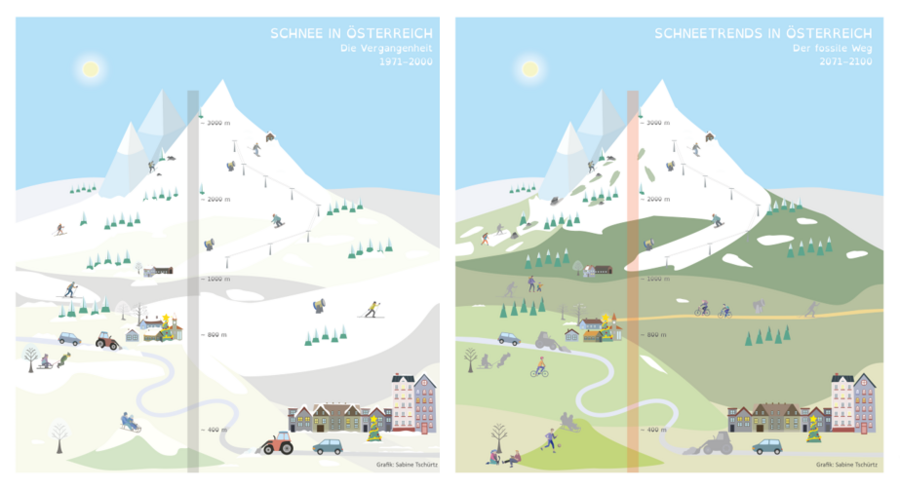
Johannes Vergeiner: We are increasingly feeling the effects of climate change first hand. The main characteristic is man-made warming, which has amounted to around 2.5 °C in the Alpine region over the past 60 years. The current global warming is therefore happening at breakneck speed, which poses a major challenge for climate protection and the necessary adaptations. In 2019, tourism caused almost 9% of the greenhouse gas emissions responsible for global warming (Sun et al., 2024). As a result of global warming, the number of days with snow cover and the average snow depth in Austria have decreased significantly over the last 60 years. Decreases of over 50% have been recorded at low altitudes; only above 2000 to 2500 m have there been no significant changes. In the same period, the number of hours that are suitable for technical snowmaking has also fallen by around 25%. This trend will continue over the next two to three decades - regardless of the future scenario. In the second half of the 21st century, the snow situation could only be stabilized at this level if the "2-degree path" is implemented with major internationally coordinated efforts in terms of climate protection. If, on the other hand, we continue as before, snow at low and medium altitudes will almost disappear by the end of the century and even at 2000m above sea level the number of days with snow cover will at least halve. The figure on the right illustrates the snow conditions towards the end of the century in a (still) fossil world. For comparison, the conditions in the recent past are shown on the left.
What specific changes can be expected for tourism in Tyrol?
Johannes Vergeiner: This development is affecting the mountain regions and tourism in Tyrol in a variety of ways. The consequences of climate change are already being observed by those involved in winter tourism. However, this does not automatically lead to adaptation measures, as investments in winter tourism are high. There is a clear shift in the season towards summer. This is driven on the one hand by more difficult conditions for winter sports, particularly at lower altitudes, but also by the desire to escape the (urban) heat in summer with a vacation in the mountains. According to a study in the COIN project, however, the monetary losses caused by climate change in winter exceed the gains in summer tourism. The changes in natural hazards caused by climate change, which affect the well-being and safety of vacation guests, must also be taken into account. For example, rockfalls are increasing in the high mountains because former permafrost areas are thawing. There is also an increase in landslides and mudflows that affect settlements or cause damage to protective forests and infrastructure. The increase is largely due to the increasing intensity of heavy precipitation caused by the rising heat.
What does it take to counter these developments?
Johannes Vergeiner: The rapid progression of climate change requires rapid adaptation measures at many levels in addition to serious climate protection measures. Doing nothing is not an alternative and is far more expensive than taking the necessary steps. Based on long-term measurement series and high-resolution climate models, GeoSphere Austria provides essential support for this adaptation process and investigates how climate change is already having an impact locally and what changes can be expected in a particular region over the next few decades.