
Prepared for what lies ahead in tourism
Stay up-to-date with current, independent statistics and information on tourism in the Alpine region.
 Inspiration
At the 77th Annual General Meeting of the International Air Transport Association (IATA), a resolution was passed to make the global aviation industry climate-neutral by 2050. This commitment is in line with the goal of the Paris Agreement that global warming should not exceed 1.5°C. Until now, the problem has been that international aviation has not been specifically taken into account and has not been counted towards national targets. The targets relating to flying were left to the individual countries to develop themselves.
The airline industry is faced with the dilemma of having to drastically reduce emissions on the one hand, while at the same time having to satisfy growing demand. According to estimates, up to 10 billion people will be flying by 2050. This means that a total of 21.2 gigatons of carbon would have to be saved by then. On the one hand, attempts are being made to offset carbon emissions in international aviation or to reduce emissions. However, this measure can only stabilize international emissions at the 2019 level in the short to medium term, but not reduce them.
In October 2021, IATA therefore presented its Fly Net Zero Plan, which aims to avoid as much CO2 as possible through industry-internal solutions. Keith Bushell from Airbus states that there is no single solution, but that success can only be achieved through the interaction of these different measures. 65% is to be saved through sustainable aviation fuels, 13% through new aircraft technologies such as the development of new emission-free energy sources such as electric and hydrogen propulsion, and 3% through more efficient operating processes and infrastructures. For example, the aircraft manufacturer Airbus SE is to produce a hydrogen-powered aircraft for 150 passengers and a range of at least 1,000 km by 2035. The remaining emissions that cannot be eliminated at source are to be eliminated through non-industry options such as carbon capture and storage (11%) and credible offsetting programs (8%).
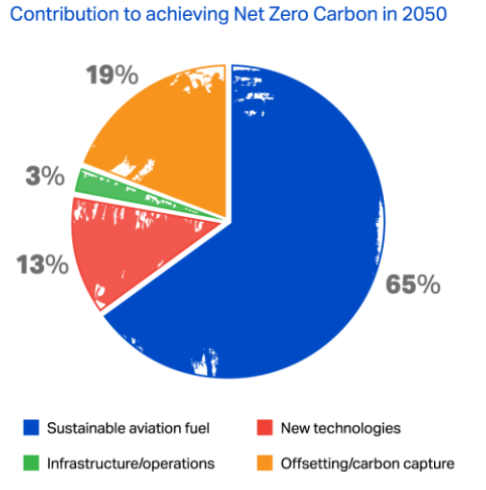
The cooperation of all stakeholders is crucial to the success of these measures:
Above all, solutions need to be more cost-efficient, especially for sustainable fuels. The technology exists, but production incentives are needed to increase supply and reduce costs. By 2025, 2% of the total fuel requirement is to be met by sustainable fuels (approx. 8 billion liters) and gradually increased to 65% by 2050 (449 billion liters). From 2035, electric and/or hydrogen aircraft with a capacity of 50-100 seats and a flight time of 30-90 minutes should be available for the regional market. Hydrogen aircraft for the short-haul market (100-150 seats, 45-120 minutes flight time) will be available from 2040. It also emphasizes the importance of working with travelers, environmental NGOs, research institutions, new investors and governments on the basis of transparent reporting.
This plan is the first update since 2009. At that time, airlines committed to reducing CO2 emissions by 50% by the middle of the century compared to 2005. Since then, however, emissions have risen, driven by a boom in air travel that was only slowed down in 2020 by the COVID-19 pandemic. It will be interesting to see whether this plan can be implemented at all levels.