

Prepared for what lies ahead in tourism
Stay up-to-date with current, independent statistics and information on tourism in the Alpine region.
 Project
The tourism industry has long been considered a very crisis-resistant sector. Previous crises were limited either geographically or in terms of time and the regions recovered relatively quickly. The current Covid-19 crisis, on the other hand, is affecting international tourism as a whole, bringing all tourism activities to a standstill by mid-March at the latest. This is how quickly the hot discussion about "over-tourism" turned into "zero tourism". It is still impossible to predict how long this crisis will continue to affect us and what the long-term consequences will be.
A team of researchers from MCI Tourismus therefore set itself the goal of analyzing the communication of Tyrolean tourism associations in more detail. To this end, 412 Instagram posts in the period from March 16, 2020 to April 19, 2020 - i.e. in the first 5 weeks of the shutdown - were examined using quantitative and qualitative content analysis (you can find out more about the methodological approach in the Tourism Knowledge Quarterly article in the download section).
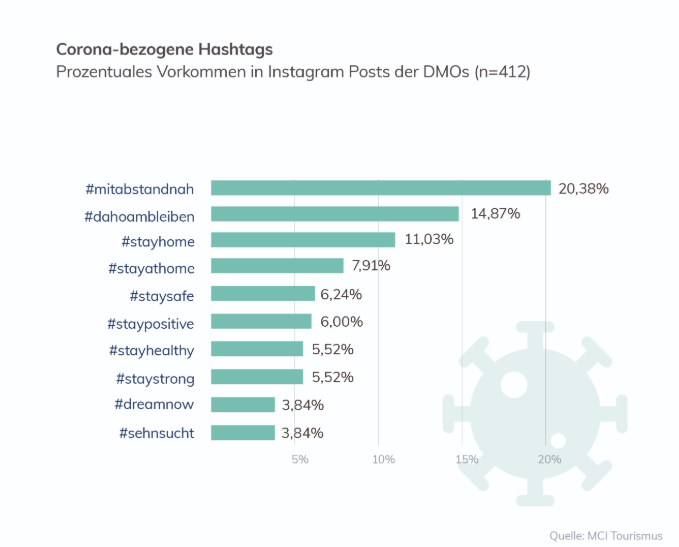
In a first step, all hashtags used (n=1,063) were analyzed quantitatively. The most frequently used hashtags were #visitaustria (n=107) and #tyrol (n=89). In third place is the crisis-related hashtag #mitabstandnah (n=85), which was initiated by Tirol Werbung. If we look at other corona-related hashtags, the top 10 list mainly contains non-tourist hashtags such as #dahoamblieben or #stayhome.
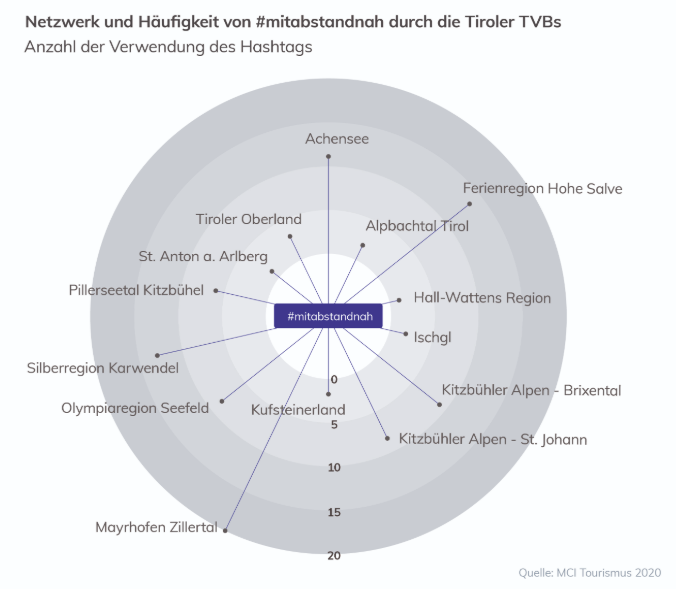
If we now go one step deeper and look at the most frequently used corona-related hashtag #mitabstandnah, it becomes quite clear which associations have increasingly taken it up and used it in their own communication. The further out in the circle or the darker gray the area, the more frequently the hashtag was included. Almost every second Tyrolean TVB used #mitabstandnah.
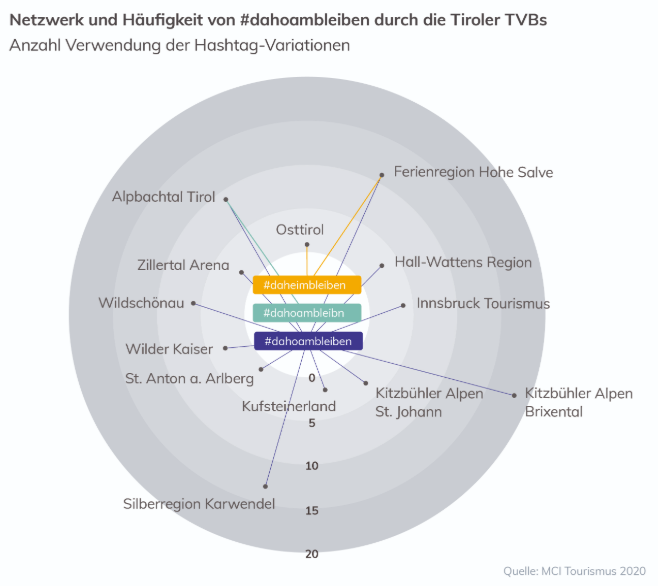
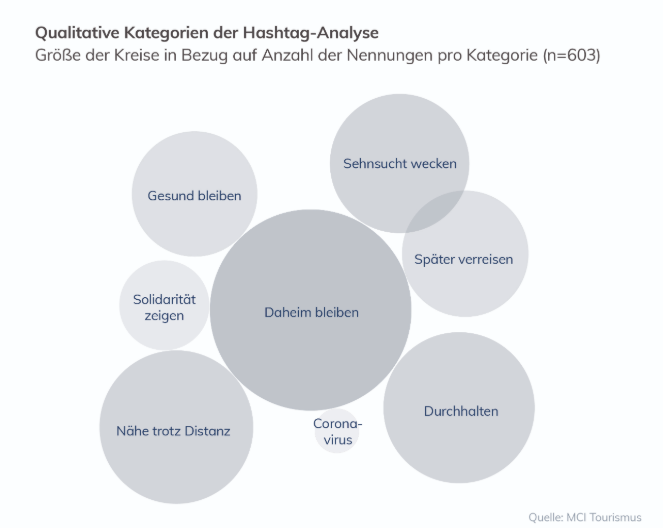
In a second step, all coronavirus hashtags were categorized into a total of eight categories. The largest category turned out to be "Stay at home" (n=165). Unusually for tourism associations, guests were encouraged to stay at home during the quarantine period and tried to convey a sense of home, closeness and familiarity. In some cases, the hashtags are personalized or regionalized and contain specific instructions for action. It is interesting to note that these posts are not only aimed at guests, but also at locals.
Category 2 concerns the topic of "Closeness despite distance" (n=96) and includes the aforementioned Tirol Werbung hashtag #mitabstandnah. Associations used this to convey emotional closeness despite physical separation and thus clearly distinguish between physical and social distance (#farbutnear, #mitabstandnah).
Category 3 was labeled "perseverance" (n=93), as it conveys hope and a positive attitude despite the crisis situation (#alleswirdgut, #staystrong, #staypositive). In 4th place comes the category "awakening longing" (n=79), which inspires dreaming, as travel was not possible at the time. The aim was to awaken guests' anticipation and longing and to stay in touch with them (#dreamnow, #träumedeinereise, #urlaubimkopf). Category 5, which refers to the temporary component "Travel later" (n=65), is similar to this. It includes the request to start or postpone a trip at a later date (#traveltomorrow, #enjoylater, #werreisenliebtverschiebt) and forms an intersection between category 4 - dreaming - and category 5 - longing (#dreamnowtravellater, #dreamnowvisitlater). Category 6 includes "staying healthy" (n=64) and the safety aspect (#stayhealthy, #staysafe). Category 7, on the other hand, refers to "solidarity" (n=33) and conveys values such as community or cohesion (#stickingtogether, #togetherwecandoit, #sammhaltn). Finally, category 8 refers to the coronavirus itself (n=8) and the pandemic (#flattenthecurve, #covid19, #cautionarymeasures). Individual mentions were also made of topics such as regionality when shopping (#shoplocal, #supportyourlocalbusiness), slowing down (#relaxation, #recreation) and working from home (#workfromhome, #homeofficewithaview).
The results show that a coordinated approach to communication - especially in times of crisis - is of enormous importance. On the one hand, this concerns the correct wording and few opportunities to change the hashtag. A positive example of this is the Tirol Werbung hashtag #mitabstandnah, which was used to convey a cohesive image. Another challenge is the correct spelling and sources of error such as spaces, emojis or dialect words. As the analysis shows, the associations have focused on positive messages in an attempt to maintain emotional proximity to guests despite the coronavirus crisis, to maintain contact and to inspire them to dream. The topics of safety, health and solidarity also play a role in communication.
In a next step, the research team will deepen the existing analysis. On the one hand, this will be done by extending the time horizon to the period up to the reopening at the end of May. In addition to the hashtags, the text and image material of the posts will also be qualitatively evaluated in order to gain further insights. In addition to the existing researcher triangulation, this would also allow for data and method triangulation. As has been shown, the Covid-19 crisis has further intensified existing trends and all the more reason for tourism associations to face new challenges and improve communication with existing and potential guests, as well as tourism and non-tourism service providers and locals. This makes it all the more important to further analyze the associations' crisis communication in order to further develop the central coordination and leadership role of DMOs.
The entire article was published in the current Tourismuswissen Quarterly from July 2020. You can download the entire article here.