
Prepared for what lies ahead in tourism
Stay up-to-date with current, independent statistics and information on tourism in the Alpine region.
 Inspiration
Following visits to Tyrolean and Salzburg destination partners in Serfaus-Fiss-Ladis (2008/09), Ischgl (2009/10), Kitzbühel (2010/11), St. Anton am Arlberg (2011/12), Pitztal (2012/12), Stubai (2013/14), Innsbruck (2014/15), Seefeld (2015/16), Ötztal (2016/17), Saalfelden-Leogang (2017/18), Achensee (2018/19), Zell am See-Kaprun (2019/20), a one-year Covid-19 break (2020/21) and Axamer Lizum (2021/22) with destination partner Tirol Werbung, there was a particularly long journey this year. Our journey took us all the way to Styria, to the beautiful Schladming-Dachstein region.
The development of the region began in the 1970s. Back then, the question was whether Schladming would host the World Ski Championships. The prerequisite for this was the construction of a hotel. This was realized with the Sporthotel Royer and Schladming hosted the first Alpine Ski World Championships in 1982. The 42nd Alpine World Ski Championships followed in 2013. The destination has also become famous for the Nightrace on the Planai, which took place for the 26th time at the end of January 2023. With 1.5 million Austrian TV viewers, this race is ahead of the Streif with 1.1 million TV viewers. In addition, there are another 45,000 viewers on site.
Winter is still the dominant season, although summer is catching up more and more. In summer 2022, the region recorded more summer overnight stays than winter overnight stays for the first time with a record result and is thus increasingly positioning itself as a year-round destination. To this end, the low season will also be revitalized even more in the future. The Schladming-Dachstein region in the upper Enns Valley only merged in October 2021 and therefore took this step much later than Tyrol. The move was less politically driven, but all the more emotional. In the meantime, however, it has managed to get everyone on board and establish itself as a strong destination.
In winter, the region scores with alpine skiing in Schladming (230 km of pistes) and Nordic skiing in Ramsau am Dachstein (413 km of cross-country trails). Guests also have 300 km of winter and snowshoe hiking trails at their disposal. In summer, the region focuses on hiking (1,000km of hiking trails), biking (26 bike tours and 2 bike parks) and climbing (26 via ferratas). The Sommercard offers guests attractive inclusive services with eight summer cable cars, public transport, swimming lakes and other excursion destinations. The Dachstein, the highest mountain in Styria (2,700m), offers spectacular views of the surrounding mountains from a suspension bridge and viewing platforms as well as an ice palace inside.
With 3.8 million overnight stays (2021/22) and almost 30,000 guest beds, the region is roughly comparable to Ötztal (4.2 million overnight stays, 27,600 beds in winter). With 1,800 accommodation establishments, the destination is mainly small-scale, i.e. the proportion of private rooms and vacation apartments is high. Two thirds of guests come from Austria and Germany, followed by the Czech Republic.
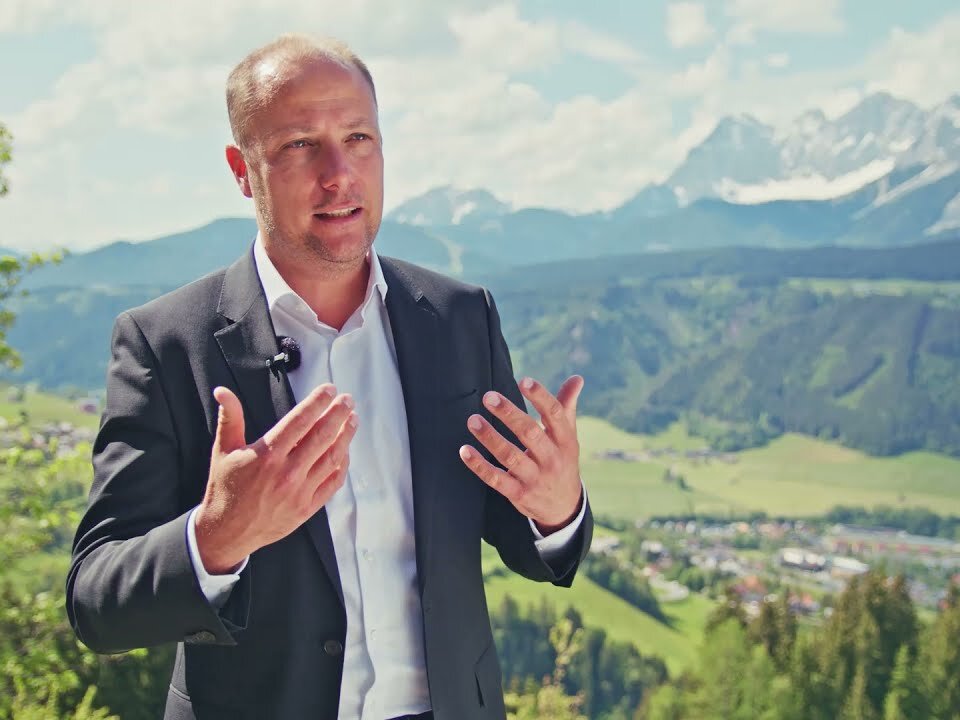
The Managing Director of the region - and also BÖTM Austria President - Mathias Schattleitner not only presented us with the highlights of the region, but also showed us the challenges the Schladming-Dachstein destination has to contend with due to the Styrian Tourism Act. While in Tyrol the compulsory contributions and the visitor's tax are earmarked for tourism, in Styria 50% of the revenue goes to the province of Styria. An additional financing problem arises from the capping, as businesses above a certain turnover are subject to a flat rate. For this region in particular, which accounts for 30% of overnight stays in Styria, this is of course a major disadvantage compared to Tyrolean or Salzburg destinations.
"Tourism today is a total work of art in which many cogwheels have to mesh in order to function successfully." Schladming-Dachstein region
In line with the concept of living space, the region has been focusing on tourism for several years and has commissioned a value creation study for this purpose. Two thirds of all jobs there depend on tourism. This also raises exciting questions:
The results of the study are expected in April 2023.
The Tourism Dialogue in November 2022 also recorded record attendance with 300 visitors. In future, the DMO wants to focus more on the topic of visitor management. While the flow of visitors is well distributed in winter, in summer there are overcrowded streets and a precarious parking situation in some places on around 10 days a year. Mobile phone data is analyzed to counteract this. The first electric buses are now also being used in winter and summer to guarantee local mobility. A car-sharing system is also being considered for the region. Unfortunately, when it comes to improving public transport, there is often a lack of implementation with external partners.
The association also has its own Employer Branding department. Community Days have been offered to all employees in the region since last year. In addition, the Next Generation project was launched, in which young people are actively involved in the future development of the region. A kick-off event in February 2020 was followed by two impulse workshops with several initiatives.
We would like to thank Mathias Schrattleitner (FH), Julia Schram and Jenny Scott for the great reception and the insights into this exciting region.