
Prepared for what lies ahead in tourism
Stay up-to-date with current, independent statistics and information on tourism in the Alpine region.
 Research

F.acT: Why is it important to investigate areas of conflict between tourists and locals in tourism-intensive regions?

Maria Jäger: It is important to investigate areas of conflict between residents and tourists, as this is a globally observable problem. Many tourism-intensive regions around the world have to deal with a wide variety of conflicts. Comparable conflicts can be observed. In this way, my work can provide a targeted analysis in the global tourism context. The theoretical foundation of my work can achieve a fundamental transferability.
F.acT: What are the core results of your work?
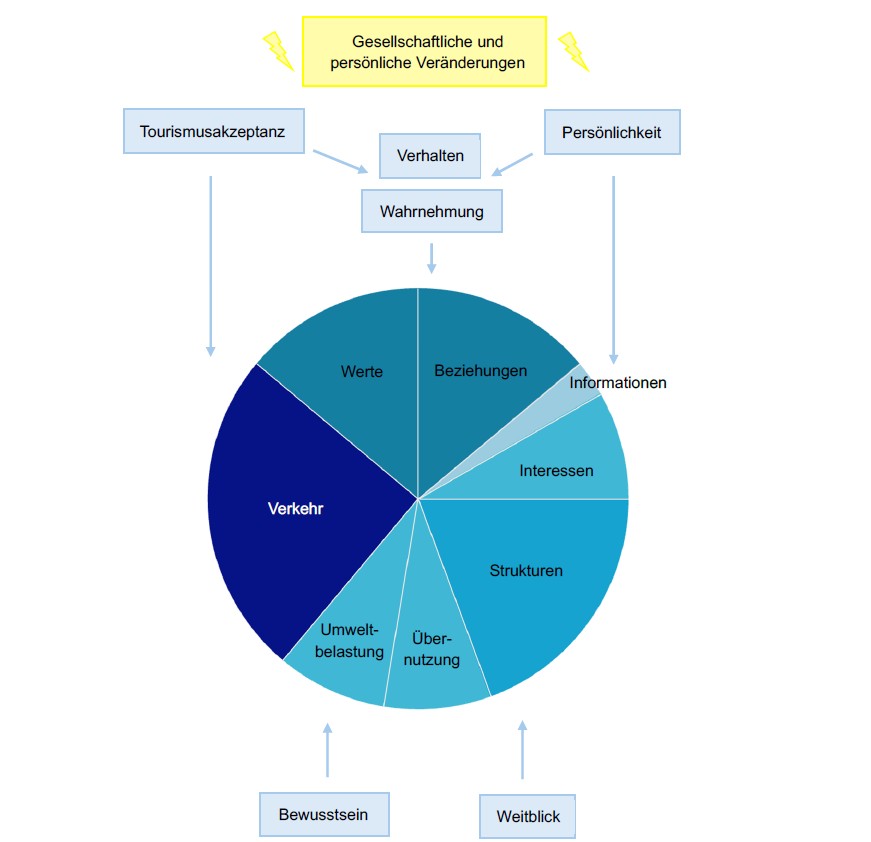
Maria Jäger: In principle, it is clear that there are various areas of conflict between residents and tourists. These are dependent on the two factors of tourism acceptance and personality. Furthermore, any development times influence the prevailing areas of conflict (exhibit a high degree of subjectivity). Awareness and foresight can contribute to minimization. In view of the core results, I would also like to refer to the adapted CC model (based on Moore, 2014).
Q.acT: What recommendations for action can be derived from this for tourist destinations and companies?
Maria Jäger: In view of the recommendations for action, it should be noted in principle that existing areas of conflict must be tackled in a holistic and future-oriented manner. The aspects of sustainability, integration/participation of the stakeholders involved and transparency play a key role here.
In addition, the solution approaches must be divided into joint and individual recommendations.
F.acT: What are the special features of your study?
Maria Jäger: The main feature of this work lies in its innovative approach to a topic that has been little researched to date: the perception and development of areas of conflict between residents and tourists in tourism-intensiveregions. While previous work has mostly focused on urban areas or general causes of conflict, this work specifically examines how areas of conflict arise in rural-alpine areas, how they change over time and what role individualperceptions play in this.
Theoretically, the study is based on the CC model (based on Moore, 2014), which was first applied to tourism in rural Alpine areas and further developed in this study. The inclusion of additional dimensions such as ecological aspects and development times creates an extended, practice-oriented analysis tool that makes the dynamics and connections between the conflict areas visible.
Methodologically, the work is characterized by the use of so-called go-along interviews. This is a qualitative research method in which interviews are conducted in real environments or linked to local references. This makes it possible to capture authentic impressions and emotional reactions of the interviewees and gain a deep understanding of their perspectives.
Overall, the work makes an important contribution to a better understanding of prevailing areas of conflict in tourism. It shows that conflicts do not necessarily have to be destructive, but can also serve as an impetus for further development and awareness-raising.