


Prepared for what lies ahead in tourism
Stay up-to-date with current, independent statistics and information on tourism in the Alpine region.
 Research

F.acT: Why is this topic relevant for the Tyrolean tourism industry?

Verena Klumaier: In view of the upcoming winter season, the issue of staff shortages in tourism is much discussed. More than ever, the tourism industry is struggling with a loss of attractiveness as an employer and a shortage of specialist staff. Among other things, this is due to the ongoing pandemic and the limited ability to plan, as well as the migration of many employees to other industries. In order to counteract these challenges on the labour market, targeted employer branding measures are required to highlight the attractiveness of jobs in the family-run hotel industry and establish a strong employer brand. This is because an employer brand makes it possible to stand out from the competition and attract qualified employees. The family-run hotel industry in particular has special characteristics due to the strong presence of the entrepreneurial family, which has a positive effect on the employer image and the attractiveness of the workplace.
For successful implementation, it is therefore necessary for a company to understand the requirements, wishes, attitudes and values of employees and applicants and to incorporate this knowledge into employer branding. Since the hotel industry has a multigenerational employee structure, which means that different generations work side by side, each generation brings different attitudes and values to the workplace. Accordingly, in my research I differentiate between Generation X (1965 - 1980), Generation Y (1981 - 1994) and Generation Z (1995 onwards), highlight the differences between the generations and derive targeted measures in relation to employer branding.
F.acT: What are the key findings of your work and what significance do they have for the family-run hotel industry?
Verena Klumaier: In order to determine the differences between Generation X, Y and Z in terms of their employment in a family-run hotel business, eight areas were defined in advance in which the employees could differ in terms of attitude, values and behavior. These areas were partly derived from existing literature and related research and adapted with other aspects that were relevant to our own work. The eight areas consisted of the intention to work in the family-run hotel industry, work ethics and values, working atmosphere, career opportunities, work-life balance, attractiveness of tasks, attractive income and instrumental and symbolic characteristics of employer attractiveness.
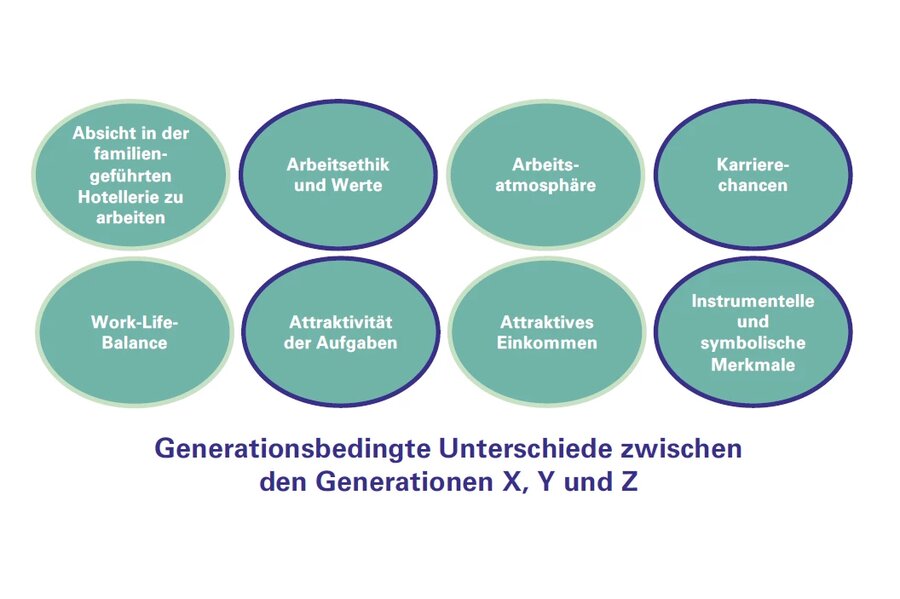
I chose a quantitative method, a standardized online questionnaire, for the empirical study of the master's thesis. Former and current employees of the family-run hotel industry were asked about the areas mentioned above. The results of the study show that Generation X, Y and Z differ significantly in four of these eight areas. Namely in their attitudes towards work ethics and values, career opportunities, attractiveness of tasks and instrumental and symbolic characteristics of employer attractiveness.
With regard to work ethics and values, significant differences can be seen in the acceptance of bureaucracy, loyalty and self-confidence of employees. In terms of career opportunities, it can be seen that the generations have different perceptions of the offer of mentoring programs and the receipt of regular feedback. The area that examines the attractiveness of tasks shows that there are significant differences in terms of the importance of challenging tasks and the connection to the tasks. The instrumental and symbolic characteristics illustrate that there is a significantly different perception of employer attractiveness in terms of the team activities offered and the sustainability of a company.
F.acT: What practical results does your Master's thesis deliver and what specific recommendations for action do you make?
Verena Klumaier: The aim of my master's thesis was to create a representative employee persona for each generation, which depicts the identified character traits and attitudes towards work of Generation X, Y and Z. The results are practice-oriented. These practice-oriented results should help family-run hotel companies to better understand the needs of the individual generations in order to position themselves as an attractive workplace. As the age of employees can be used as a distinguishing feature, family-run hotel businesses should adopt a generation-conscious approach in future in order to recruit new employees and strengthen the loyalty of existing staff. My master's thesis also calls on family-run hotel businesses to think about their own employee personas. The insights gained through employee surveys, for example, can then be immediately incorporated into employer branding and the development of a strong employer brand.