

Prepared for what lies ahead in tourism
Stay up-to-date with current, independent statistics and information on tourism in the Alpine region.
 Research
Franziska Klotz was awarded the Rudolf Sallinger Fund for her work - congratulations!

F.acT: To what extent is the topic relevant for the Tyrolean tourism industry?

Franziska Klotz: Family businesses form the backbone of the Tyrolean tourism industry, accounting for over 90% of all businesses. The handover to the next generation is one of the most critical phases in the life cycle of these businesses. Only around a third of family-run businesses are successfully handed over to the second generation and only 10-15% make the transition to the third generation. Effective communication within the business family and with employees is a key success factor. As this topic has been largely neglected in both practice and research, my master's thesis makes an important contribution to understanding the importance of internal communication in the handover process.
F.acT: What methodological approach did you use in your work?
Franziska Klotz: As part of my master's thesis, I conducted a qualitative study in which a total of 14 members of the entrepreneurial families and employees were interviewed in five family-run hotels. In four of the five hotels, the handover had already been successfully completed and the participants reported on their experiences. In one hotel, the generational handover is due to take place next year, which is why the interviewees talked about their impressions and preparations to date. In order to be able to take the size of the company into account in this context, the selected hotels differed in size. While the smallest company employs 15 people, the largest family business manages several hotels with around 400 employees. As I conducted all the interviews on site in the hotels, I was able to gain particularly authentic insights into this sensitive and emotional topic.
F.acT: What are the core results of your work and what significance do they have for tourist destinations and businesses?
Franziska Klotz: With the help of my master's thesis, I was able to show that functioning internal communication is crucial for a successful handover and that the size of the company changes certain communication structures and processes. In smaller companies, communication is usually informal and spontaneous, with private and professional conversations being heavily intermingled. In larger companies, on the other hand, communication is more formal and the involvement of managers from outside the family and clear communication rules are more often necessary.
Regardless of the size of the company, communication is predominantly verbal in all family businesses surveyed. The need for external support depends less on the size of the company and more on the respective family and business situation. Consistent and timely communication between the business family and employees is particularly important.
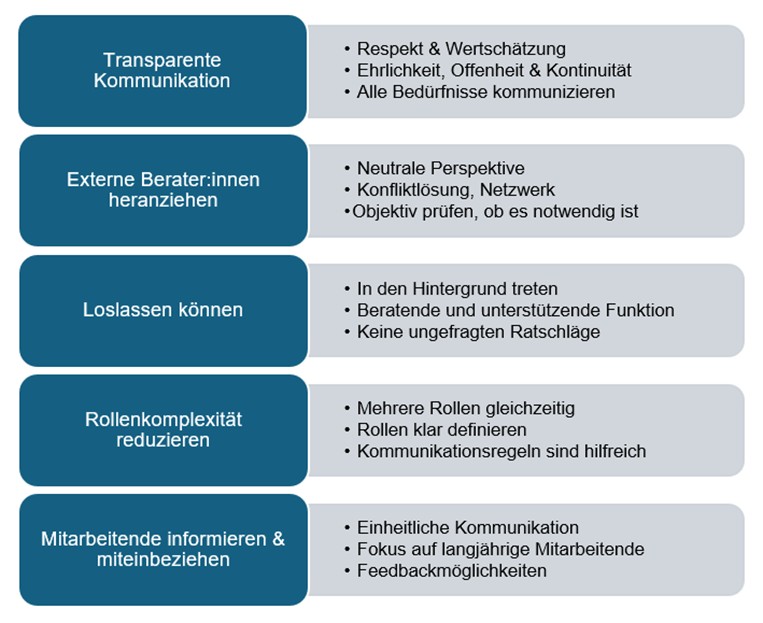
F.acT: What specific recommendations for action do you make in your Master's thesis?
Franziska Klotz: