
Prepared for what lies ahead in tourism
Stay up-to-date with current, independent statistics and information on tourism in the Alpine region.
 Research

F.acT: Why is this topic relevant to the Tyrolean tourism industry?

Madeleine Baruk: Tyrol and tourism have always gone hand in hand. That is precisely why the question for the future arises: How can the region remain attractive as the people for whom it designs tourism experiences change? I don’t see Generation Z as a short-term target audience, but rather as a generation that will shape future demand and the world of work. Their perspective reveals early on what the industry needs to address. This is important because hotel concepts and investments are planned for the long term. My work brings expectations to light before they turn into economic pressure to adapt. It doesn’t provide a blueprint for every hotel, but rather a foundation for asking the right questions: Will people in the future choose Tyrol as a travel destination and, at the same time, choose to work here?
F.acT: What methodological approach did you use in your work?
Madeleine Baruk: Iconducted a focus group with nine Generation Z participants who are interested in travel and the hospitality industry or whose work involves tourism. Through their collective exchange, it becomes clear how expectations arise, influence one another, and are negotiated. I analyzed the discussion using Mayring’s qualitative content analysis and contextualized the results using value change theory, the hierarchy of needs, and self-determination theory. In addition, I examined best-practice businesses in Tyrol. The results are exploratory and cannot be generalized to the entire generation, but they provide a solid conceptual foundation.
F.acT: What are the key findings of your work, and what significance do they have for tourist destinations and businesses?
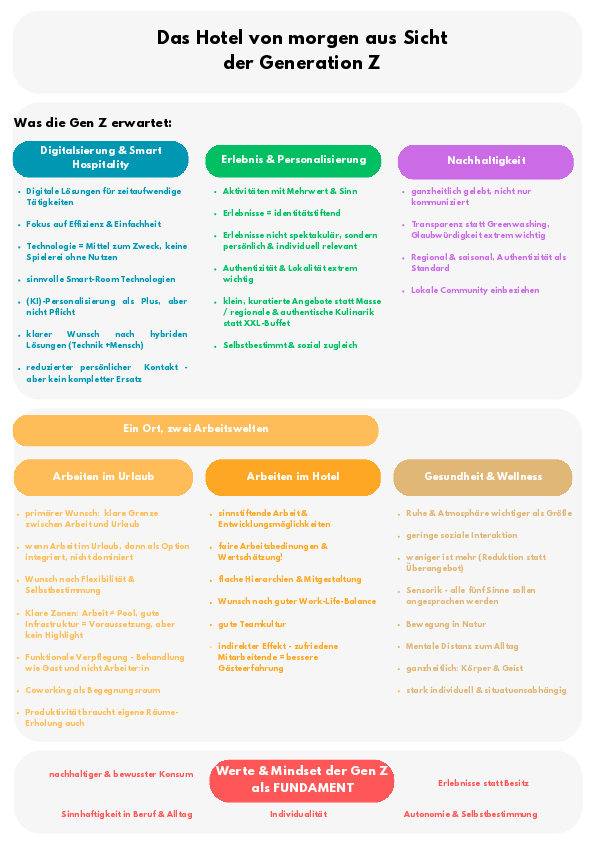
Madeleine Baruk: Generation Z views the hotel of tomorrow not as a lodging facility, but as a value-based, integrated system. It is guided by six principles:
Work and vacation are clearly separated but united within a single system.
Sustainability is lived, not just communicated.
Simplicity, tranquility, and authenticity take center stage.
Locality is not an afterthought but a central part of the identity.
The hotel is understood as a space for experiences, not as a building.
Digitalization is used strategically: efficiently for functional processes, personally for moments that enhance the experience.
For destinations and businesses, this means: Credibility isn’t created through marketing, but through consistent action in everyday life. What matters isn’t maximizing individual offerings, but a coherent overall concept that is designed to be credible and authentic.
F.acT: What specific recommendations for action do you provide in your master's thesis?
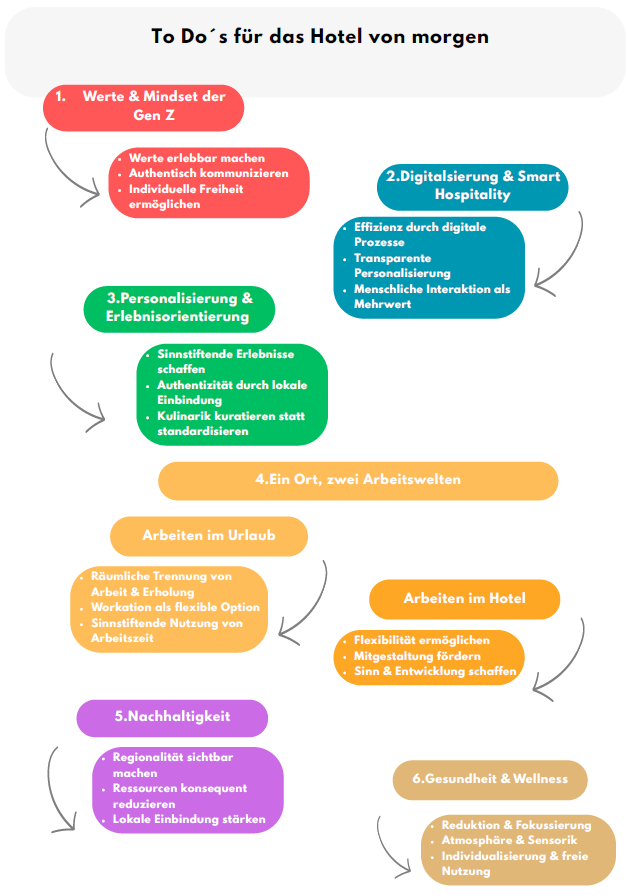
Madeleine Baruk: Based on the results, I developed a guide with six areas of focus.
The starting point is the values of Generation Z: These values must be tangible at the hotel—through authentic stories about the team, the region, and partners, rather than through marketing jargon. This also applies to the guest experience, which guests want to shape as freely as possible.
Digitalization should make processes more efficient and not replace personal interaction, but rather enable it, and personalization must remain transparent.
Experiences should be meaningful and authentic through regional partners—for example, through curated culinary offerings rather than a standardized, overwhelming selection.
Work and leisure should remain physically separate; “workations” work as a flexible option, not as the main selling point. For employees, flexibility, a sense of involvement, purpose, and opportunities for growth are what matter.
Sustainability is a minimum standard: ensure transparency regarding origin, consistently reduce resource use, and avoid greenwashing.
In the wellness area, minimalism and focus, a harmonious atmosphere and sensory experience, as well as unrestricted, individualized use, are key.